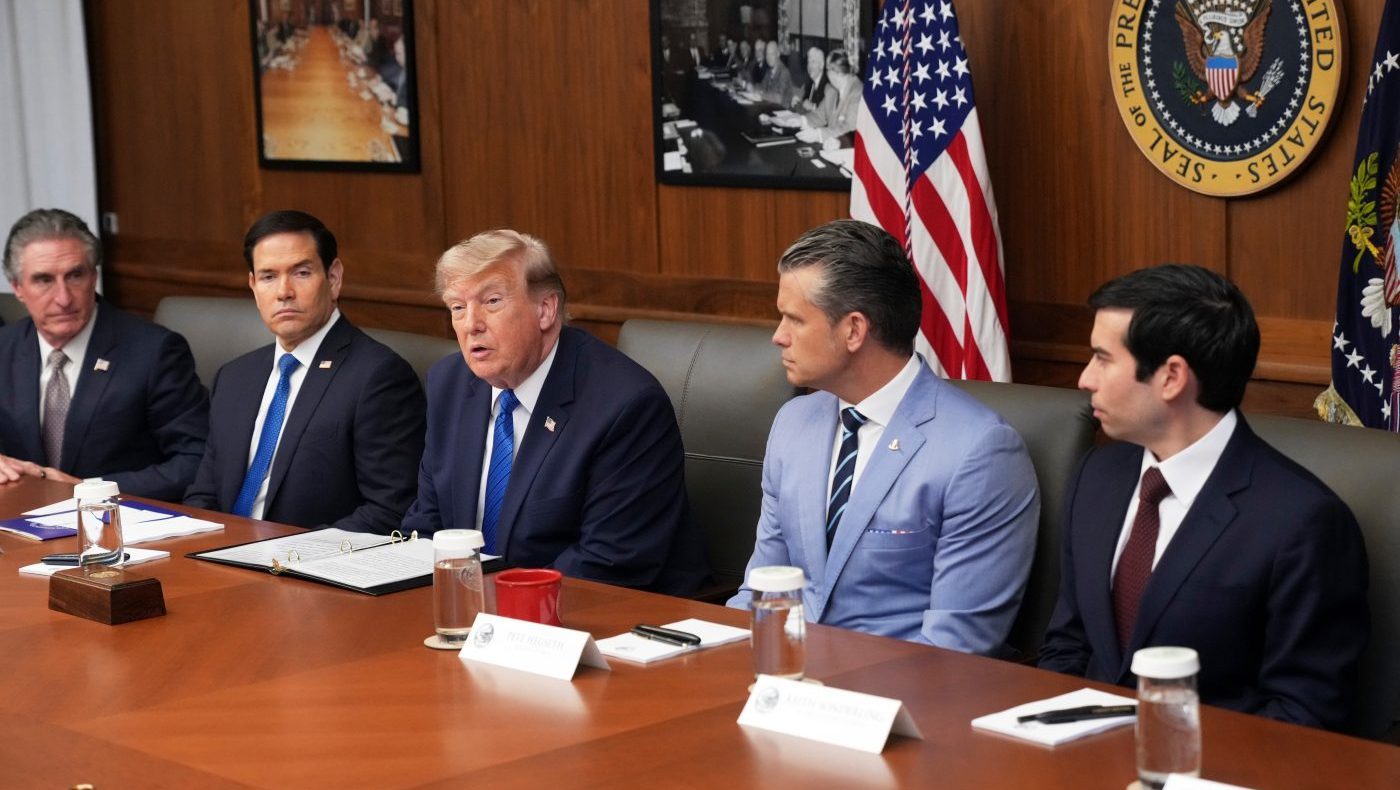
Defense Secretary Pete Hegseth said Monday that the Trump administration's economic campaign against Iran is inflicting the greatest damage on the regime, yet he stopped short of ruling out renewed U.S. military strikes if Tehran miscalculates.
"If we need to use kinetic strikes, we'll use them. If Iran is foolish enough to overplay their hand or mess with the American military, we'll do what we need to do," Hegseth told reporters in Oshkosh, Wisconsin, during the Pentagon's "Arsenal of Freedom" tour. "But economic pressure hurts them the most right now."
The remarks came hours after Treasury Secretary Scott Bessent previewed a new financial pressure campaign against Tehran, as the conflict has reached a stalemate after six months of hostilities. Bessent warned countries to sever financial ties with Iran or risk being cut off from the U.S. dollar system, outlining what he called Operation Economic Outcast but offering few specifics.
"Well, we are giving everyone the opportunity to remedy bad behavior, why would I want to blow up the global financial system?" Bessent told a reporter when pressed for details.
The Treasury secretary said President Trump is personally calling world leaders, and that officials at the State Department, the Pentagon, and Treasury are engaging their counterparts to urge a break with Iran. "I would expect that very quickly, if they do not respond, then you will see the ramifications of their actions," Bessent added.
Iran's Parliament speaker, Mohammad Bagher Qalibaf, dismissed the U.S. pressure campaign. "Americans know that no one buys their bombast; the United States is not in an economic position to further restrict its relations with other countries," Qalibaf wrote on X. He claimed Iran's trading partners have made clear they don't take Washington's statements seriously.
Hegseth argued that the economic squeeze is designed to force Tehran to negotiate over its nuclear program. "More economic pressure only ensures that Iran really has – the only choice they have is to come to the table and actually talk about their nuclear program, which is what the president has demanded," he said.
The defense secretary touted the U.S. naval blockade and asserted American control over the Strait of Hormuz. "Iran can't run anything through; we can. The world economy realizes that, and so they made a big bet on controlling it, and they can't," he told reporters. Ship-tracking data from Kpler showed five vessels crossed the strait on Sunday, down from 25 on Saturday and 21 on Friday.
U.S. Central Command reported Monday that the military has redirected 71 commercial ships, disabled three, and boarded two others since resuming the blockade in the Arabian Sea. More than 40 vessels carrying humanitarian aid have been allowed to pass. Hegseth concluded, "Ultimately, their economy is in a spiral. They also know that we control the Strait of Hormuz, that our blockade is ironclad, and that oil is flowing through, ultimately."
The escalation comes amid broader debate over the costs of the Iran conflict, with some lawmakers pressing for transparency on war spending. Meanwhile, analysts question whether Washington's pressure strategy will achieve its aims, and some argue that economic coercion alone may not be enough to change Tehran's calculus.