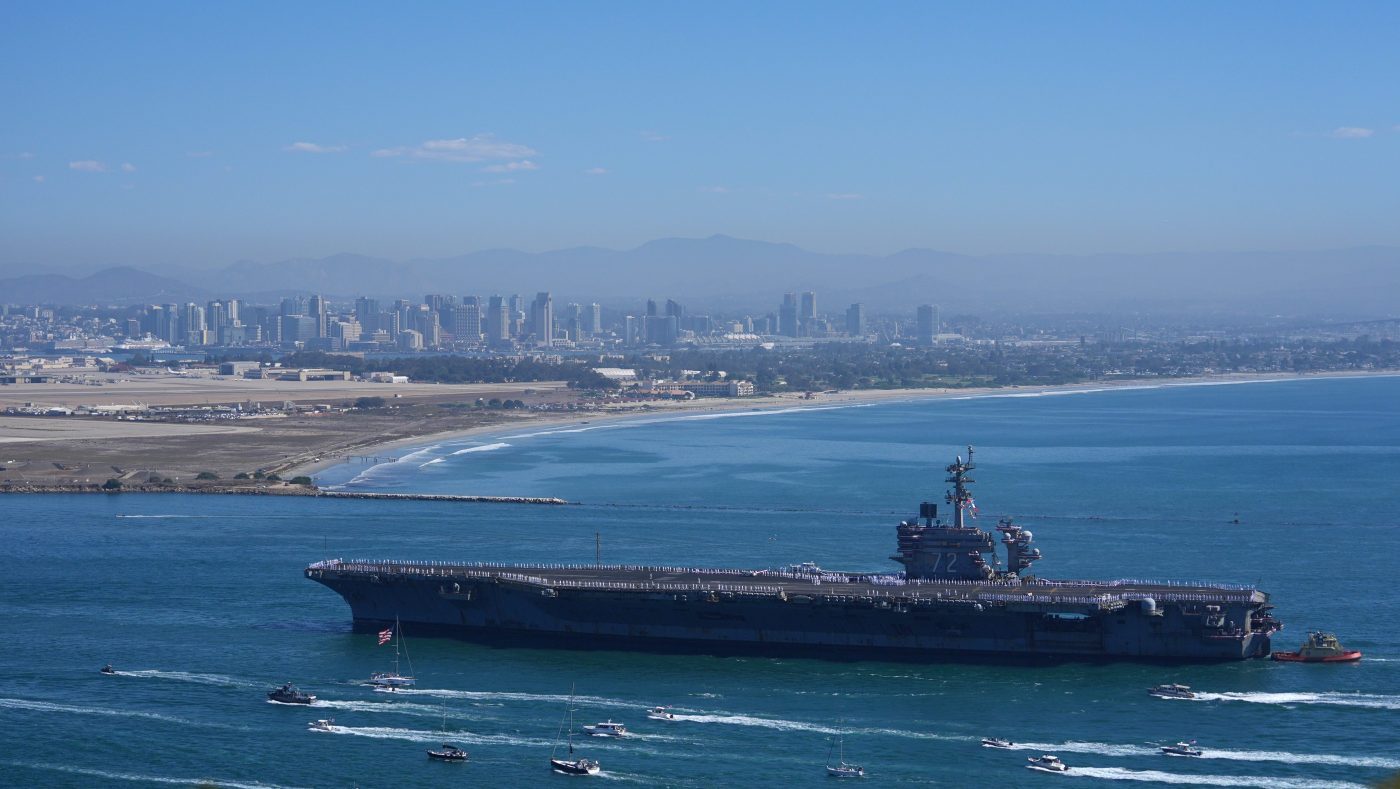
The Nimitz-class aircraft carrier USS Abraham Lincoln pulled into San Diego on Thursday, wrapping up a 322-day deployment that stretched far beyond its original schedule. The mission, extended to support U.S. operations against Iran, included enforcing a naval blockade in the Arabian Sea and conducting a relentless tempo of combat missions.
Defense Secretary Pete Hegseth, who addressed the crew aboard the vessel on Wednesday, praised their performance, saying the strike group "projected decisive combat power and established maritime advantage" in support of President Trump's strategic goals. Hegseth presented the Presidential Unit Citation, the military's highest unit award, to the carrier strike group, and pushed back against media reports of low morale and logistical failures.
"You have changed the arc of history, ensuring that crazy people, theocrats, never get a nuclear weapon," Hegseth told the sailors, according to a transcript of his 16-minute remarks. He dismissed news coverage that portrayed the ship as "a symbol of dysfunction or a symbol of low morale, or a symbol of a failed mission," insisting that the crew's resilience and excellence were the real story.
The deployment, which kept roughly 5,000 sailors at sea, was marked by significant challenges. The ship went 286 days without a port call, finally docking in Thailand last month. Reports emerged of tight food supplies and declining mental health among the crew, issues that some attributed to the extended mission and the loss of a key logistics hub in Bahrain after Iranian strikes.
Pentagon officials confirmed that the Naval Support Activity in Bahrain, home to the U.S. 5th Fleet, was devastated by Iranian attacks, complicating resupply efforts. The strain took a human toll: Acting Navy Secretary Hung Cao told Sen. Kirsten Gillibrand that eight sailors assigned to the Lincoln strike group attempted suicide during the deployment.
Democratic lawmakers, including Rep. Mike Levin of California, whose district includes parts of San Diego, welcomed the crew home but demanded accountability. "For months, Marines and Sailors sounded the alarm about conditions aboard the ship, inadequate support, and the mental health toll this deployment was taking on those serving onboard," Levin said on social media. "Their families begged for help and were repeatedly ignored." He accused Hegseth of calling the reports "fake news," calling it "a betrayal of the men and women who put everything on the line for this country."
Despite the hardships, the Lincoln's combat record was substantial. Hegseth cited 3,693 combat sorties, 1.37 million pounds of ordnance delivered, 450 Tomahawk cruise missiles launched, and the downing of 77 Iranian one-way attack drones. The strike group also sank 64 Iranian warships and destroyed 21 antiship cruise missiles, according to the Pentagon chief.
For many sailors, the return meant long-awaited reunions. Brent Ledbetter, an air traffic control officer, told NBC News he was eager to meet his baby boy, Nathan, who was born during the deployment. "He's crawling around now, so I'm excited to chase him around the house and give him all the love that has been kind of withheld for the last 10 months," he said.
Hegseth, in his address, asked the crew to pass on gratitude to their families for their patience and support, saying the extended mission was "in service of a righteous and historic mission." The carrier's return comes amid broader political tensions over the administration's Iran policy, including controversial remarks by Trump about targeting Los Angeles and San Diego, which drew sharp criticism from California officials.