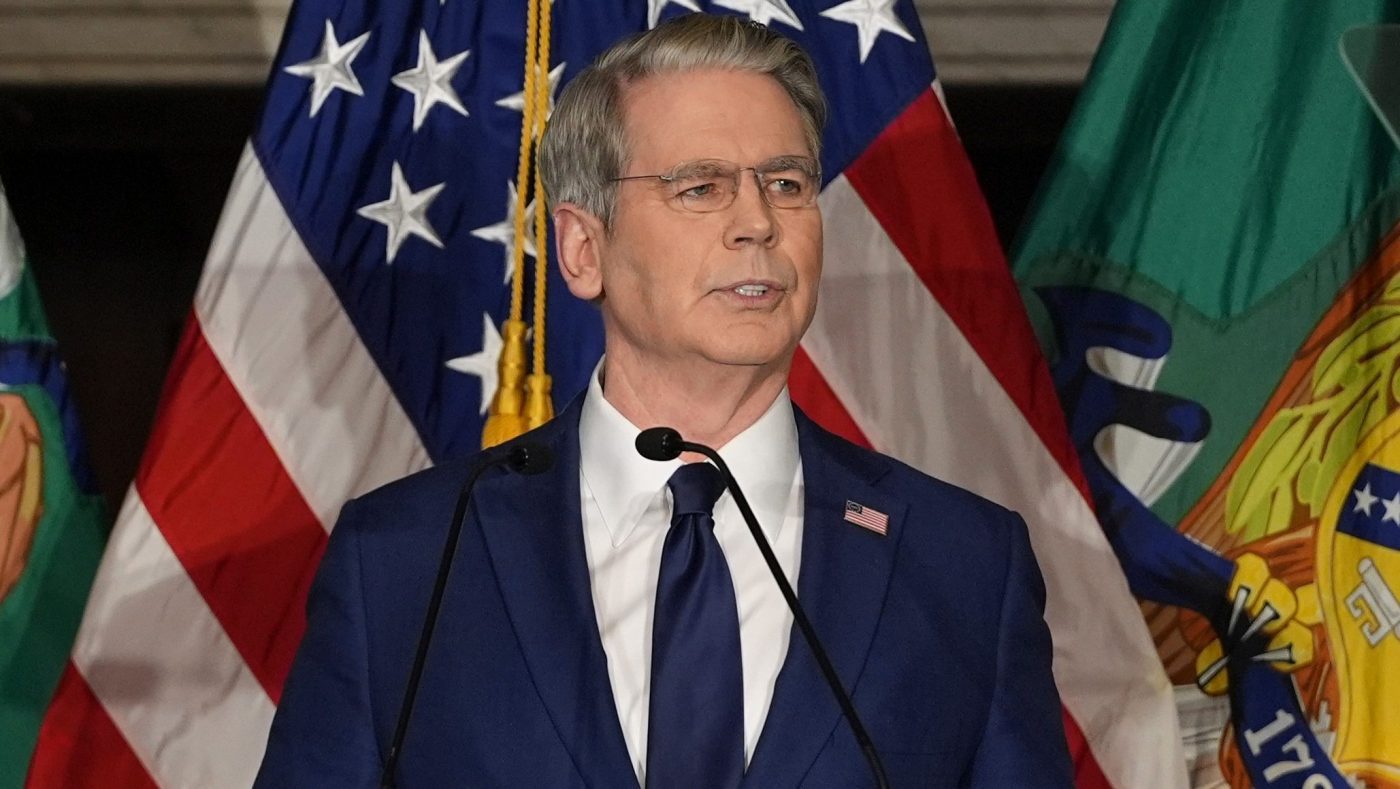
Treasury Secretary Scott Bessent on Monday rolled out a sweeping economic pressure campaign against Iran, warning global partners to sever financial ties with Tehran or face exclusion from the U.S. dollar system. The initiative, dubbed "Operation Economic Outcast," comes as the military conflict with Iran has reached a stalemate six months after the initial U.S. strikes.
Bessent framed the campaign as a financial "D-Day," evoking the Normandy invasion, but his highly anticipated remarks delivered few concrete actions, instead serving as a stern advisory. "We are giving everyone the opportunity to remedy bad behavior, why would I want to blow up the global financial system?" he told reporters, responding to questions about the lack of immediate punitive measures.

The Treasury chief indicated that President Trump has been personally calling world leaders, while officials from the Defense, Treasury, and State departments are pressing counterparts to cut ties with Tehran. Bessent declined to name specific governments or provide timelines, saying such details are being communicated through private channels. "We're not going to name names. We've already seen some results, and I am confident the president, as you all know, is quite persuasive," he said. "I would expect that very quickly, if they do not respond, then you will see the ramifications of their actions."
Notably absent from Bessent's remarks was any explicit threat against China, Iran's largest oil buyer and top trading partner, though Chinese imports of Iranian crude have dropped significantly during the war. Trump is set to host Chinese President Xi Jinping for a state visit on Sept. 24, with both sides aiming to finalize a trade deal. When pressed on whether Washington was going easy on Beijing, Bessent insisted that "no country is above the reach of U.S. sanctions," adding that "quiet diplomacy" is the preferred approach. The administration has previously sanctioned Chinese entities involved in Iranian oil transfers.
Alongside the announcement, the Treasury expanded its authority to sanction any person operating in specific sectors of Iran's economy, including digital assets, technology, gold, aviation, and shipping. New penalties were imposed on 60 entities, individuals, and vessels linked to Iran's nuclear and missile programs, cyber operations, and oil revenue generation. "Treasury has mapped every node, every facilitator, and every network that Iran has used to smuggle oil and evade sanctions," Bessent said. He also called for the closure of international branches of Iran's Bank Melli and teased a major financial institution sanction by week's end.
The secretary framed the choice for Iran as "complete global isolation and a subsistence economy, or a path back to normalcy with an opportunity to rejoin the global economy." Trump has maintained that the war, which began in late February, aims to prevent Iran from developing nuclear weapons. However, Iran has withstood six months of U.S. and Israeli attacks, demonstrated its ability to disrupt the Strait of Hormuz, and walked away from nuclear talks.
The U.S. naval blockade in the strait has slashed Iranian oil exports by sea, contributing to a record low for the rial, which fell to about 2.02 million per dollar on Monday. Trump took to Truth Social to declare Iran is "in Economic and Military Death Spiral" and, in a separate post, "IRAN IS COMPLETELY COLLAPSING!!!"
Yet Iran's military threats in the strait have created a chokehold on the vital waterway, driving up global energy prices and stifling Persian Gulf exports. U.S. escort efforts have not restored shipping to prewar levels, and American gas prices have again topped $4 per gallon, according to AAA.
Iranian Parliament Speaker Mohammad Bagher Qalibaf, who previously negotiated with the U.S., dismissed the pressure campaign on X, writing: "Americans know that no one buys their bombast; the United States is not in an economic position to further restrict its relations with other countries." He added that Iran's trading partners have "made it clear that they don't take these statements into account anywhere."
Still, the United Arab Emirates, which had sought rapprochement with Tehran, announced last week it was cutting trade ties after renewed military attacks. The situation underscores the fragile balance as Washington pushes its economic offensive while navigating global alliances.