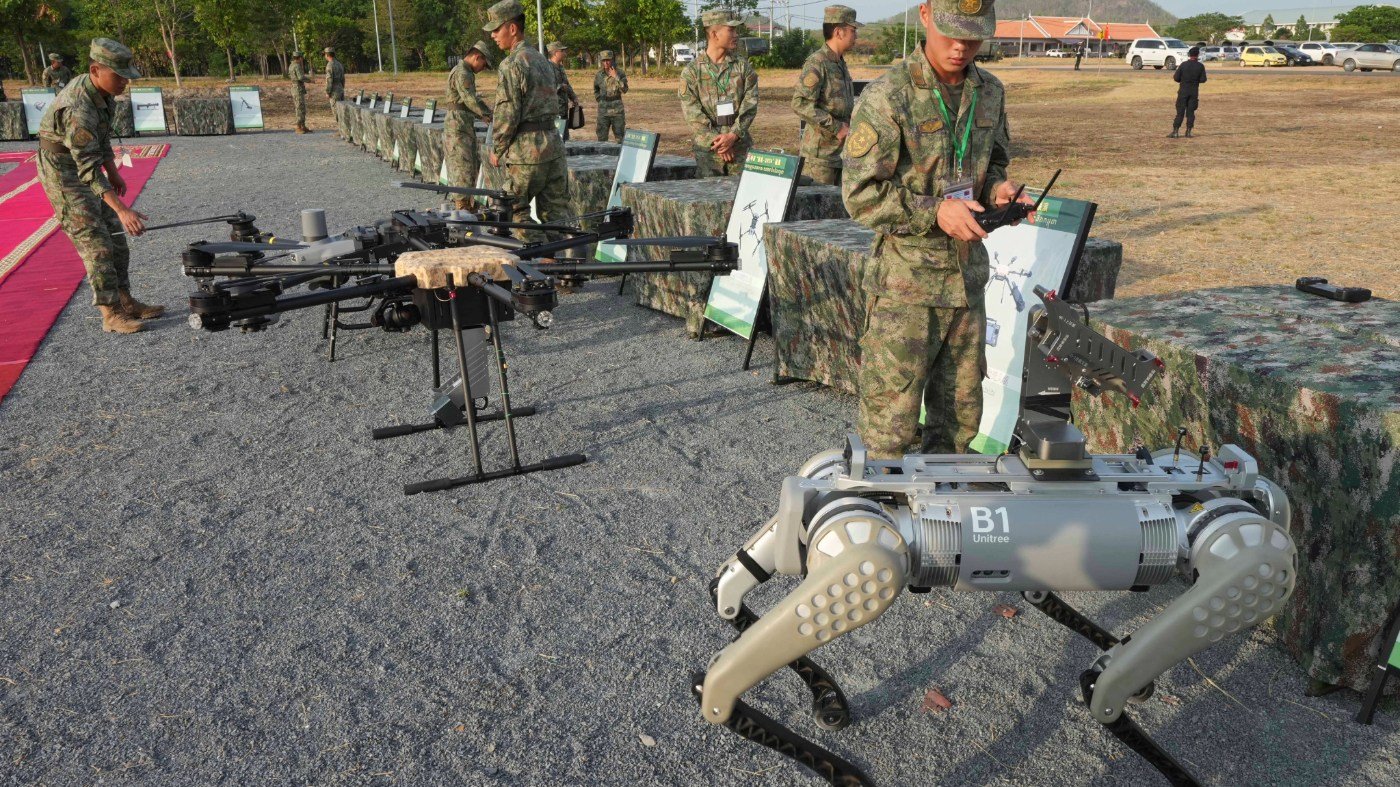
When Salvadoran troops swept through Port-au-Prince last week, they brought more than rifles and armored vehicles. Among their gear were robotic dogs — four-legged machines whose manufacturer and exact capabilities remain undisclosed by President Nayib Bukele's government. But the technology, widely believed to be from China's Unitree, has raised alarms that Haiti is being used as a live-fire laboratory for Beijing's autonomous warfare tools.
The deployment comes as more than 270 NGOs across 70 countries push for a ban or strict regulation of autonomous weapons under the Stop Killer Robots initiative. The core concern: a machine should never hold the power to decide who lives and who dies. AI systems lack ethical judgment and cannot reliably distinguish a child from a combatant, or a weapon from a toy. That is why few nations have used armed robot dogs in real combat, typically reserving them for search-and-rescue or reconnaissance.

China, which controls roughly 85 percent of global production of AI-powered quadruped robots, has tested armed units in Cambodia in 2024 and in a simulated invasion of Taiwan in 2025. But those were controlled exercises, not operations involving real civilians. In Haiti, the stakes are far higher. The country is already gripped by gang violence, political collapse, and a humanitarian catastrophe, with multiple armed actors — gangs, self-defense groups, U.N. forces, Haitian police and military, international contractors, Salvadoran troops, and civilians — all operating in a chaotic and poorly regulated environment.
In July, the U.S. Federal Communications Commission banned imports of new humanoid and four-legged robots, citing cybersecurity and national security risks. The Chinese government routinely subsidizes AI and telecom technologies, driving down costs to capture global markets and advance dual-use capabilities. That economic strategy, combined with the inherent limitations of AI, means armed robot dogs could effectively become judge, jury, and executioner in places like Haiti.
Bukele has touted his troops' successes on social media, but his propagandistic videos do not answer critical questions: Who pulls the trigger? Is the firing controlled by a human operator, or does the robot act autonomously? No one has provided transparency, and no investigation has been announced.
Haitians have welcomed Bukele's soldiers with a mix of hope and fear. Bukele, who dramatically reduced homicides in El Salvador, is seen by some as a possible savior for the failed Caribbean state. Since late October, El Salvador has sent about 2,500 troops to Port-au-Prince, initially to rescue four kidnapped aviation technicians. President Trump gave the green light, reportedly telling Bukele to "do what you have to do." Secretary of State Marco Rubio, however, urged strong coordination with the U.N. to prevent friendly-fire incidents.
On the ground, Bukele has achieved symbolic victories: recapturing the Sylvio Cator National Stadium, which gangs had held since 2024, and striking the headquarters of the 400 Mawozo gang. Boston gang leader Mathias Saintil has been eliminated, and 400 Mawozo's leader, Wilson Joseph, has appealed to the U.N. for help. Yet amid these successes, no one is asking whether the use of Chinese-made robots in Port-au-Prince is appropriate or legal.
The arrival of Salvadoran troops has brought hope to a desperate population, but Haiti must not become a proving ground for Chinese military technology. The end does not justify the means. Greater transparency and restraint are essential to avoid a larger tragedy. As the world watches, the question remains: will Haiti be remembered as a place where lives were saved, or where autonomous weapons were tested on a vulnerable people?