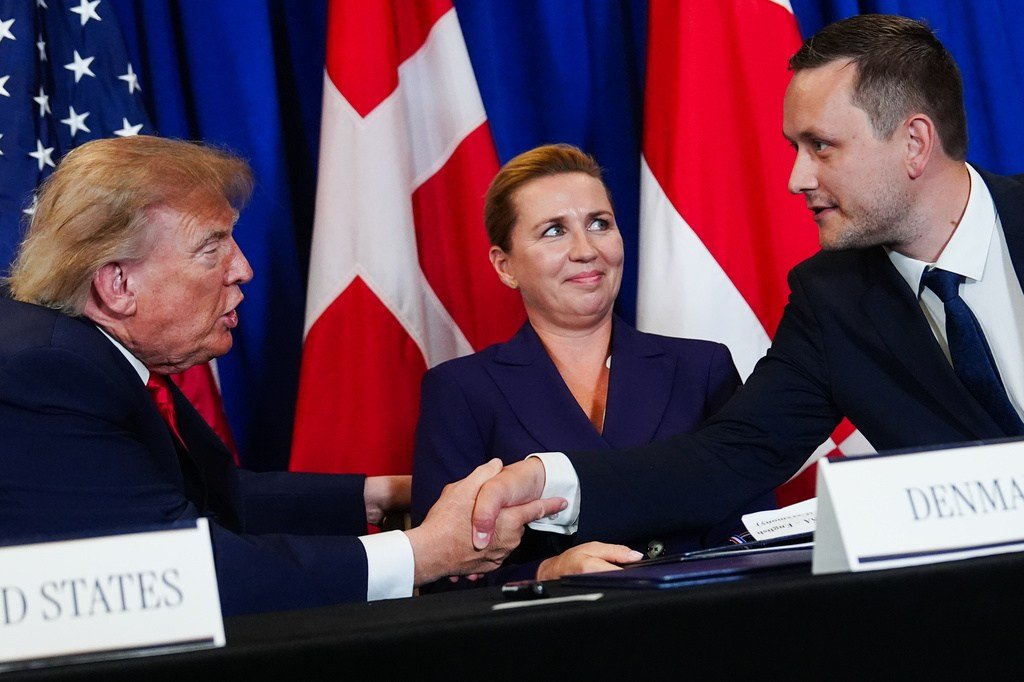
In a landmark move, the United States, Denmark, and Greenland have signed a permanent agreement that hands Washington its most significant strategic gain in the Northern Hemisphere in decades. The pact, which has no expiration date, secures enduring military and security advantages for the US while preserving Danish sovereignty over the vast Arctic island.
The agreement grants the US broad military access to Greenland, from basing rights to overflight permissions. This marks a major expansion from the current US footprint, which is limited to Pituffik Space Base. Under the new terms, the US can expand operations at Pituffik and, pending further details, establish defense areas at Narsarsuaq in the south and Mestersvig in the east. The deal also outlines a process for additional defense zones and expedited approval of unmanned installations.
Greenland's strategic importance is twofold. It sits on the western edge of the Greenland-Iceland-United Kingdom gap, a crucial naval chokepoint, and hosts forward-based radar along the shortest route for Russian ballistic missiles and long-range aircraft targeting the US. A Moscow-to-Washington great-circle route passes near Greenland's southern tip, saving over 500 miles compared to a path via Paris.
Beyond missile warning, Greenland's position enables monitoring of satellites over the polar region, making it vital for space surveillance and future missile-defense systems, including the Golden Dome initiative explicitly cited in the agreement.
Melting Arctic ice is opening new shipping routes and resource areas, where China has already staked claims through its "Polar Silk Road" and "Near-Arctic State" policy. The agreement allows American public vessels undersea access within Greenland's territorial waters, enhancing patrol and monitoring capabilities as these routes become more navigable.
The pact also restricts non-NATO nations from establishing military installations or maintaining a persistent presence on Greenland, and requires Denmark and Greenland to screen foreign investments in sensitive sectors like infrastructure and resource extraction. These provisions remain in force even if Greenland opts for independence, as the agreement mandates that an independent Greenland must assume its obligations and remain in NATO or apply to join.
Strategically, the US strengthens its position regarding Greenland's vast resources, including an estimated 1.5 million metric tons of rare-earth reserves, along with deposits of copper, nickel, zinc, and other critical minerals. The broader geological province is estimated to hold 7.8 billion barrels of oil and 91.9 trillion cubic feet of natural gas. While the deal does not grant the US ownership or automatic extraction rights, it blocks competitors like China and Russia from gaining control of sensitive sectors and fosters conditions for American and allied investment.
This agreement is not a seizure or purchase of Greenland. It secures military access, bolsters North American defense, and imposes lasting restrictions on adversarial military footholds. Greenlanders retain their right to self-determination, yet the pact ensures US access even in the event of independence. Politics aside, these are substantial strategic gains for the United States.