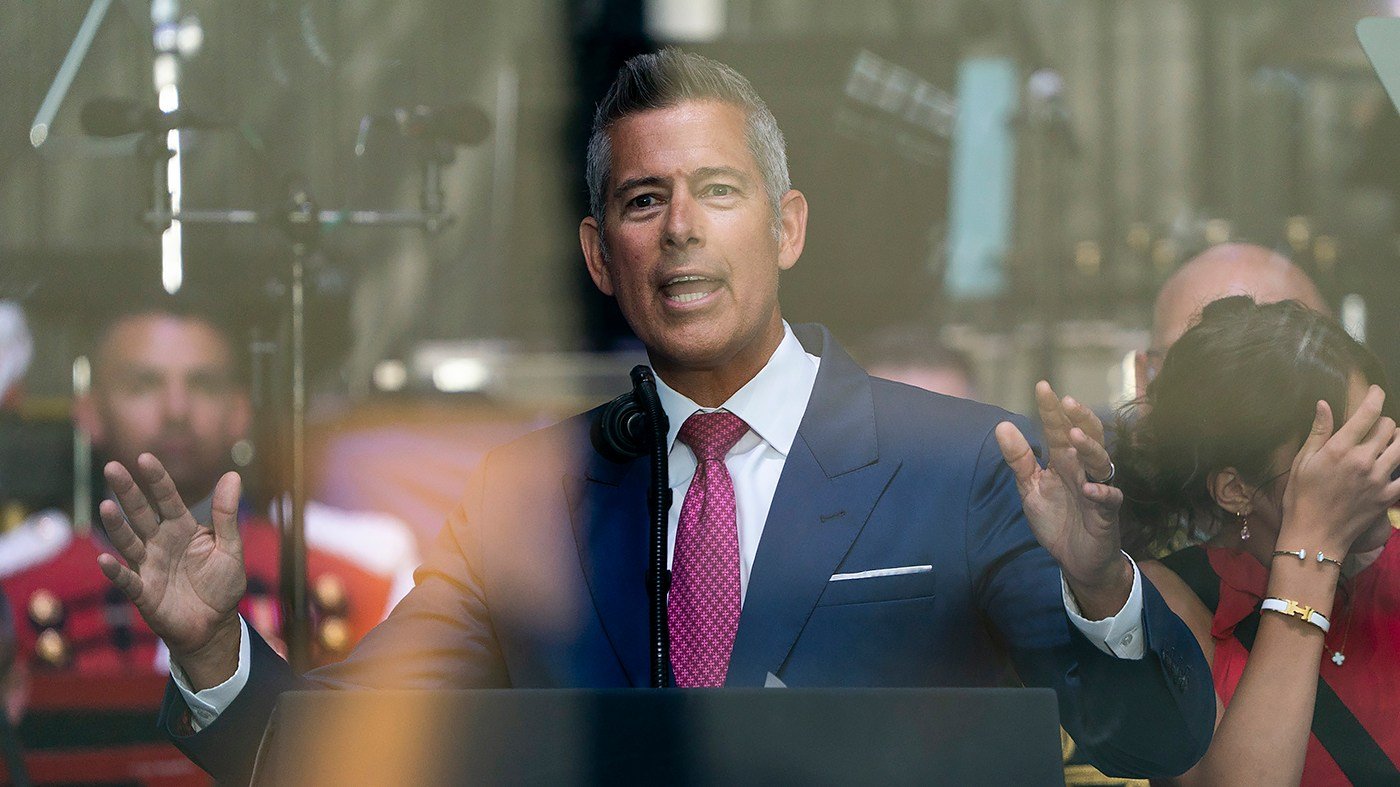
Transportation Secretary Sean Duffy said Sunday that Canadian Prime Minister Mark Carney will ultimately enter trade negotiations with the United States, arguing that the looming 50 percent tariffs would be "devastating" for Canada's economy.
Speaking on Fox News Sunday, Duffy dismissed the idea that Ottawa could prevail in a trade confrontation with President Donald Trump. "To think that they're going to go to war with Donald Trump and actually win that war with the U.S., I think it's foolish on their part," he said.

Duffy framed the administration's tariff strategy as a push for fairness, not hostility. "What the president is trying to do with [U.S. Trade Representative] Jamieson Greer, who, by the way, has done an amazing job representing the president and America, is we want fairness for the American worker," he said. He added that "some of our best friends are the worst offenders that treat us the worst."
The transportation secretary also invoked the security dimension, noting that the U.S. provides for Canada's defense while Ottawa has taken economic advantage. "The fact that we provide their security for them and they take advantage of us, I think President Trump was the first one to go, 'You know what? That's not the kind of relationship that friends should have,'" he said.
Duffy predicted Carney would quickly join discussions because the tariffs would be "devastating for his country." His comments come as the two nations remain locked in a dispute that has already seen tariffs take effect and both sides threaten further escalation.
On Sunday morning, Trump took to Truth Social to press his case, writing: "Canada wants the benefits of being a State, without being one!!! They have also charged our great farmers, for many years, massive amounts of Tariffs. No more!!!" The president's remarks underscore the administration's willingness to use economic pressure on its northern neighbor.
Carney, for his part, announced Saturday that Canada would impose retaliatory duties on U.S. goods starting September 8, matching Washington's new 50 percent tariffs "dollar for dollar in order to protect Canadian workers, farmers, families and businesses." The move follows the administration's decision to raise tariffs on Canadian products, a step that has intensified the trade conflict.
The dispute has broader implications beyond tariffs, with previous pauses for talks failing to yield a lasting resolution. Analysts note that the September 8 deadline for Canadian retaliation could force a new round of negotiations, though both governments remain publicly entrenched.
Duffy's comments reflect the administration's confidence that economic pressure will bring Canada back to the table. Whether that calculation proves correct remains to be seen, but the next few weeks are likely to be critical in determining the trajectory of U.S.-Canada trade relations.