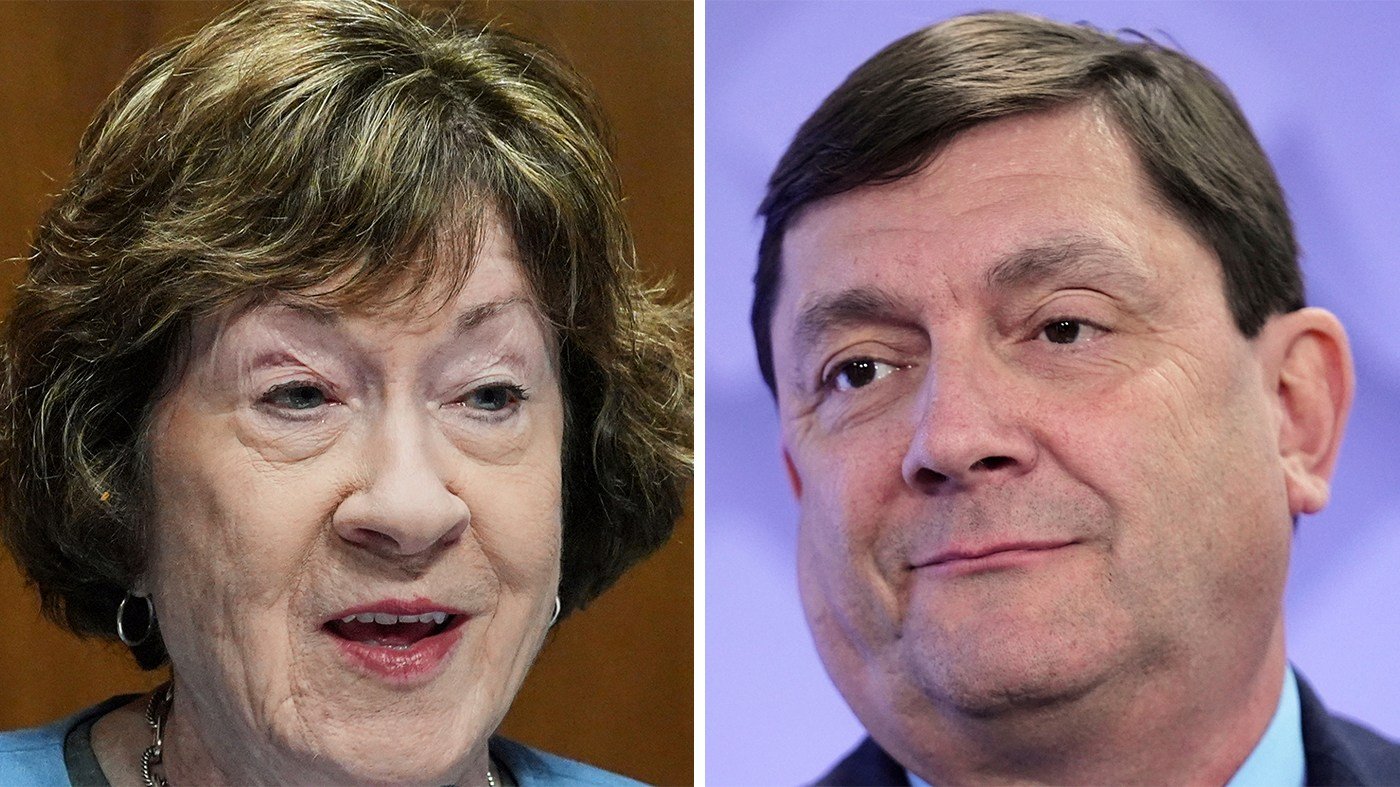
Republican Sen. Susan Collins and Democratic challenger Troy Jackson faced off Tuesday in the first debate of their closely watched Maine Senate race, a contest that could help determine control of the Senate. Collins, a five-term incumbent who has repeatedly won statewide in a state that leans Democratic, used the hourlong WGME forum to highlight her independent streaks, while Jackson, a former state Senate president, sought to tie her to President Trump's agenda and her pivotal vote to confirm Supreme Court Justice Brett Kavanaugh.
The debate came as polling averages from Decision Desk HQ show Jackson leading Collins by roughly a point, and top forecasters rate the race a toss-up. Jackson entered the race after the initial Democratic nominee, Graham Platner, withdrew amid sexual misconduct allegations, giving him a shortened campaign runway. The two are scheduled to meet in three more debates over the next two weeks, with the next set for Thursday.

Jackson presses Collins on Kavanaugh vote
Collins's 2018 vote to confirm Kavanaugh has haunted her since, contributing to her narrow 9-point victory in 2020 after a 40-point blowout in 2014. On Tuesday, Jackson connected that vote to the Supreme Court's 2022 decision overturning Roe v. Wade, asking Collins directly: "What will it take for you to admit that you were wrong?" He noted that many Maine women had begged her not to confirm Kavanaugh, and that he went on to help overturn abortion rights.
Collins defended her vote, saying she evaluates judicial nominees based on their fitness for the bench, not on predicted rulings. "I clearly don't agree with how Brett Kavanaugh voted on Roe v. Wade," she said, adding that she also voted for Democratic-nominated Justices Sonia Sotomayor, Elena Kagan, and Ketanji Brown Jackson. She acknowledged that Kavanaugh had told her during their pre-confirmation meeting that he considered Roe "settled law," but she said she did not feel he lied to her. "I think that he should not have said it was settled law because, to me, that meant that it would not be overturned," she said, while also noting that nominees cannot be asked how they might rule on hypothetical cases.
Collins also attacked Jackson's own record on abortion, noting that he had taken more conservative positions earlier in his career. "There's only one of us on this stage who has always been pro-choice," she said. She also criticized Jackson over Maine's high cost of living, pointing to policies enacted during his 20 years in the Legislature.
Collins distances from Trump
Collins repeatedly sought to distance herself from Trump, despite Democrats pointing to her voting record that they say aligns with the president 96 percent of the time. She called that figure "greatly misleading" and argued that the same analysis showed she had voted against her party more than any other senator. When Jackson attacked her vote to advance Trump's "Big Beautiful Bill" out of committee, she said the vote was necessary to move other legislative priorities and stressed that she ultimately voted against final passage.
Jackson was unimpressed, likening Collins to "an arsonist who helped set the fire, and then she wants credit for bringing a cup of water to put it out." Collins also touted her pro-choice position, a rarity for a Republican Senate candidate, and criticized the administration's handling of the war in Iran as "not well thought out." Asked whether she would welcome Trump to Maine, she said, "I don't think that President Trump is going to come to Maine. I've heard nothing from his office, and I'm not exactly his favorite senator."
Rivals diverge on ICE after fatal shooting
The candidates also clashed over immigration enforcement, particularly the role of ICE, following the fatal shooting of Johan Duran Guerrero by a federal agent in Biddeford earlier this year. The incident has fueled Democratic efforts to tie Collins to Trump's immigration policies, with protesters rallying outside her office. Jackson called for disbanding ICE, arguing that its functions should be folded into Customs and Border Patrol, which he said has proper training and public respect. "We don't respect ICE," he said.
Collins called the shooting "horrifying" and expressed sympathy for Guerrero's family, but she stopped short of endorsing Jackson's proposal, emphasizing the need for border security and lawful enforcement. The debate underscored the broader national battle over immigration, a theme that has energized both parties' bases.
As the race enters its final weeks, the outcome in Maine could hinge on whether Collins can convince voters of her independence while Jackson continues to tie her to Trump. With control of the Senate at stake, national groups are pouring money into the contest, including Planned Parenthood's super PAC boosting ad spending in Maine and Michigan. The next debate is set for Thursday, and both candidates are expected to sharpen their attacks further.