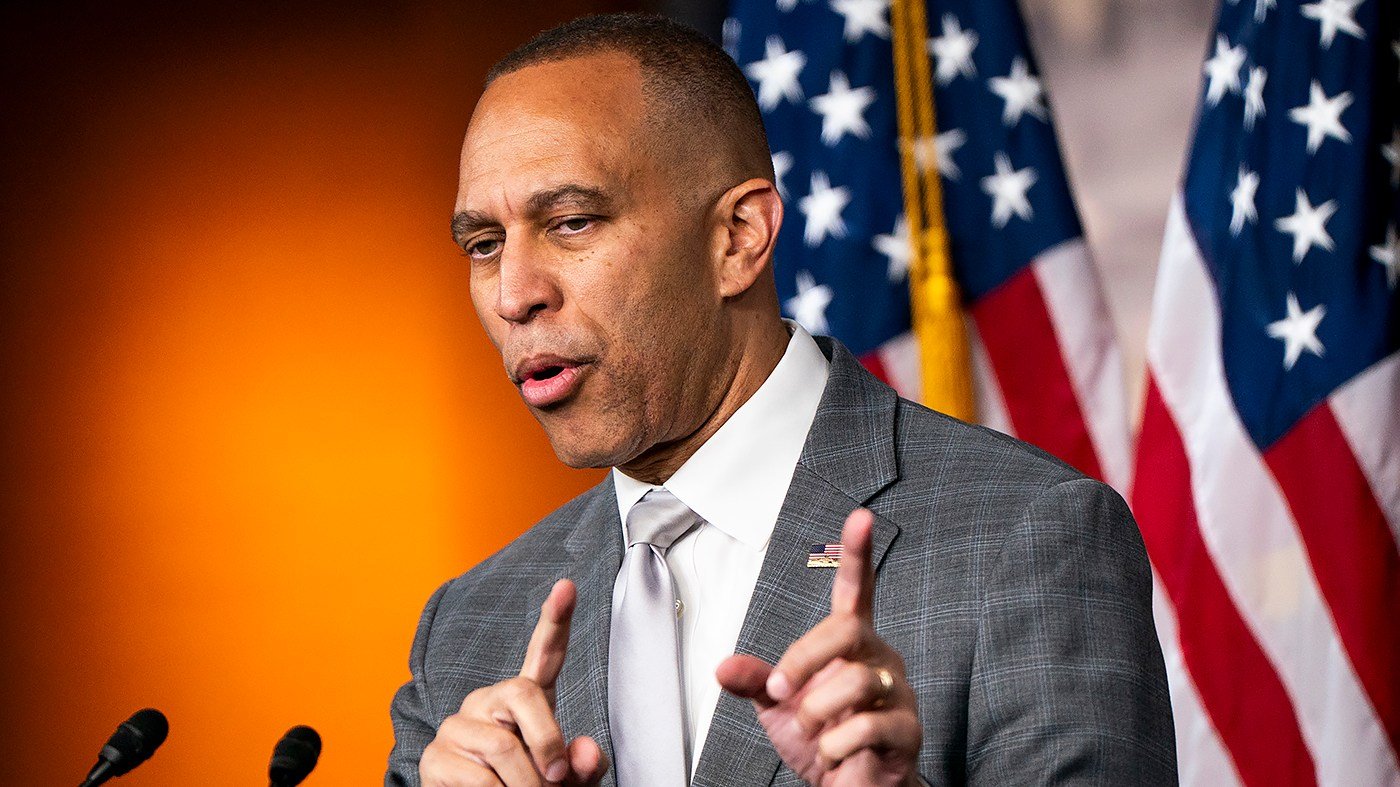
Democrats are uniting around a plan to broaden Medicare eligibility and benefits when they assume control of Congress in January, a compromise that aims to bridge the party's ideological divide. The proposal, dubbed “Medicare for More,” has drawn support from both liberal and moderate wings, though it may only be the opening salvo in a longer fight over healthcare reform.
House Democratic Leader Hakeem Jeffries (D-N.Y.) unveiled a plan last week to lower the Medicare eligibility age from 65 to 55, extend coverage to children under 18, and add dental, vision, and hearing benefits. Jeffries also pledged to reverse Medicaid cuts enacted under the GOP's One Big Beautiful Bill Act and restore the Affordable Care Act's enhanced premium tax credits that lapsed at the end of last year.

“Right out of the gate, we will aggressively work on fixing the extraordinary damage that's been done,” Jeffries said at a press conference Tuesday. “But we also know, as Democrats, that a return to the status quo is not acceptable.”
The plan represents a pragmatic middle ground between those who advocate for a single-payer system and those who prefer incremental changes that preserve private insurance. Progressives, buoyed by the election of Sen.-elect Abdul El-Sayed (D-Mich.), are expected to push for a more sweeping overhaul, but for now, they are backing the incremental approach as a first step.
Rep. Maxwell Frost (D-Fla.), a member of the Congressional Progressive Caucus, called the expansion “very achievable” given the party's majority. “I think we have such a large majority that this step forward is going to be something that we're going to be able to accomplish,” he said, adding that the immediate priority is undoing parts of the Big Beautiful Bill.
Sen. Bernie Sanders (I-Vt.), a longtime champion of Medicare for All and incoming chair of the Senate HELP Committee, praised Jeffries's plan as “the first year [of] Medicare for All.” Sanders argued that the current healthcare system is “broken” and that the time for tinkering is over. “Yes, we have to protect those people who lost their Medicaid, ACA premiums—I'm all in on that,” he said. “But I think increasingly the American people and elected officials understand the current healthcare system is broken.”
El-Sayed, who made single-payer a central theme of his campaign, also endorsed the plan as a “great start.” However, with President Trump still in office, major legislation is unlikely to pass in the next two years. Advocates are already positioning for the 2028 presidential election, where healthcare is expected to be a defining issue.
Rep. Adelita Grijalva (D-Ariz.) acknowledged the challenges of working with Trump but stressed the importance of restoring funding to a weakened healthcare infrastructure. “I don't know if we're going to be able to do very much with Trump, but I do think that the first steps are really critical,” she said. Grijalva, who supports Medicare for All in the long term, noted that a sudden transition could disrupt an already strained system. “Ideally, we want to get to Medicare for All relatively quickly, but I even heard Sen. Sanders say if we just flip a switch, you know, we could collapse a system that is already struggling,” she said.
The internal tension is likely to surface as progressives push for a floor vote on Medicare for All, something neither Jeffries nor Senate Democratic Leader Chuck Schumer has endorsed. Such a vote would force Democrats to take a clear stance, potentially alienating moderate voters but energizing the base. Rep. Ami Bera (D-Calif.), a physician and centrist, emphasized the need to focus on immediate fixes like reversing H.R. 1 cuts, while acknowledging that long-term solutions depend on cost and coverage.
As Democrats navigate this delicate balance, the party's ability to deliver on healthcare will be closely watched, especially with fiscal constraints looming in the 2028 campaign. The coming months will test whether the party can maintain unity while advancing a policy that satisfies both its progressive base and its moderate wing.