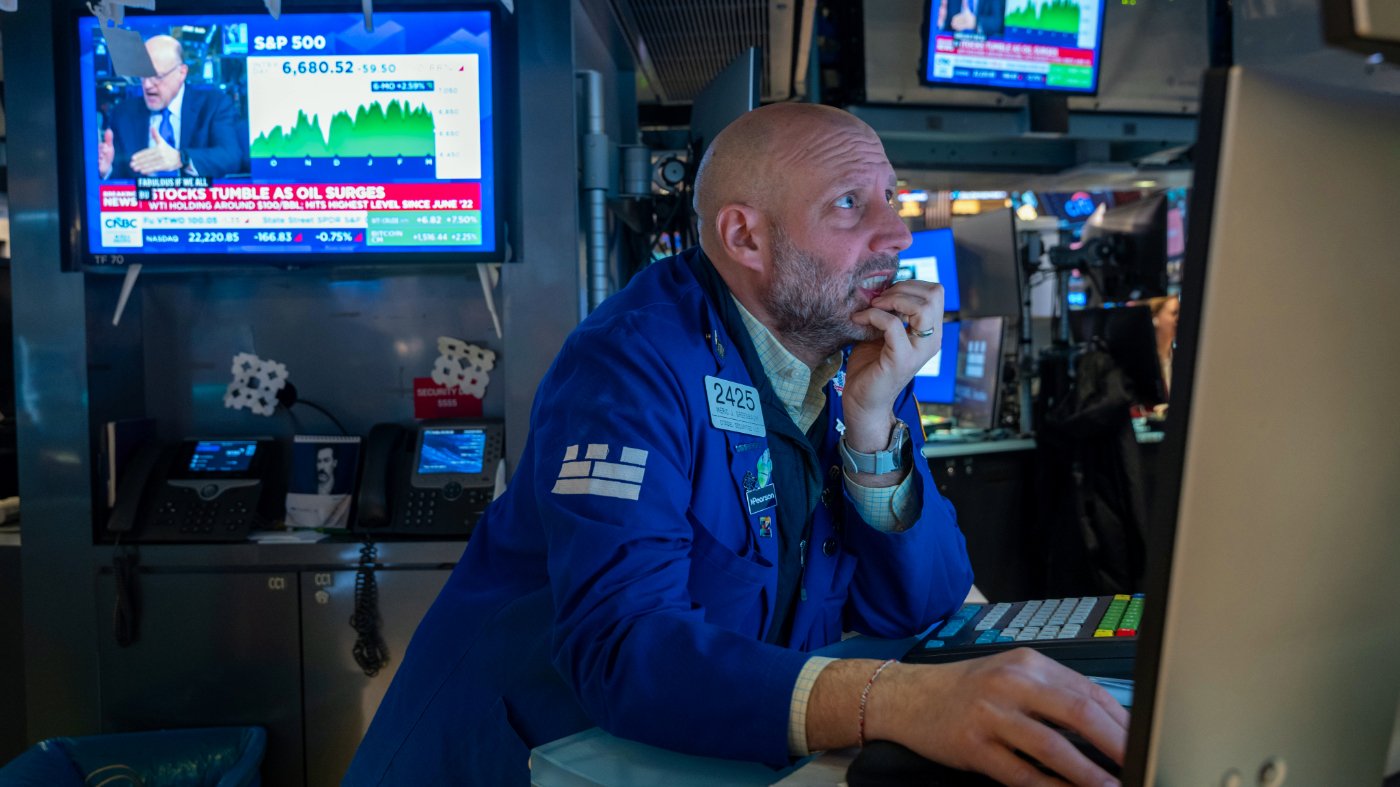
U.S. financial markets closed a turbulent week with significant losses Friday, driven by escalating economic anxieties stemming from the ongoing military conflict in Iran. Investors retreated from risk assets as the war's second month approaches with no definitive resolution in sight, creating sustained pressure across global commodity and equity markets.
Markets Slide into Correction
The Dow Jones Industrial Average plummeted nearly 800 points, a decline of 1.7 percent, to close at 45,166.64. This drop pushed the blue-chip index more than 10 percent below its recent peak, formally pushing it into correction territory. The broader S&P 500 index mirrored the decline, also falling 1.7 percent, while the technology-focused Nasdaq Composite suffered a steeper 2.1 percent loss. The Nasdaq had already entered a correction earlier in the week, highlighting the particular sensitivity of growth stocks to the current geopolitical and economic climate.
Friday's sell-off capped another difficult week for equities, which have struggled under the weight of uncertainty. The persistent conflict has directly impacted critical global supply chains, with Iran's effective closure of the Strait of Hormuz severely restricting the flow of crude oil and fertilizer. This blockade has triggered sharp price increases for a wide array of energy and agricultural commodities, raising the specter of a broader inflationary surge that could dampen economic growth and consumer spending.
Economic and Consumer Impact
The financial volatility is beginning to translate into tangible economic concerns. "The US-Iran conflict is taking a toll on consumer sentiment, as it has lifted gas prices substantially and caused declines in equity markets," wrote Grace Zwemmer, U.S. economist at Oxford Economics, in a Friday analysis. "We expect a sustained recovery in sentiment from near record lows will be delayed as long as the war persists."
Zwemmer noted that while the war's impact on consumers' outlook for future economic conditions has so far been more contained, that could change. "That could change the longer the war persists, or when higher energy prices begin to lift overall inflation," she added. This economic pressure comes as the White House, facing political headwinds over the economy, announced a series of measures aimed at providing relief to the agricultural sector, which has been hit hard by the disruption in fertilizer supplies and shipping routes.
Political and Strategic Uncertainty
The market's unease is compounded by a complex and seemingly contradictory political strategy from the Trump administration. Despite repeated assertions from President Trump that the joint U.S.-Israeli military operation has largely achieved its objectives, the conflict continues. The administration has simultaneously pursued diplomatic channels with Iranian officials while deploying thousands of additional U.S. troops to the Middle East to reinforce threats of further action.
This dual-track approach has failed to reassure markets, which are pricing in a prolonged period of instability. The strategic implications extend beyond immediate combat, with officials like Senator Marco Rubio warning allies about potential long-term Iranian control over key shipping lanes. Rubio has cautioned G7 nations about Iran potentially establishing a toll system in the Strait of Hormuz after the conflict, a scenario that would entrench economic leverage for Tehran.
The domestic political fallout is also intensifying. The economic strain adds to a series of challenges for the GOP, including internal policy disputes. For instance, President Trump recently rebuked a Senate Department of Homeland Security funding bill for excluding key border enforcement agencies, highlighting the difficult balancing act between national security priorities and fiscal concerns during a crisis. Furthermore, recent special election losses in Florida have signaled potential Republican vulnerabilities ahead of the midterms, with economic anxiety being a likely factor for voters.
As the war enters its next phase, Wall Street's primary concern remains the conflict's duration and its cascading effects on global energy prices, inflation, and ultimately, corporate earnings and economic stability. Until a clear path to de-escalation emerges, financial markets are likely to remain on edge, reacting sharply to each new development in the Persian Gulf and in Washington's policy response.