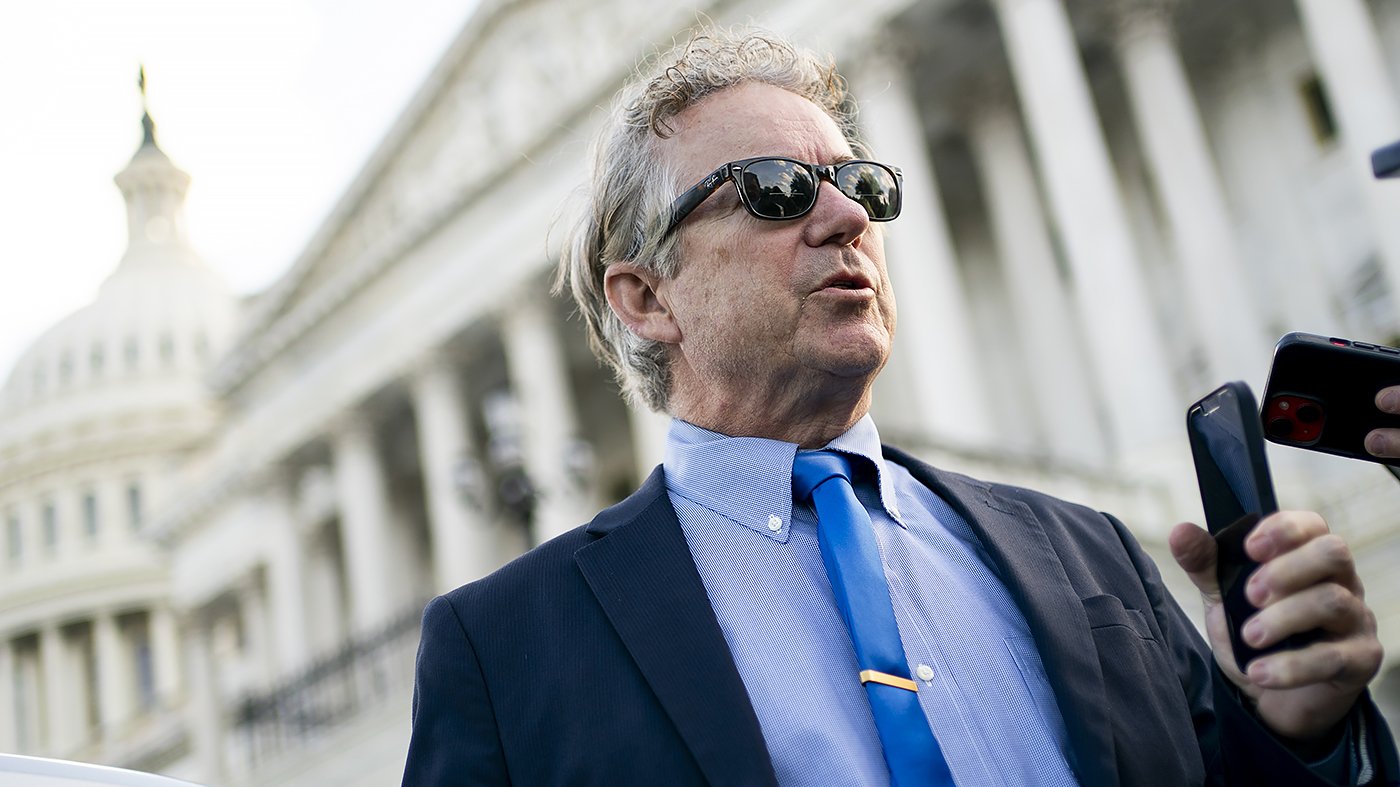
Senate Homeland Security Committee Chairman Rand Paul (R-Ky.) signaled Tuesday that the $1 billion earmarked for the White House ballroom is unlikely to survive the budget reconciliation process. Paul, whose panel is set to mark up part of the Senate's immigration enforcement funding package, told reporters the ballroom provision faces significant obstacles before reaching the floor.
The funding, which would cover security upgrades for the ballroom, was included in legislative text released last week by the Senate Judiciary Committee. That text is slated to be combined with Paul's Homeland Security Committee language to form the broader reconciliation bill, which Republicans aim to pass with a simple majority to bypass a Democratic filibuster.

Paul, a frequent critic of taxpayer-funded presidential perks, reiterated his preference for private donations to cover the ballroom and its security enhancements. “I’m for still doing it with the private donations,” he said, noting he has introduced legislation to create an expedited approval process for such projects without federal funding.
The Kentucky Republican pointed to the Byrd Rule—a Senate restriction on what can be included in reconciliation bills—as a key hurdle. “I think it will have to go through the Byrd Bath and they’ll have to decide whether it can be in reconciliation,” Paul said, referring to the review by the Senate parliamentarian. But he cautioned that even if the funding clears that test, it could still be stripped at the committee level.
“If it were in reconciliation, there’s all these technical things but I think it has to go to the committee of jurisdiction and I think the committee of jurisdiction is not my committee,” Paul added. His bottom line: “I don’t think it will be in there, is what my guess is.”
Paul's comments come as Senate Judiciary Committee Chairman Chuck Grassley (R-Iowa) postponed a markup of the reconciliation bill originally scheduled for March 12. Judiciary Republicans announced that Homeland Security would take the lead, noting that Paul’s committee does not have a rule requiring two meetings to advance a bill. “The decision to postpone tomorrow’s Judiciary markup…was made following discussions between the Judiciary and HSGAC committees and Senate leadership,” the panel said in a statement on X.
The move may reflect concern that Grassley lacks the votes to report the bill from his committee. Sen. Thom Tillis (R-N.C.), a Judiciary member, told reporters he needs “a lot of questions answered” before backing the ballroom funding. “I’m going to ask basic questions on it. We’re supposed to get briefed this week,” Tillis said.
Tillis warned that approving taxpayer money for the ballroom could be a political liability in an election year, especially with voters worried about rising costs for food and fuel. “If I’m in the Democratic marketing department, I’m probably thinking of a lot of ways I would use this on targeted senators that vote for it,” he said. “We certainly shouldn’t expect any members who are in any of these at-risk states to [vote for] it if they see the potential consequences.”
The ballroom funding has drawn sharp criticism from Democrats, who have seized on the issue as a symbol of GOP priorities. In a related development, Senate Minority Leader Chuck Schumer has led the charge against the $1 billion allocation, framing it as a giveaway to Trump allies. Meanwhile, some conservative commentators have dismissed the Democratic backlash as overblown, with Bill Maher recently calling the fury “stupid.”
Paul’s committee is expected to mark up the reconciliation package next week, and the outcome will likely determine whether the ballroom funding survives—or becomes a flashpoint in the broader budget battle.