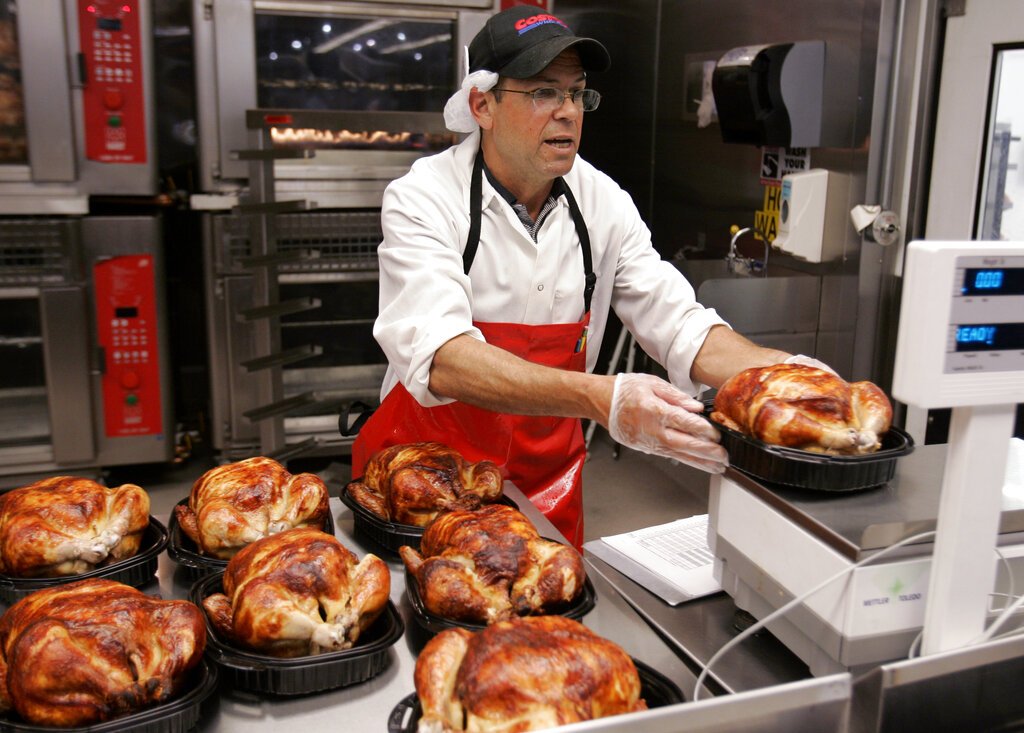
Costco is mounting a vigorous defense against a class-action lawsuit filed in a Southern California court that accuses the membership retailer of misleading customers by advertising its $4.99 rotisserie chicken as containing “no preservatives.” The company’s legal team argues the suit is “fatally flawed,” pointing to FDA regulations that do not classify the disputed ingredients as preservatives.
The lawsuit, filed on January 22 by two California residents represented by the Almeida Law Group, claims Costco’s Kirkland Signature Seasoned Rotisserie Chicken contains sodium phosphate and carrageenan—substances that the plaintiffs say function as preservatives despite the “no preservatives” label. Carrageenan, derived from seaweed, is commonly used as a stabilizer or thickener, while sodium phosphate helps extend shelf life and retain moisture in meat.

“Consumers reasonably rely on clear, prominent claims like ‘No Preservatives,’ especially when deciding what they and their families will eat,” said Wesley M. Griffith, a partner at Almeida Law Group, in a statement after the suit was filed. “Costco’s own ingredient list contradicts its marketing. That’s unlawful, and it’s unfair.”
Costco’s attorney, Charles Sipos, countered in a recent court filing obtained by Nexstar that the two additives are “unambiguously” listed in the ingredients as part of the chicken’s seasoning and are not considered preservatives under FDA definitions. Sipos also argued that the plaintiffs failed to prove any financial harm, noting that Costco did not raise the $4.99 price after removing the “no preservatives” label in response to the lawsuit.
“Plaintiffs maintain this supposed price premium can be identified by evaluating the different prices between Costco’s Rotisserie Chicken and competitors’ products,” Sipos wrote. “Yet, the Amended Complaint does not identify a single ‘competitor’ who prices a whole rotisserie chicken for sale for less than $4.99.”
The plaintiffs’ attorneys initially accused Costco of having “systemically cheated customers out of tens—if not hundreds—of millions of dollars” through the alleged false advertising. However, Costco’s legal team has dismissed these claims as speculative, emphasizing that the company’s pricing strategy remains consistent with its long-standing value proposition. The case highlights ongoing tensions over food labeling practices, as consumers and regulators increasingly scrutinize marketing claims. Costco has also been adjusting prices on other items amid broader inflationary pressures, further complicating the narrative around its pricing integrity.
The dispute over preservatives is part of a wider pattern of legal challenges to food advertising, where terms like “natural” and “preservative-free” are often contested. In a similar vein, the Trump administration recently fought a lawsuit over a White House event, underscoring how legal battles over marketing and government actions can intersect. Nexstar reached out to Almeida Law Group for comment but did not immediately receive a reply.
As the case unfolds, it raises questions about how far companies can go in using terms like “no preservatives” when additives serve functional roles in food preservation. For now, Costco appears confident that its labeling complies with FDA standards, but the outcome could set a precedent for how similar claims are evaluated in the future.