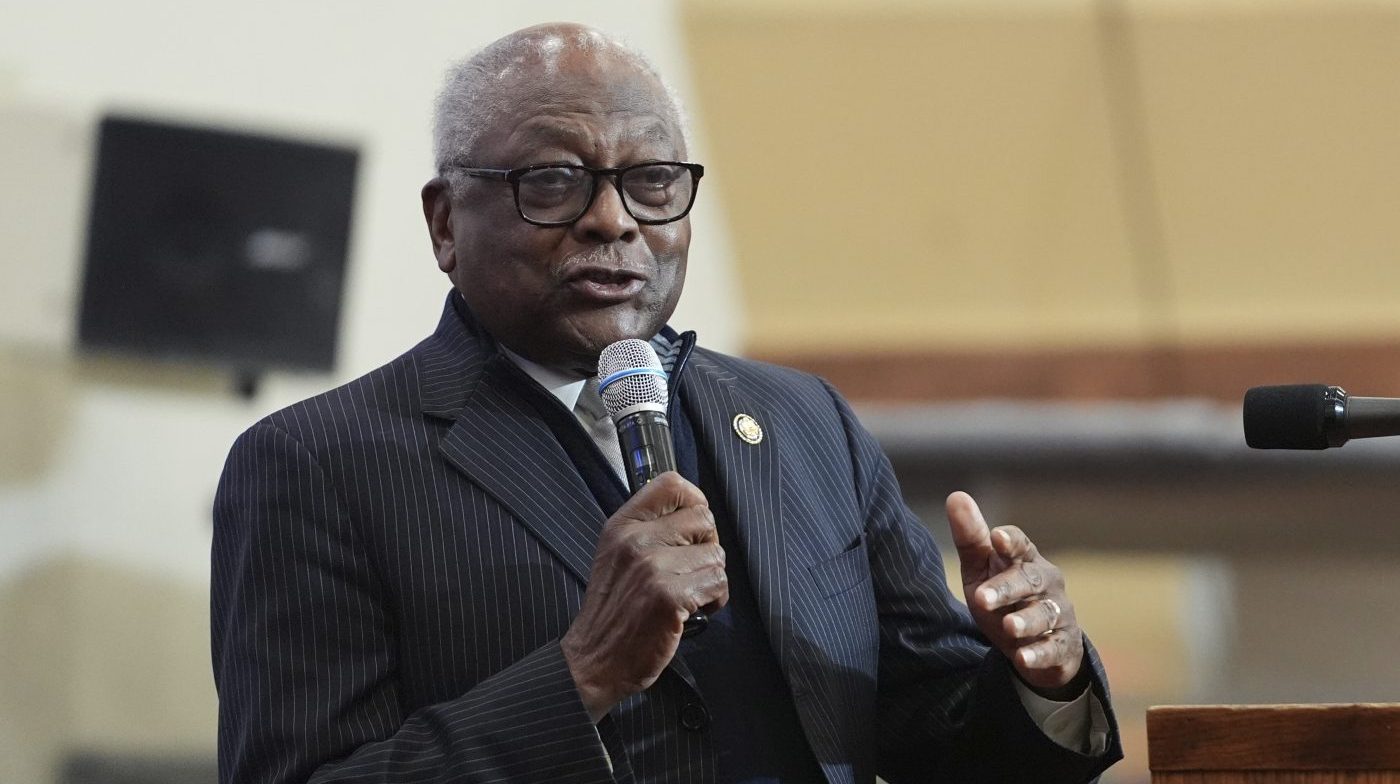
Representative Jim Clyburn (D-S.C.) launched a blistering attack on Chief Justice John Roberts on Sunday, predicting the conservative jurist will be remembered alongside some of the most reviled figures in Supreme Court history. The sharp rebuke came after the high court’s April ruling in Louisiana v. Callais, which struck down Louisiana’s second majority-Black congressional district as an unconstitutional racial gerrymander.
Speaking on CNN’s “State of the Union,” Clyburn told host Jake Tapper that the current Supreme Court has displayed an “openly partisan” bent that he never expected to witness. “I never thought I would see the day that the United States Supreme Court would be so openly partisan with what it’s been doing,” he said.

Clyburn went further, invoking the specter of Chief Justice Roger Taney, who authored the infamous 1857 Dred Scott v. Sandford decision that declared enslaved Black people were not U.S. citizens and could not sue in federal courts. “I think that Justice Roberts is going to take his place alongside some other infamous justices like [former Supreme Court Chief Justice Roger] Taney, who gave us the Dred Scott decision,” Clyburn added.
The Louisiana v. Callais ruling, decided 6-3 along ideological lines, dealt a significant blow to Section 2 of the Voting Rights Act, a provision that for decades allowed advocacy groups to push for the creation of majority-minority districts. Justice Samuel Alito, who wrote the majority opinion, characterized the decision as a long-overdue “update” to the legal framework governing Voting Rights Act cases, rather than a full repeal of the provision.
Democrats have been furious over the ruling, accusing the conservative majority of undermining a landmark civil rights law. The decision has already triggered a wave of redistricting efforts in Republican-controlled Southern states, as GOP lawmakers rush to redraw congressional maps ahead of the November midterms. Southern GOP states have moved swiftly to revise their maps, hoping to lock in advantages before new court challenges can materialize.
Clyburn has been particularly vocal about developments in his home state of South Carolina. There, state lawmakers have extended their session to consider redrawing the congressional map—a move Clyburn says is aimed squarely at eliminating the state’s only Democratic-held House district, his own 6th District. “Republicans in the South Carolina state legislature began the process of extending their session to allow for the redrawing of the state’s congressional map—with one goal in mind: eliminating the state’s only Democratic House district that is occupied by a Democrat,” Clyburn wrote in a series of posts on X last week.
He directly tied the effort to former President Donald Trump, alleging the redistricting push is being driven by Trump’s personal request rather than any voter demand. “Republicans are trying to break apart South Carolina’s 6th District. Not because voters demanded it, but because Donald Trump requested it,” Clyburn said. “We cannot let them succeed.”
The South Carolina controversy is part of a broader pattern across the South. Similar battles are playing out in Alabama and Virginia, where GOP-led legislatures are testing the limits of the Supreme Court’s ruling. In Alabama, Republicans have raced to revise their voting map in an effort to secure an electoral edge, while in Virginia, the state’s high court blocked a Democratic redistricting plan, preserving the GOP’s current advantage.
Clyburn’s comparison of Roberts to Taney is a striking escalation in the political rhetoric surrounding the Supreme Court. Taney’s Dred Scott ruling is widely condemned as one of the worst judicial decisions in American history, and invoking it signals the depth of Democratic anger over the current court’s direction. For now, the battle over voting rights and redistricting is set to intensify, with both parties gearing up for a protracted legal and political fight that could shape control of the House for years to come.