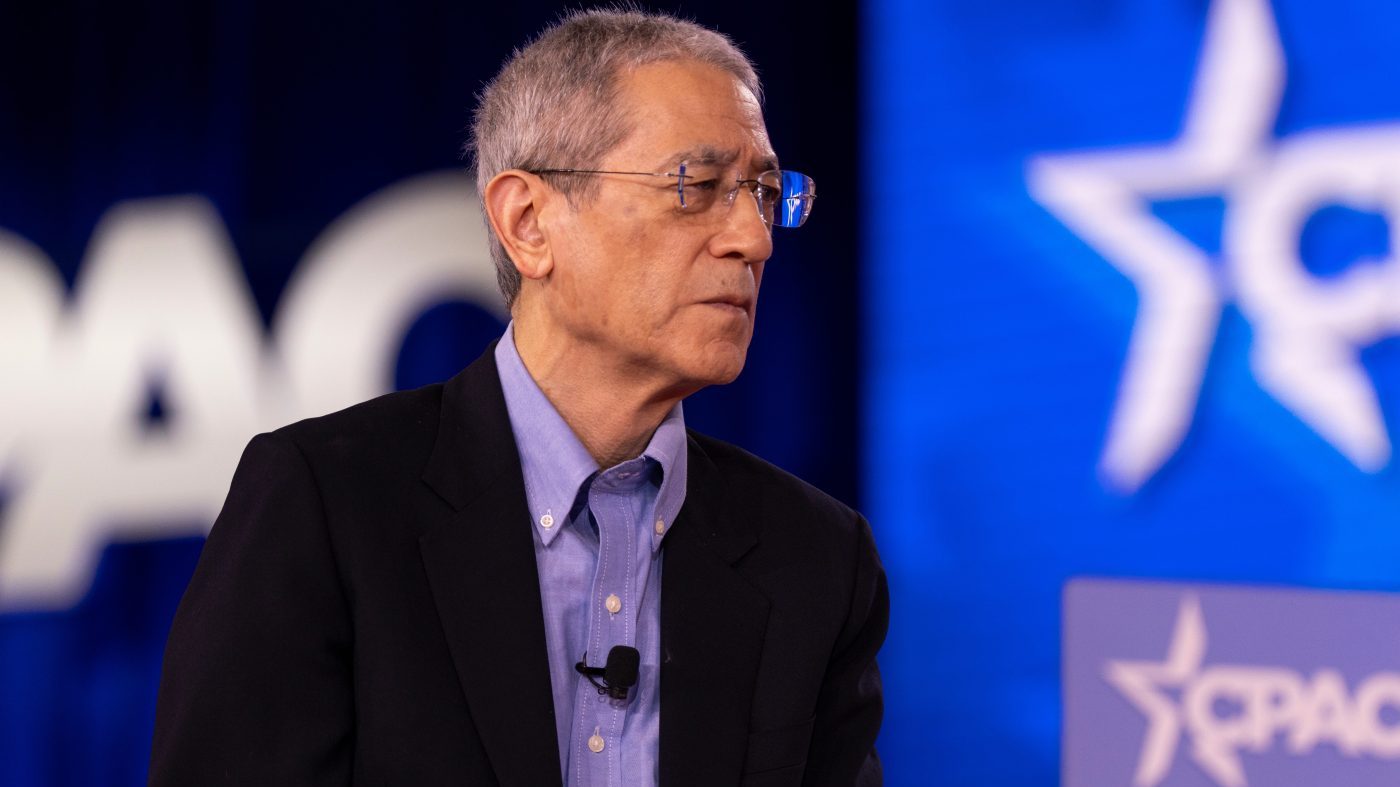
Lawyer and longtime China critic Gordon Chang argued Tuesday that any US attempt to regulate Chinese artificial intelligence companies would be practically unenforceable, casting doubt on the Biden administration’s approach to curbing Beijing’s tech advances.
“Cooperation and coordination with not just China, but all other nations in the world, that sounds like a good thing,” Chang told NewsNation’s “Jesse Weber Live.” “The problem is in practice, it’s not going to work.”
Chang, a prominent China hawk who once predicted the collapse of the Chinese Communist Party by 2011, said AI differs from traditional weapons systems. “AI would be unenforceable. It’s not like counting warheads. So, it’d be very difficult for the United States to police all the people who develop AI,” he said. “But more important, it would be impossible to enforce against a China, which doesn’t have a great track record for adhering to its promises.”
His comments came just hours before President Trump arrived in Beijing for a summit with Chinese President Xi Jinping. Trump, traveling with a delegation of business leaders including Tesla CEO Elon Musk and Nvidia CEO Jensen Huang, said his first priority would be convincing Xi to open China’s markets to US tech firms. The trip has already sparked debate, with some critics pointing to a $1 trillion investment deal that has drawn MAGA backlash.
Rather than pursuing international agreements, Chang urged US companies to “race ahead” on AI development and set global standards—while explicitly excluding China. “If the US dominates AI, our global standards, product of a democracy, of a free society, will predominate over those of China, which is, after all, either a totalitarian or semi-totalitarian state,” he said.
Chang’s skepticism about enforcement echoes broader concerns in Washington about China’s track record on technology pledges. Earlier this month, the Center for AI Standards and Innovation, a US government agency, reported that Chinese firm DeepSeek’s V4 Pro AI model trails OpenAI’s GPT-5.5 by about eight months. Still, Chang warned the US lead is narrow and fragile, partly because Chinese companies face “no restrictions on the data” they can feed into their systems.
“We’ve got these leads,” he said. “They’re not enormous leads. But we also have a sense, as you point out, that this is a really important competition, and the Chinese are very close behind us.”
The lawyer added, “So, we’re not resting on our laurels.”
The debate over AI regulation and China’s role comes as Trump’s broader trade agenda continues to reshape US-China relations. Meanwhile, a separate court ruling could hand Trump a path to regime change in Iran, adding another layer of complexity to his foreign policy approach.