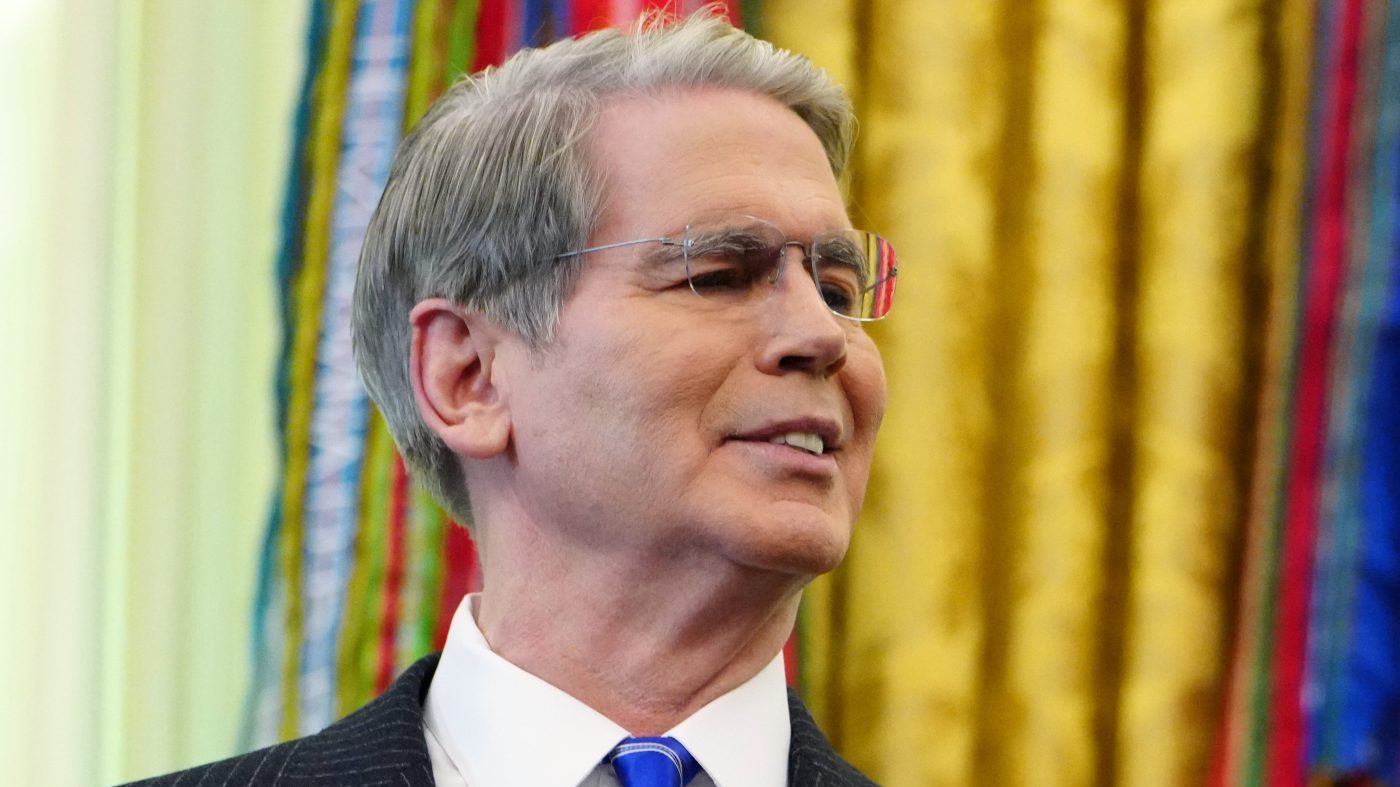
Treasury Secretary Scott Bessent on Tuesday said the United States and China should pursue a "more balanced" trade relationship, just days after President Trump indicated he expects to sit down with Chinese President Xi Jinping later this month.
Speaking at the National Committee on U.S.-China Relations Gala, Bessent acknowledged that the long-standing U.S. trade deficit with China has been a persistent source of tension. "The U.S. trade imbalance with China has long been a source of friction," he said.

Bessent was clear about the administration's approach, stating, "Let me state firmly and unequivocally tonight that as we work toward a more balanced relationship, our objective is to de-risk, not to decouple." This signals a continuation of the White House's strategy to reduce economic vulnerabilities without severing ties with Beijing.
According to Census Bureau data, the U.S. trade deficit with China fell to a two-decade low last year, with imports exceeding exports by $202.7 billion. While the deficit has been a fixture of the economic relationship for decades, it has widened significantly since the early 2000s.
Bessent argued that the U.S. economy has become "too dependent" on foreign supply chains, while China's economy has grown "increasingly reliant" on foreign demand. "In other words, the United States must produce more of what we consume, while China must consume more of what it produces," he said. "Working together, we can strengthen both of our economies without perpetuating the imbalances between them."
The Treasury secretary's remarks come as President Trump told reporters in Florida on Sunday that he expects to meet with both Xi and Russian President Vladimir Putin at the upcoming APEC summit in Shenzhen, China. Trump said the discussions would include "denuclearization," noting that the U.S., China, and Russia together hold more than 80 percent of the world's available nuclear warheads, according to the Federation of American Scientists.
This would be the second meeting between Trump and Xi in recent months. In September, the two leaders agreed to extend a trade truce until January 10, 2027. That arrangement rolled back some U.S. tariffs on Chinese goods and prompted China to suspend export controls on rare earth metals. Additionally, both countries agreed to lower tariffs on $30 billion worth of products.
Bessent emphasized the administration's goal to "advance a fair and reciprocal relationship with China," with just two months remaining before the current truce must be renewed or replaced by a broader deal. "After decades of imbalance, we are restoring a spirit of reciprocity for the benefit of both of our peoples," he added.
The comments come amid broader trade tensions, including bipartisan concerns over tech exports and China's dominance in clean energy, which could influence the upcoming negotiations.