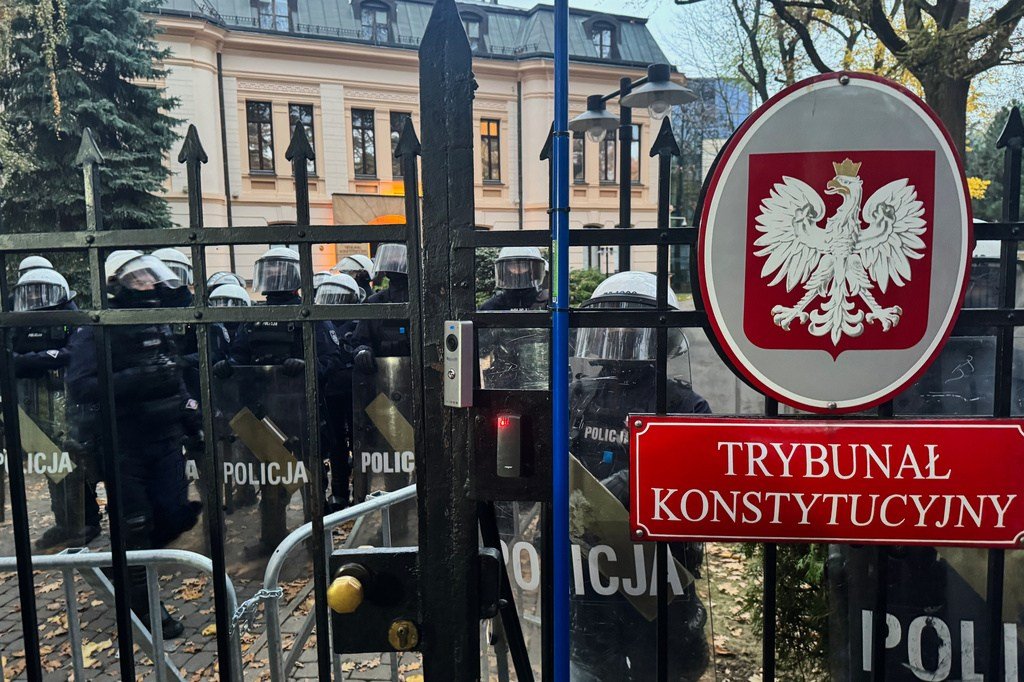
Poland's political crisis escalated dramatically on October 30 when riot police, deployed from across the country, stormed the Constitutional Tribunal in Warsaw. The building was largely empty, as most staff had left for the All Saints' Day holiday, and President Karol Nawrocki was on a diplomatic trip to Senegal. In a swift move, the government suspended the tribunal's president and deputy, barred them from their offices, and installed judges loyal to Prime Minister Donald Tusk, who reportedly entered through a back door from his office.
President Nawrocki, upon learning of the takeover, turned his plane around and returned to Warsaw. He attempted to enter the tribunal alongside legitimate judges but was blocked by layers of masked riot police armed with machine guns. His presence did little to resolve the standoff. He left, calling for compromise and consultations with judges and political leaders. Tusk, however, dismissed any notion of negotiation, declaring that he was restoring the "rule of law" and that no compromise was possible.
The roots of this conflict trace back to 2015, when the outgoing government of Tusk's party appointed five judges to the tribunal instead of the constitutionally mandated three, leaving two seats for the newly elected conservative parliament. The subsequent replacement of those judges drew accusations from European institutions of violating the rule of law. Today, the European Commission fully supports Tusk's actions, while Nawrocki insists he is defending the Polish Constitution.
Both sides claim legal justification. Tusk invokes European Union laws and directives, while Nawrocki points to Poland's constitutional supremacy. The tribunal itself ruled in 2021 that Polish law takes precedence over EU law, a stance echoed by Germany's constitutional court. Yet Tusk and his European backers reject this, arguing that the rule of law only applies when EU laws are enforced under European courts' jurisdiction. This, critics say, effectively transfers political authority to an undemocratic, centralized institution in Brussels.
To legitimize this takeover, Tusk's newly appointed judges must overturn previous rulings affirming Polish legal sovereignty. To prevent criticism, the government has enacted a law on November 6 that muzzles free speech online and on social media. The first part adopts the EU's "Democracy Shield" directive, aimed at fighting disinformation and foreign interference. The second part, championed by the government, adds draconian penalties for vaguely defined offenses like "threats to national security" or "hate speech."
These penalties include property seizures for individuals and organizations, fines up to $5 million, prison sentences up to 12 years, and placement on a permanent sanctions list. Decisions are made by a single government official with no right of appeal. The law's architect is Foreign Minister Radek Sikorski, whose office will oversee its implementation. Critics note it goes far beyond EU law, targeting not just offenders but their families and friends, aiming to suppress independent voices outside mainstream media.
This has profound implications for European elections. The government and EU will control the information environment, with heavy sanctions for arbitrarily defined "disinformation." The interior minister's recent characterization of a mass attack suspect as "far-right"—despite no evidence of such views—illustrates how the law could be misused to tar political opponents with terrorism associations.
The EU-backed takeover of the Constitutional Tribunal and the new censorship law represent a dangerous consolidation of power. By silencing dissent and subordinating Polish law to EU institutions, Tusk and his allies are undermining democratic accountability. As Poland's tribunal standoff and censorship law unfold, the consequences for Polish sovereignty and European democracy are severe. The government's actions, while framed as restoring rule of law, risk creating an illegitimate regime that will have lasting costs for Poland and Europe.