Poland is in the grip of a full-blown constitutional crisis after Prime Minister Donald Tusk moved to replace the leadership of the Constitutional Tribunal and pushed through a draconian censorship law that critics say eviscerates free speech. The standoff pits Tusk against President Karol Nawrocki and has drawn in the European Commission, which backs the prime minister's actions.
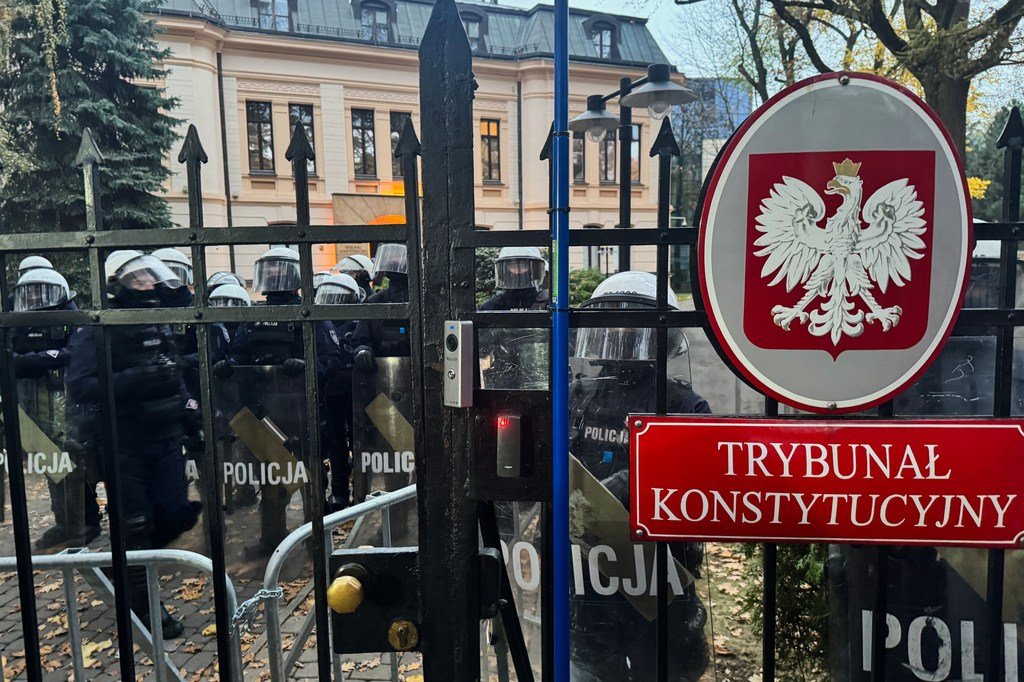
The crisis erupted on October 30 when riot police from across the country entered the Constitutional Tribunal building in Warsaw. The tribunal's president and deputy were suspended, barred from their offices, and replaced by judges appointed by Tusk, who entered through a back door from his office. President Nawrocki, returning from a diplomatic mission to Senegal, attempted to enter the tribunal at the request of the legitimate judges but was blocked by masked riot police armed with machine guns. He left calling for compromise and consultations, but Tusk declared he was restoring the "rule of law" and that there would be no compromise.
The roots of the conflict stretch back to 2015, when the outgoing government of Tusk's party appointed five judges to the tribunal instead of three. The two remaining seats were to be filled by the newly elected conservative parliament. The subsequent replacements triggered accusations from European institutions of rule-of-law violations. Today, the European Commission fully supports Tusk's actions.
Both sides claim legal legitimacy, but they invoke different sources of authority. Tusk grounds his arguments in European Union law and directives, while Nawrocki says he is defending the Polish Constitution. In 2021, the Constitutional Tribunal ruled that Polish law takes precedence over EU law, a stance similar to that of Germany's constitutional court. That ruling remains valid under Polish law, but Tusk and his European allies reject it, insisting that the rule of law prevails only when EU law is applied under the jurisdiction of European courts. Critics warn that this effectively transfers political authority to centralized EU institutions lacking democratic legitimacy.
To cement the takeover, Tusk's newly appointed judges—who do not meet constitutional requirements—are expected to reverse previous rulings on Polish legal sovereignty. And to silence opposition, the government has prioritized a law that muzzles free speech online and on social media.
That law was adopted on November 6. Its first part implements the EU's "Democracy Shield" directive, which targets disinformation, upholds European values, and prevents foreign election interference, imposing sanctions on violators. The second part adds a radical layer of punishments championed by the current government. For vaguely defined violations—such as threats to national security or public order, hate speech, or Foreign Information Manipulation and Interference—the government can impose draconian penalties: seizure of property from individuals, corporations, and NGOs to be immediately auctioned off; fines up to $5 million; up to 12 years in prison; or placement on a permanent sanctions list with loss of political and economic rights.
These punishments are to be decided by a single government official with no right of appeal. The law's originator is Foreign Minister Radek Sikorski, whose office will oversee its implementation. The Polish law is far more radical than the EU directive, targeting not only offending individuals but also their families and friends. Its purpose is to control independent voices outside the mainstream media.
The implications for European elections are severe. In addition to funding activist NGOs and withholding EU funds, the government and the EU will control the entire information environment with heavy sanctions for arbitrarily defined "disinformation." A recent example of potential misuse came when the interior minister characterized a man suspected of a mass attack in Poland as having "far-right extremist views," despite no indications he held such views. Local investigators described him as quiet, a good student, critical of the Catholic Church, always dressed in black with a hood and black painted nails. The "far-right" label appeared designed to tar conservative political opponents with terrorism associations.
The EU-backed takeover of the Constitutional Tribunal used violence to establish what is effectively an illegitimate rule of law. The censorship law silences independent voices critical of the government and the EU, granting primacy to undemocratic, centralized, international bureaucratic institutions. Poland and Europe will pay dearly for it.