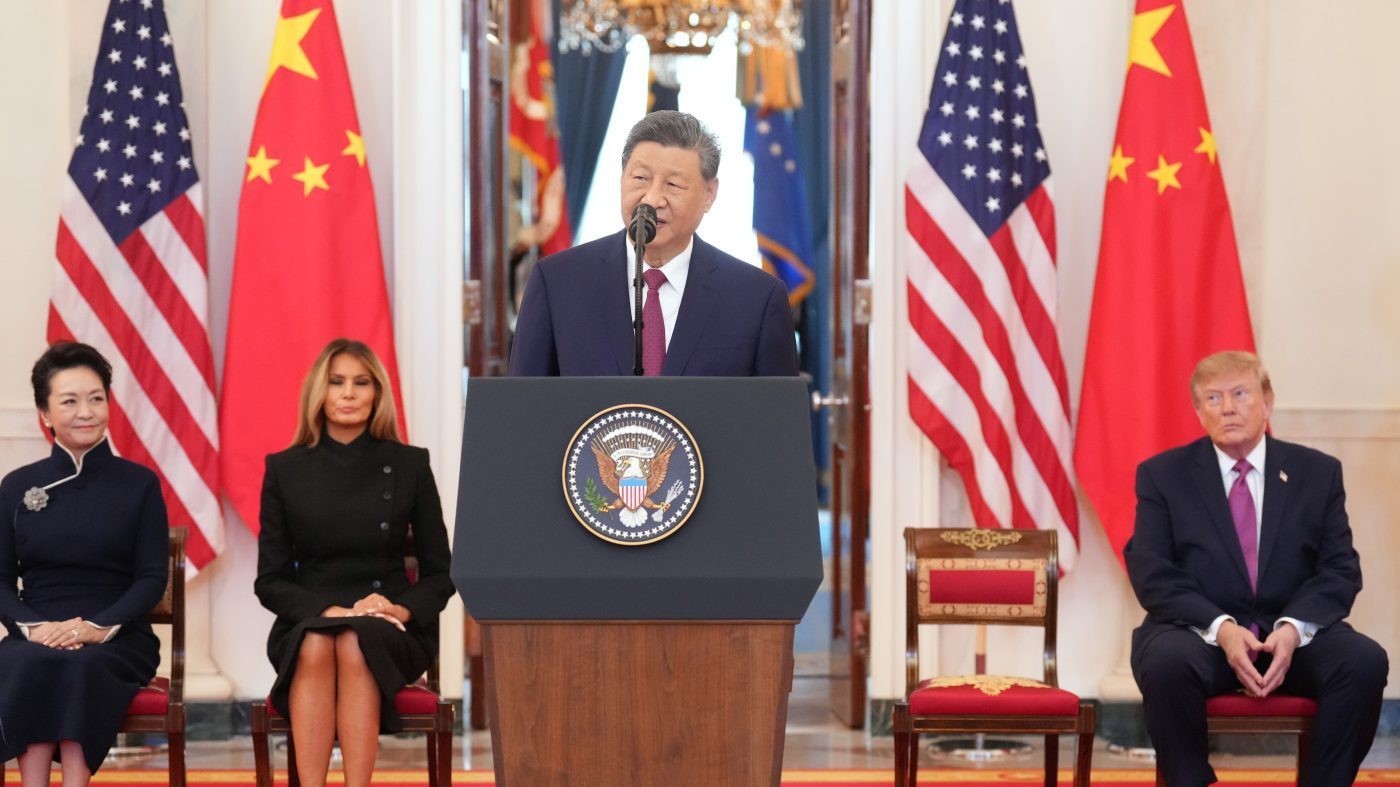
During a joint appearance at the White House on Thursday, Chinese President Xi Jinping asserted that the United States and China, as the world's leading AI powers, share a duty to guide the technology's evolution responsibly. “We have both the capability and responsibility to develop and manage AI for good and ensure that the development of AI is always under human control and serves the well-being of the people,” Xi stated from the Grand Foyer.
President Donald Trump, who has frequently referred to AI as “super intelligence,” acknowledged that he and Xi would discuss the matter, framing the stakes in generational terms. “The decisions we make in these areas today can promote peace and prosperity for decades and decades to come,” Trump said.
Earlier in the day, Trump took to Truth Social to preview the conversation, writing that AI would be a “big topic of discussion, but I want to leave it exactly where it is.” He added, “That is China’s position also. Our guardrail is the DOJ!” The president has repeatedly insisted that existing legal enforcement is sufficient, despite mounting calls from industry leaders for new safeguards.
That stance clashes with the appeals of top AI executives. On Wednesday, OpenAI CEO Sam Altman and Anthropic CEO Dario Amodei addressed the United Nations Security Council, urging nations to collaborate on AI safety measures. Altman drew on historical parallels, saying, “In our history, there have been times where countries who compete and don’t always like each other very much still come together for shared interests and the collective good in the face of a powerful new technology. We believe this must be one of those times.”
Trump, however, pushed back against any multilateral approach. In his remarks, he declared that the U.S. “totally rejects any attempt to construct a globalist scheme” on AI governance. He has consistently maintained that Washington must win the AI race and has dismissed concerns about existential risks as a “hoax.”
The divergence between the two leaders underscores a broader geopolitical tension: while both nations recognize their outsized role in shaping AI's trajectory, they disagree on the framework for oversight. Xi's emphasis on human control echoes longstanding Chinese policy statements, but his direct appeal to a U.S. audience signals a willingness to engage bilaterally.
Trump's insistence on unilateral leadership has drawn criticism from experts who argue that international coordination is essential to prevent harmful outcomes. Yet his administration has prioritized competitive advantage, as seen in recent moves like introducing an AI air traffic tool while insisting humans stay in control—a nod to safety even as he resists broader regulation.
The visit also comes amid a US-China trade truce extension, highlighting the delicate balance between economic rivalry and strategic cooperation. As Xi's state dinner menu blends American and Chinese flavors, the two sides are navigating a complex relationship where AI has emerged as a central point of friction.
For now, the only concrete guardrail Trump has endorsed is the Justice Department, a position he reiterated without elaboration. Whether that suffices to address the challenges posed by increasingly capable AI systems remains an open question, one that Xi's remarks suggest deserves more than a unilateral answer.