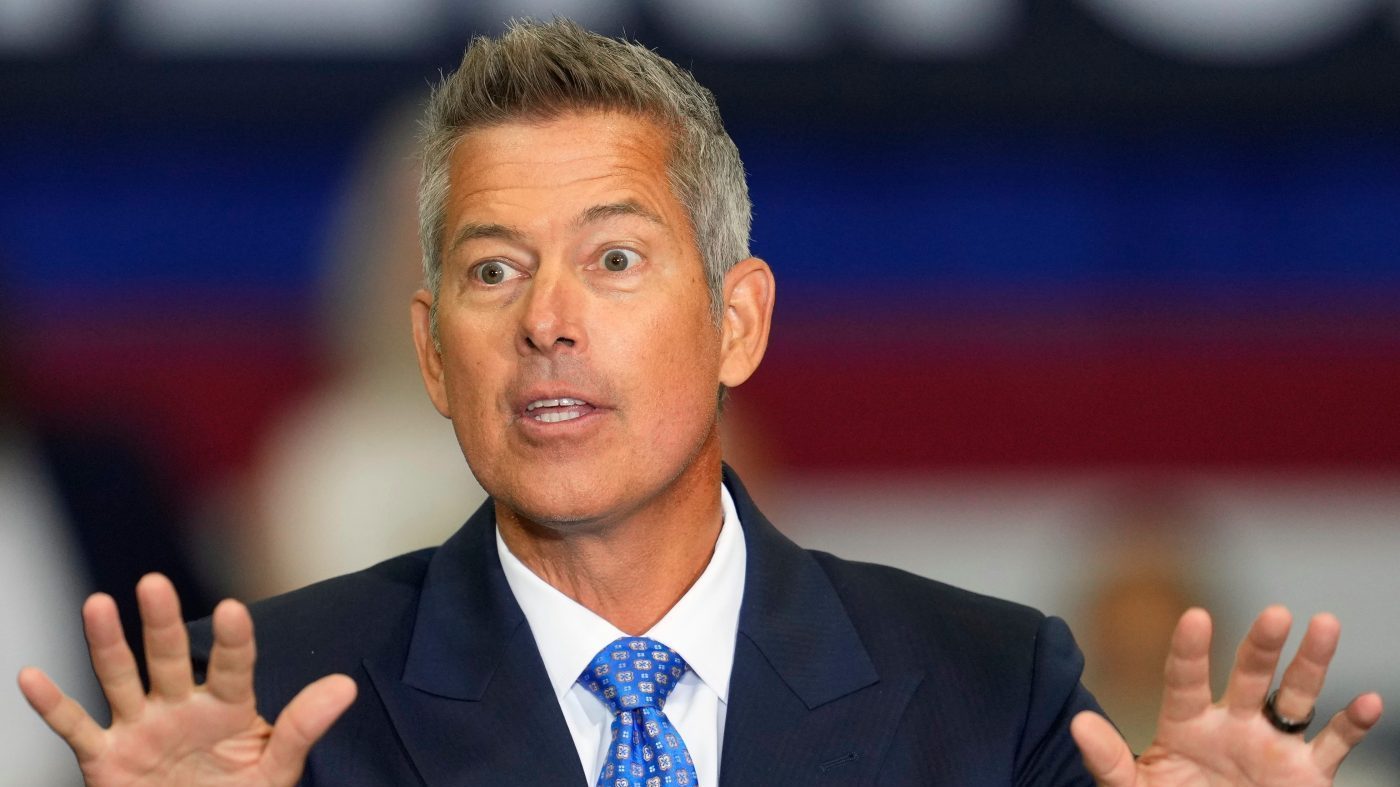
Transportation Secretary Sean Duffy on Monday unveiled a new artificial intelligence tool designed to help air traffic controllers manage congestion and reduce delays, while seeking to reassure the public that human oversight will remain central to U.S. aviation.
“It's always going to be a human that manages the airspace in America,” Duffy said at an event in Washington, responding to growing concerns about AI's role in critical infrastructure.

The program, called the Strategic Management of Airspace, Routes, and Trajectories (SMART), will use AI to analyze air travel patterns, airport capacity, and weather conditions. The initial rollout will cover Reagan Washington National (DCA), Dulles International (IAD), and Baltimore-Washington International (BWI) airports, according to the Department of Transportation.
“This tool won't manage the airspace, but it gives us better information, better data to manage the airspace on behalf of the American people,” Duffy added.
The announcement comes amid heightened scrutiny of AI safety. Several researchers from Anthropic have recently raised alarms about the potential for AI to become uncontrollable, with one warning that AI could pose an existential threat to humanity by the end of the decade. These warnings have prompted calls for policymakers and regulators to take the risks seriously, even though the exact dangers remain difficult to quantify or independently verify.
President Trump, however, has dismissed such concerns, labeling efforts to restrict AI development as part of a “SICK conspiracy.” In a social media post, he wrote: “AI taking over the World, destroying Humanity, and all other things bad, is a HOAX.”
Duffy framed the SMART program as evidence of American leadership in aviation technology. “It's going to help us provide a different experience for the American people,” he said. “I want to be clear again: This has not been deployed anywhere in the world; America was the first in flight.”
“We're the ones that helped the world set up air traffic control, and we are again leading the world in new technology to bring more efficiency and a better experience to the American people,” the secretary added.
The rollout at the three major Washington-area airports is expected to serve as a test case for broader deployment. Officials say the AI will provide controllers with enhanced predictive analytics, helping them anticipate bottlenecks and adjust routing more efficiently.
This initiative follows other federal efforts to integrate AI into transportation, though it also draws parallels to local debates over automation. For instance, the Minneapolis city council's push to keep human drivers in autonomous vehicles reflects similar concerns about removing humans from safety-critical roles. Meanwhile, union leaders in education have warned against AI overriding human judgment, underscoring the broader societal debate over the technology's limits.
As the SMART program begins operations, aviation experts will be watching closely to see whether it delivers on its promise of reducing delays without compromising safety. Duffy's assurances that humans remain in charge are likely to be tested as the system scales.