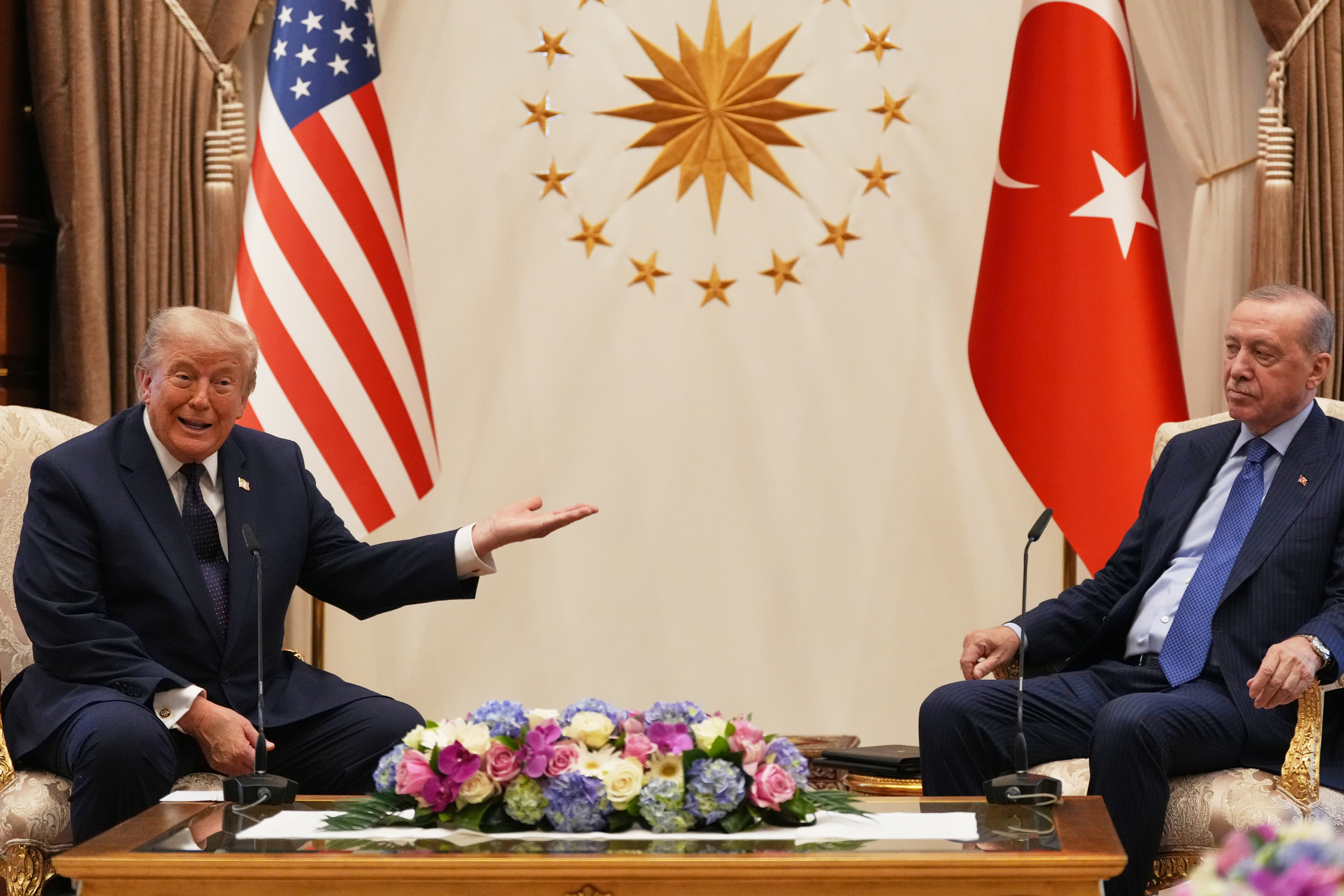
President Trump has long shown a soft spot for strongmen—leaders who centralize power, dominate institutions, and project themselves as the nation's embodiment. Few fit that mold better than Turkey's Recep Tayyip Erdogan. Yet Trump now wants to sell Ankara F-35 stealth fighters, a decision that would seriously damage American security.
Turkey was ejected from the F-35 program in 2019 after buying Russia's S-400 air defense system. The rationale was clear: integrating Russian radar systems compromises the F-35's stealth capabilities, which were crucial to U.S. and Israeli air superiority over Iran during recent operations. At the NATO conference this week, Trump said he would lift sanctions on Turkey and consider the sale. He must not.

The risk that Moscow could gain insight into NATO's most advanced aircraft is likely to spark congressional opposition. But there are deeper reasons to resist. Handing over these jets would reward one of the alliance's most successful authoritarians. Turkey still holds elections, but the foundations of democratic meaning have crumbled. Judges face pressure, journalists are jailed, academics dismissed, civil servants purged, generals prosecuted, and opposition figures harassed.
After the 2016 failed coup, Erdogan used emergency powers to push through constitutional changes that turned the presidency into his personal tool. The press has been subdued through state control, crony ownership, intimidation, and prosecution. Reporters Without Borders ranks Turkey 163rd out of 180 countries in its 2026 World Press Freedom Index. It is a mark of shame that a NATO member sits near the global bottom on press freedom. That alone should give Washington pause before handing Erdogan the U.S. military's most sophisticated fighter.
Erdogan has repeatedly strained the alliance he depends on. He bought the Russian S-400 despite warnings, delayed Nordic NATO enlargement, and created repeated crises with Greece and Cyprus, part of which Turkey occupies. His military operations in Syria have clashed with Western priorities. His backing of Azerbaijan in Nagorno-Karabakh helped trigger the flight of over 100,000 ethnic Armenians. He has flirted with Russia while still demanding NATO's benefits.
At its core, NATO was built as a community of democracies, not a club of transactional clients. Members share a commitment to constitutional government, the rule of law, civilian restraint, and collective security. That trust allows them to share intelligence, bases, integrated systems, and advanced weapons. When a member behaves like Erdogan's Turkey, the entire edifice erodes.
Turkey's posture toward Israel has made the rot even clearer. Foreign Minister Hakan Fidan recently called Israel "a burden humanity can no longer bear." Interior Minister Mustafa Ciftci expressed a desire to serve as "governor of Jerusalem," implying a Turkish claim. When Israel moved to recognize the Armenian Genocide, Turkey reacted with fury. These actions underscore a neo-Ottoman, Islamist-inflected drift.
Supporters of accommodating Turkey point to its geography: control of Black Sea access, proximity to the Middle East, key bases, and NATO's second-largest military. But that very strategic importance makes it more urgent to discourage Erdogan's authoritarian slide. The F-35 is a flying intelligence platform—a symbol of trust and core to American air superiority. Countries receive it because Washington trusts them to safeguard its technology. Turkey broke that trust when it bought the S-400.
The Turkish people deserve a democratic future. A free Turkey could again be a vital U.S. partner. But Erdogan's Turkey has moved in the opposite direction. America should not reward that trajectory. Trump's willingness to overlook all this is unsurprising—he has even seemed to want Russia to prevail in its war against Ukraine. That doesn't obligate Congress. Lawmakers should block any restoration of F-35 access. The stakes are too high.