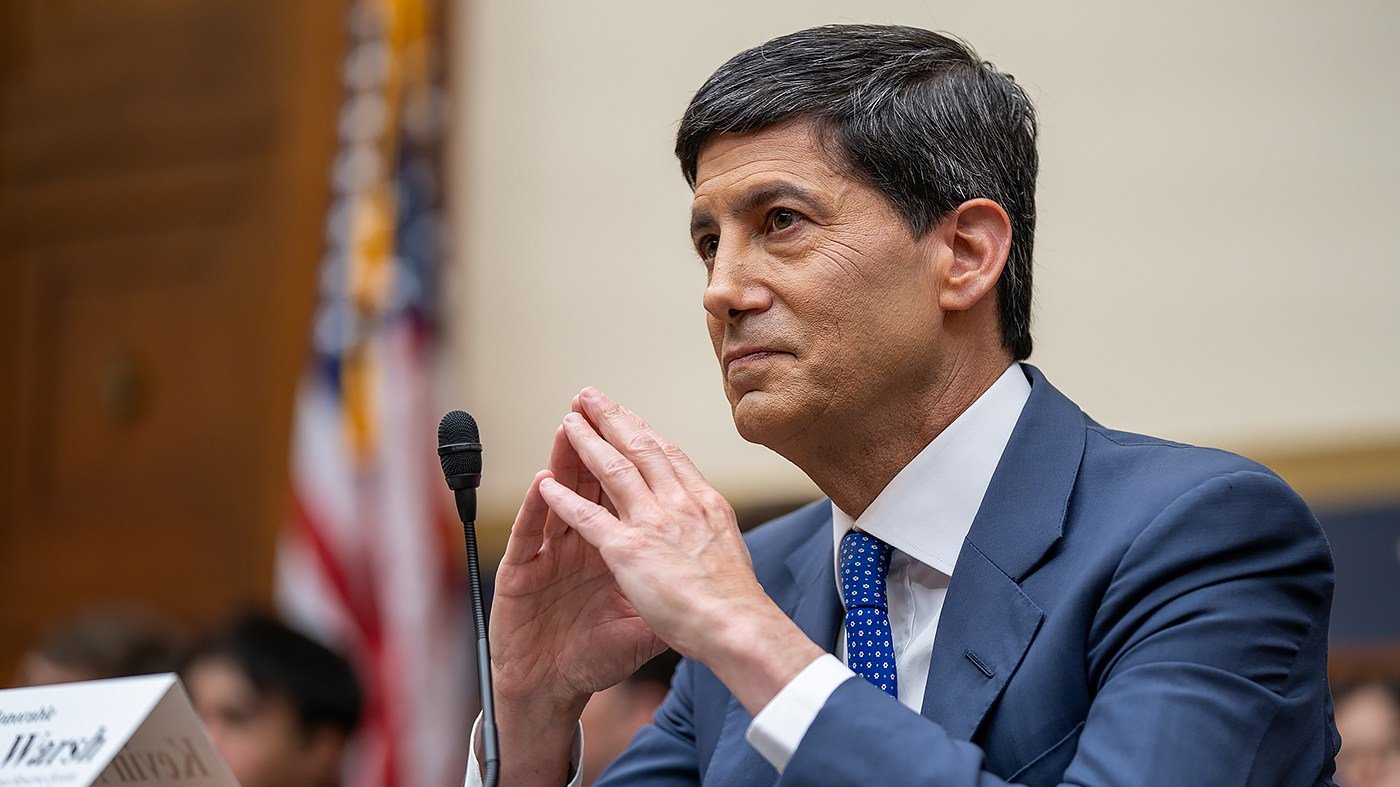
Federal Reserve Chair Kevin Warsh is navigating a politically charged environment as the central bank's September policy meeting gets underway, with market expectations for a rate hike colliding with President Trump's insistence on lower borrowing costs.
Warsh signaled in late August that he was open to tightening, stating the Fed had "work to do" if underlying inflation failed to move toward its 2 percent target. That comment, delivered at the annual Jackson Hole symposium, was widely read as a hawkish pivot.
Trump, who has repeatedly pushed for rate cuts, has grown more vocal in recent weeks. In a Truth Social post after August's stronger-than-expected jobs report, he wrote: "The Fed Board, with its great new leader, must get smart — BE PATRIOTS for a change." He also threatened to cut off trade with countries running deficits with the U.S. if the Federal Open Market Committee (FOMC) does not lower rates.
Inflation remains stubbornly above the Fed's target. The consumer price index (CPI) held steady at 3.4 percent annually in August, according to data released Friday. That report led a growing share of economists to expect a quarter-point hike. A Reuters survey found 85 percent of economists now predict such a move, up from about 70 percent before the CPI release.
Investors are similarly convinced. CME FedWatch data on Tuesday showed traders pricing in a nearly 93 percent chance of a quarter-point increase at the conclusion of the two-day meeting.
"A September Fed rate hike is almost locked in now," Heather Long, chief economist at Navy Federal Credit Union, wrote on X. "It's the right call. The risks are growing that inflation remains entrenched (or keeps broadening). Fed Chair Warsh doesn't want to make the same mistake [former Fed Chair Jerome] Powell did of waiting too long to hike."
Not everyone is convinced, however. Stephen Myrow, managing partner at Beacon Policy Advisors, argued the decision is "not as much of a fait accompli necessarily as the market sees it," adding that it is "more dependent on the politics than the actual data right now."
The Fed has held rates steady in a range of 3.5 percent to 3.75 percent for five consecutive meetings, the last two under Warsh's leadership. He voted for a hold at both.
Warsh has been explicit about the central bank's responsibility for inflation. At Jackson Hole, he said the "responsibility for 65 months of sustained, elevated inflation sits squarely with the central bank." Analysts viewed those remarks as "more hawkish than anticipated," according to Jerry Tempelman, vice president of economic and fixed income research at Mutual of America Capital Management. Tempelman added that Warsh "will be hard-pressed to explain the Fed's monetary policy stance if it does not raise short-term rates at this week's FOMC meeting."
Trump's focus on rate cuts is longstanding. He began feuding with Powell during his first term, roughly a year after nominating him. So far, Trump has avoided direct attacks on Warsh, though he has continued to press for lower rates. In June, when the Fed held rates steady, Trump said "Whatever," acknowledging the possibility of future hikes. "It could happen," he told reporters. "It's just hard to believe. It just keeps the country down. It's so unusual. But we have a very good guy over there now, so I'm guided by what he wants."
In recent weeks, Trump has intensified his pressure campaign. On Sunday, he said the U.S. "should be paying the lower interest rate in the world" regardless of the Fed's "formulas." Kevin Hassett, director of the National Economic Council, said Sunday that Trump "is not going to be super happy" if the Fed hikes, but he will respect Warsh's independence. Hassett also cautioned against a hike, noting that inflation momentum has cooled over the past three months and that raising rates less than two months before the midterms would be unwise.
Warsh may face a short-term credibility hit if he does not follow through on his hawkish signals, but the political dynamics remain fraught. The decision, expected Wednesday, will test his ability to balance economic data with presidential pressure.