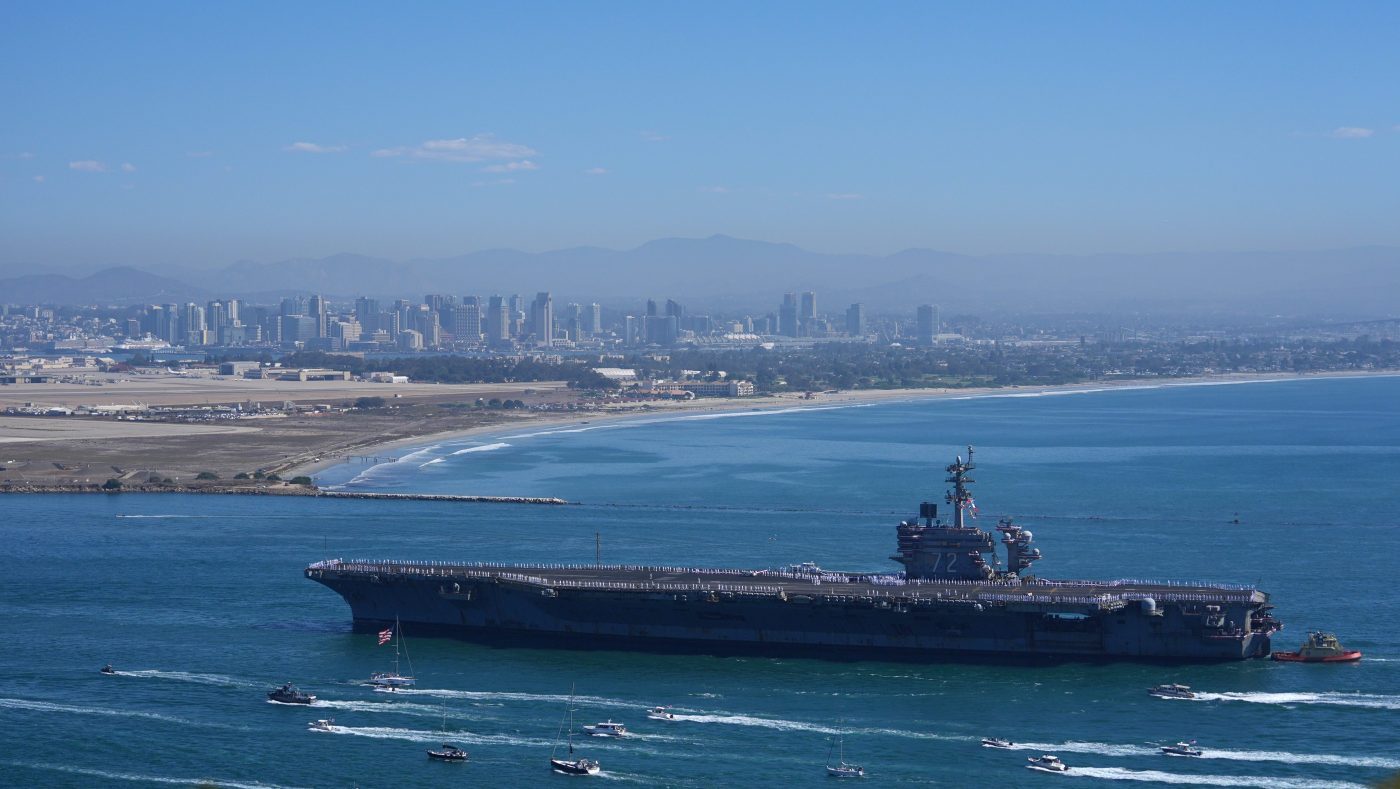
The Nimitz-class aircraft carrier USS Abraham Lincoln pulled into its homeport in San Diego on Thursday, ending a 322-day deployment to the Middle East that was extended beyond its original schedule as part of U.S. operations against Iran. The carrier, with roughly 5,000 sailors aboard, played a key role in enforcing a naval blockade in the Arabian Sea.
Defense Secretary Pete Hegseth addressed the crew on Wednesday, praising their performance in supporting strikes against Iranian forces and asserting that the carrier strike group "projected decisive combat power and established maritime advantage" to further President Trump's strategic goals. Hegseth presented the Presidential Unit Citation, the military's highest unit award, to the strike group in recognition of its actions.
According to Hegseth, the strike group conducted 3,693 combat sorties, delivered 1.37 million pounds of ordnance, launched 450 Tomahawk cruise missiles, shot down 77 Iranian one-way attack drones, sank 64 Iranian warships, destroyed 21 anti-ship cruise missiles, and repelled four fast-attack craft and dhows. "You have changed the arc of history, ensuring that crazy people, theocrats, never get a nuclear weapon," Hegseth told the sailors.
The extended deployment, which was initially expected to conclude this summer, took a toll on the crew. The ship went without a port call for 286 days before docking in Thailand last month. Reports emerged of food shortages, low morale, and mental health struggles among the crew. The logistical problems were compounded by an Iranian strike that devastated Naval Support Activity in Bahrain, the Navy's logistics hub for the region.
Hegseth dismissed media coverage of these difficulties, accusing the press of trying to "turn the USS Abraham Lincoln into some sort of a symbol of dysfunction or a symbol of low morale, or a symbol of a failed mission." He insisted that the crew's leadership and sailors he spoke with conveyed the opposite, and he framed the challenges as part of a demanding but successful mission.
Democratic lawmakers, including Rep. Mike Levin (D-Calif.), whose district includes parts of San Diego, praised the sailors as "heroes" but called on the Trump administration to answer for the conditions aboard the ship. "For months, Marines and Sailors sounded the alarm about conditions aboard the ship, inadequate support, and the mental health toll this deployment was taking on those serving onboard," Levin said. "Their families begged for help and were repeatedly ignored." He accused Hegseth of calling the reports "fake news" and called the response "a betrayal of the men and women who put everything on the line."
Acting Navy Secretary Hung Cao told Sen. Kirsten Gillibrand (D-N.Y.) that eight sailors assigned to the Lincoln strike group attempted suicide during the deployment. The revelation has intensified scrutiny of the Navy's handling of extended deployments and crew welfare.
For many sailors, the return means reuniting with loved ones for the first time in nearly a year. Brent Ledbetter, an air traffic control officer, told NBC News he was eager to see his infant son Nathan, who has started crawling. "I just want to hold him, play with him," he said. "He's crawling around now, so I'm excited to chase him around the house and give him all the love that has been kind of withheld for the last 10 months."
Hegseth, who earlier awarded the unit citation to the crew, also urged sailors to thank their families for their patience and support during the long separation, calling it part of "a righteous and historic mission." The carrier's return comes amid broader tensions with Iran, which have also led to criticism of Trump's comments about potential threats to California cities.