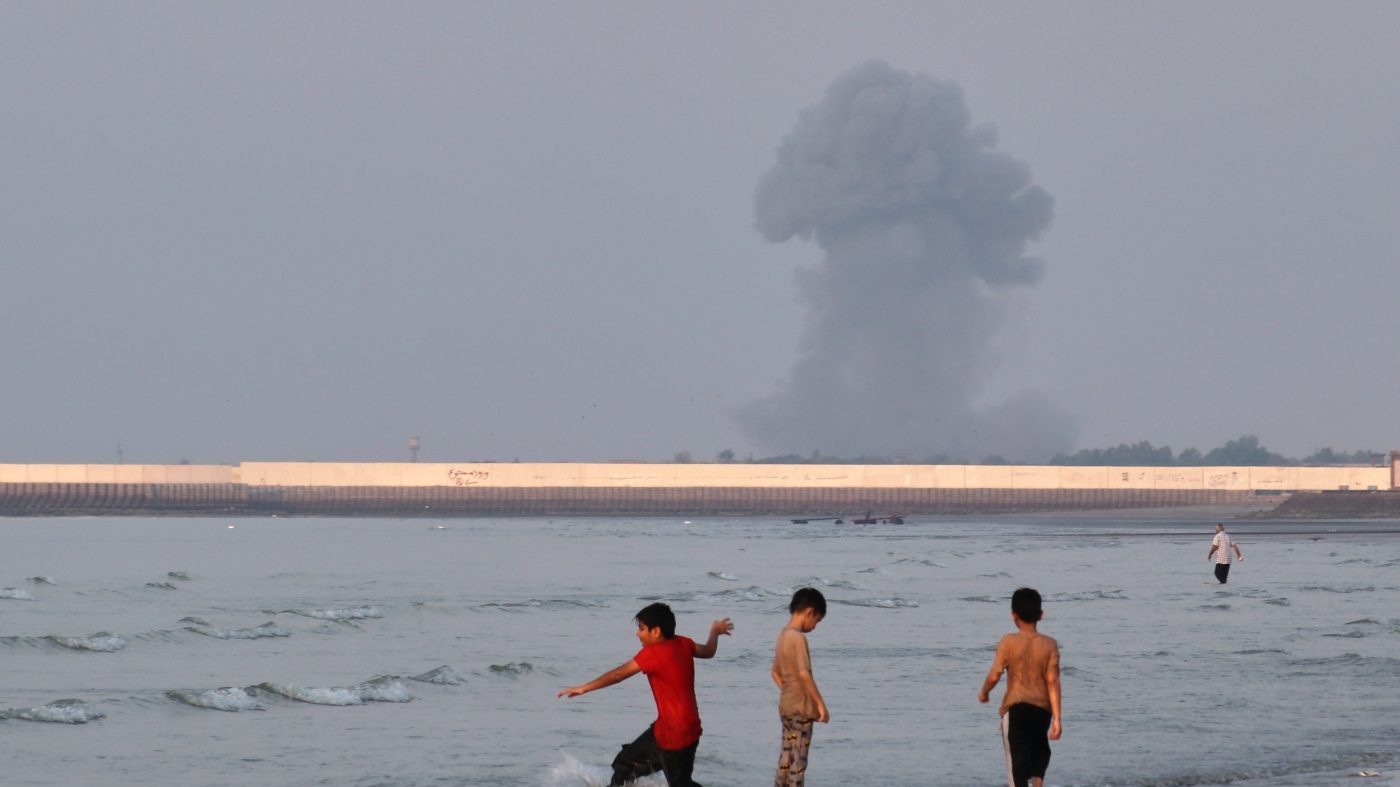
The United States resumed large-scale airstrikes against Iran early Thursday, pounding command centers, air defense installations, and coastal surveillance sites just hours after a fragile ceasefire fell apart. The operation, conducted by U.S. Central Command, began Wednesday evening and concluded at 9 p.m. Eastern Time—4:30 a.m. in Tehran—according to a Centcom statement.
U.S. forces used precision munitions to hit targets in Bandar Abbas, a strategic port city on the Strait of Hormuz, and on Greater Tunb Island in the eastern Persian Gulf. The strikes targeted Iranian missile and drone capabilities, as well as coastal defense systems, in what Centcom described as an effort to “further degrade Iran’s ability to threaten innocent mariners crewing commercial vessels transiting the Strait of Hormuz.”
The renewed offensive follows a pattern of tit-for-tat exchanges this month. President Trump informed Congress last week that hostilities with Tehran resumed on July 7, restarting the 60-day clock under the War Powers Act. That law allows the president to extend military action for 30 additional days if he provides justification to lawmakers. Trump has so far ruled out diplomatic talks, as reported earlier by The World Signal, while weighing a broader offensive.
Iranian state media, citing the Associated Press, reported U.S. strikes across six provinces: Hamedan, Hormozgan, Khuzestan, Lorestan, Markazi, and Sistan and Baluchistan. In response, Iran launched missile and drone attacks on Bahrain, Jordan, and Kuwait—all countries hosting U.S. military bases. These strikes are part of a broader Iranian campaign that has intensified since the U.S. and Israel began their joint military operations on February 28.
The human toll continues to rise. Iranian health official Hossein Kermanpoir told Middle East Eye that U.S. strikes this month have killed at least 35 people and wounded another 300. On the American side, the Navy confirmed the death of Cmdr. Gabriel Edwards, the commanding officer of Helicopter Sea Combat Squadron 5, who was lost over the Arabian Sea last week. His death brings the U.S. military death toll in the conflict to 14.
The escalation comes as the U.S. Navy reimposed a blockade of the Strait of Hormuz earlier this week, further tightening pressure on Iran’s economy and military logistics. Centcom has now conducted multiple waves of strikes, including a fourth wave that pounded dozens of Iranian military sites near the strategic waterway. The administration is also weighing a broader offensive, with some Senate Democrats pressing the Pentagon to release a probe into a school strike by July 20.
Meanwhile, Trump hosted the Iraqi prime minister amid the escalating strikes, signaling an effort to manage regional fallout. The president has also granted a license for Patriot missile production, a move that could bolster allies but also raises questions about the scope of U.S. military commitments.