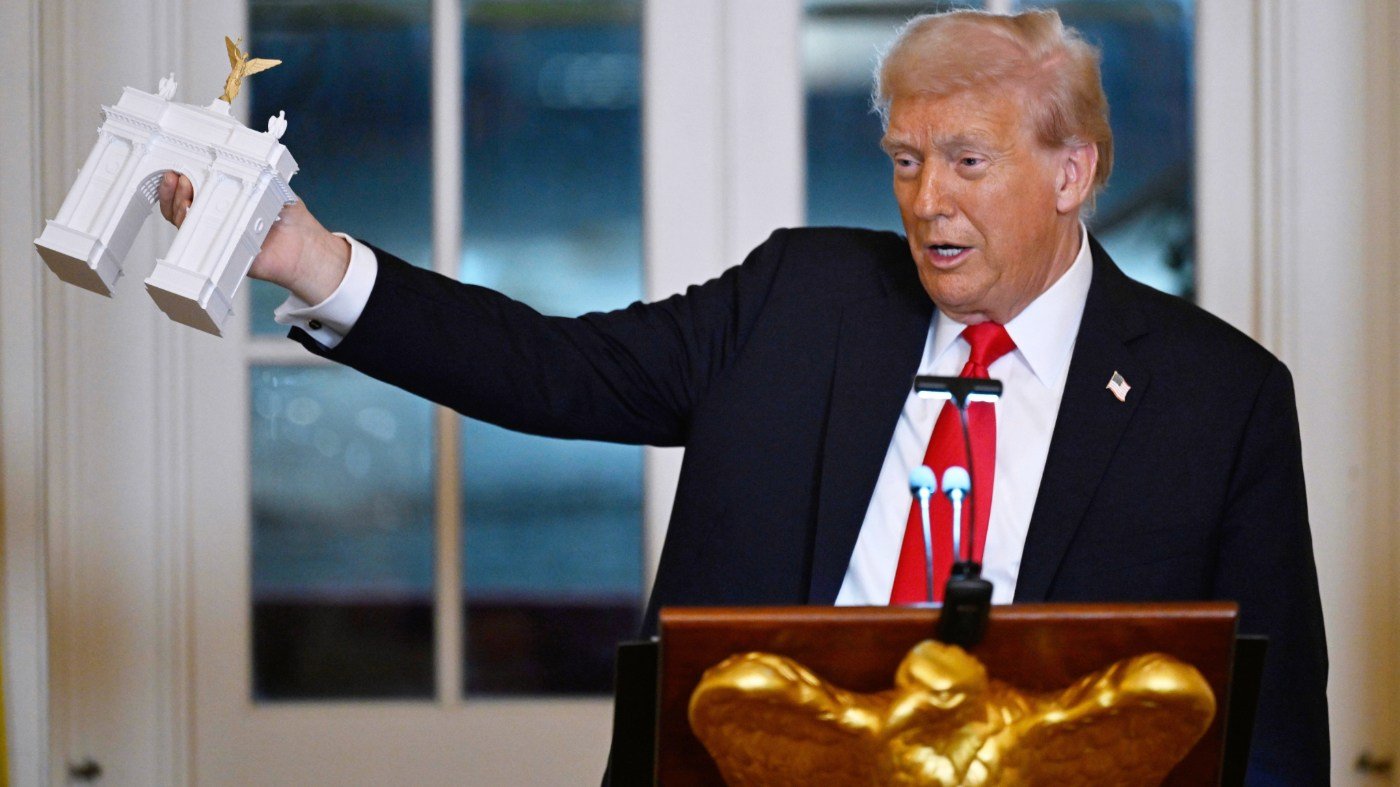
A federal judge in Washington has extended the freeze on construction of President Trump's proposed 250-foot Triumphal Arch, a project critics have derided as the "Arc de Trump." U.S. District Judge Tanya Chutkan ruled last week that work must remain halted for another 14 days while she considers arguments from local officials who contend the massive structure would harm the surrounding community.
The legal setback comes as Trump returns from a 90-minute summit in Shenzhen with Russian President Vladimir Putin and Chinese leader Xi Jinping, a meeting that yielded little in the way of concrete achievements. The joint statement issued afterward was heavy on generalities, with the three leaders agreeing only to "increase the production and supply of refined petroleum" — a possible signal that Washington might ease some energy sanctions on Moscow — and to begin a dialogue on nuclear arms reductions. No progress was made on Iran, which loomed as an unspoken concern, or on Taiwan.
Xi emerged as the clear victor of the summit, both substantively and visually. Photographs of the three leaders showed Xi at the center, with Trump and Putin flanking him like satellites. Ukrainian President Volodymyr Zelensky called the meeting "Yalta 2.0," evoking the 1945 conference where the Allied powers divided Eastern Europe and set the stage for decades of Soviet domination. The subtext was unmistakable: those not at the table risk being on the menu.
The choice of Shenzhen was also symbolically loaded. Half a century ago, Xi's father, Xi Zhongxun, was appointed to oversee Guangdong province, which included what was then the poor county of Bao'an. Xi Zhongxun's encouragement of foreign investment helped transform the area into a tech powerhouse, a point not lost on observers as Xi welcomed a weakened Trump to the city his father helped build. As one former lawyer noted, "It is always better if they come to you."
Back in Washington, the arch remains mired in controversy. Architectural critics have savaged the design, with expert Paul Goldberger calling it "over-the-top gaudiness" and "super-size Las Vegas vulgarity." The proposed location, Memorial Circle near Arlington National Cemetery, has drawn fierce opposition, including from three Vietnam War veterans, a historical preservationist, the District of Columbia, and Virginia. The Kennedy family has also sought to intervene, arguing the arch would desecrate JFK's gravesite.
The White House insists the project is a legitimate addition to the capital's skyline, pointing to a 1925 congressional authorization for two 166-foot columns at the site. But as critics note, two columns do not make a 250-foot arch. The case is expected to climb to the Supreme Court, which previously allowed Trump's ballroom renovation to proceed in a 5-4 ruling.
Public opinion is sharply against the arch, with polls showing 57% opposition and only 22% support. Protesters have regularly demonstrated at the site, and Trump has dismissed them as "paid protesters," claiming the project is "popular with the real people." He did not specify who those "real people" are, a curious omission for a president who has famously paid people to stand behind him at events.
The arch's fate now rests with Judge Chutkan, who initially halted construction in November just as work was poised to begin. Meanwhile, Trump's broader agenda faces headwinds, from the stalled Shenzhen talks to ongoing legal battles, including his effort to move his hush money case. The president's recent golf course takeover in East Potomac has also stalled, and his healthcare overtures to Democrats remain tentative. For a president who once promised to make America great, the triumphs have been few and far between.