President Trump's surprise move to tie normalization of relations with Israel to ongoing Iran peace talks has hit a wall of resistance across the Middle East, revealing the limits of his ambitious diplomatic agenda.
Pakistan, which has been acting as a mediator between Washington and Tehran, flatly dismissed the notion of joining the Abraham Accords. Other regional players have remained conspicuously quiet, leaving the administration scrambling for traction.
Experts describe the demand as puzzling and unrealistic given the current geopolitical climate. David Schenker, a senior fellow at the Washington Institute for Near East Policy and a former assistant secretary of State under Trump, noted that the administration's grand vision for regional transformation has fallen short. “This ambitious transformational agenda has fallen short. The president is looking to make lemonade out of lemons,” he said.
Pressure from Israel and Hawks
Trump is under significant pressure from Israel and his conservative base to secure a deal that goes beyond the 2015 Joint Comprehensive Plan of Action. Critics of the Obama-era deal argue it failed to address Iran's ballistic missile program, support for proxy militias, and global terrorist activities. Expanding the Abraham Accords could theoretically counter Iran's influence by fostering normalization between Israel and its regional rivals.
The president first floated the idea during a phone call with leaders from Saudi Arabia, the United Arab Emirates, Qatar, Turkey, Pakistan, Egypt, Jordan, and Bahrain. According to Axios, the initial response was dead silence, prompting Trump to ask if the leaders were still on the line.
Sen. Lindsey Graham (R-S.C.) hailed the move as “brilliant,” writing on X that “failure is not an option.” Rep. Abe Hamadeh (R-Ariz.) went further, publishing an op-ed in The Jerusalem Post calling for the accords to evolve into a full-fledged alliance against Iran. “Imagine an integrated regional air defense system connecting Israel and Gulf allies against Iranian missiles and drones,” he wrote, envisioning joint investments in AI, semiconductors, and defense systems.
Regional Rejection and Divisions
But for Pakistan and Qatar, normalization with Israel remains a nonstarter. Pakistani Defense Minister Khawaja Asif told local media that joining the accords clashes “with our fundamental ideologies,” adding that no such request had been made. Qatar's hostility toward Prime Minister Benjamin Netanyahu, who has labeled the country a terrorist state and authorized attacks on Hamas officials in Doha, further complicates matters. Yaakov Amidror, a retired IDF major general and former national security adviser to Netanyahu, called Qatar “an enemy of Israel” that “should not be legitimized.”
Deep-seated rivalry between Saudi Arabia and the UAE also poses a major hurdle. Schenker explained that “the Saudis will need to get more for normalization with Israel for the Palestinians than the Emirates got.” Saudi Crown Prince Mohammed bin Salman has long insisted on a credible pathway to a Palestinian state as a prerequisite for any deal with Israel.
Stephen Rademaker, a senior adviser at the Jewish Institute for National Security of America, admitted he was “frankly confused” by the linkage. “It’s fundamentally a bilateral negotiation between the United States and Iran. Why other countries in the region would feel that they needed to join the Abraham Accords as a result of a bilateral U.S.-Iran deal — It would be nice if they did,” he said.
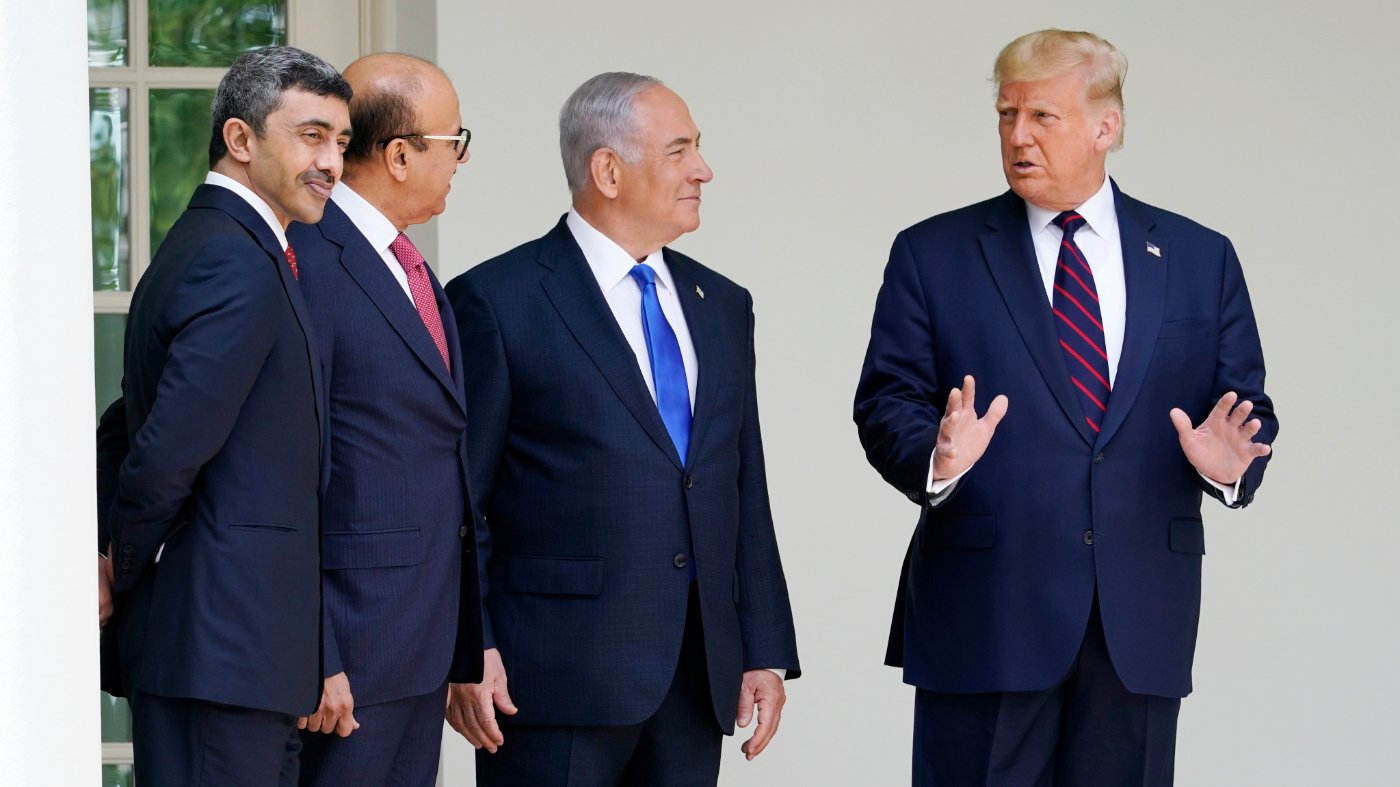
Trump has touted the 2020 accords as a historic achievement, normalizing ties between Israel and the UAE and Bahrain. The agreement was originally designed to block Netanyahu's plan to annex the West Bank in exchange for diplomatic relations with Dubai. Both the Trump and Biden administrations sought to expand it to include Saudi Arabia, a move that would end Israel's regional isolation and strengthen the anti-Iran coalition.
But Hamas's Oct. 7, 2023 attack on Israel and the subsequent war in Gaza have upended those ambitions. The conflict has deepened animosities and made normalization far more difficult. As Trump pushes ahead, the gap between his aspirations and regional realities grows ever wider.