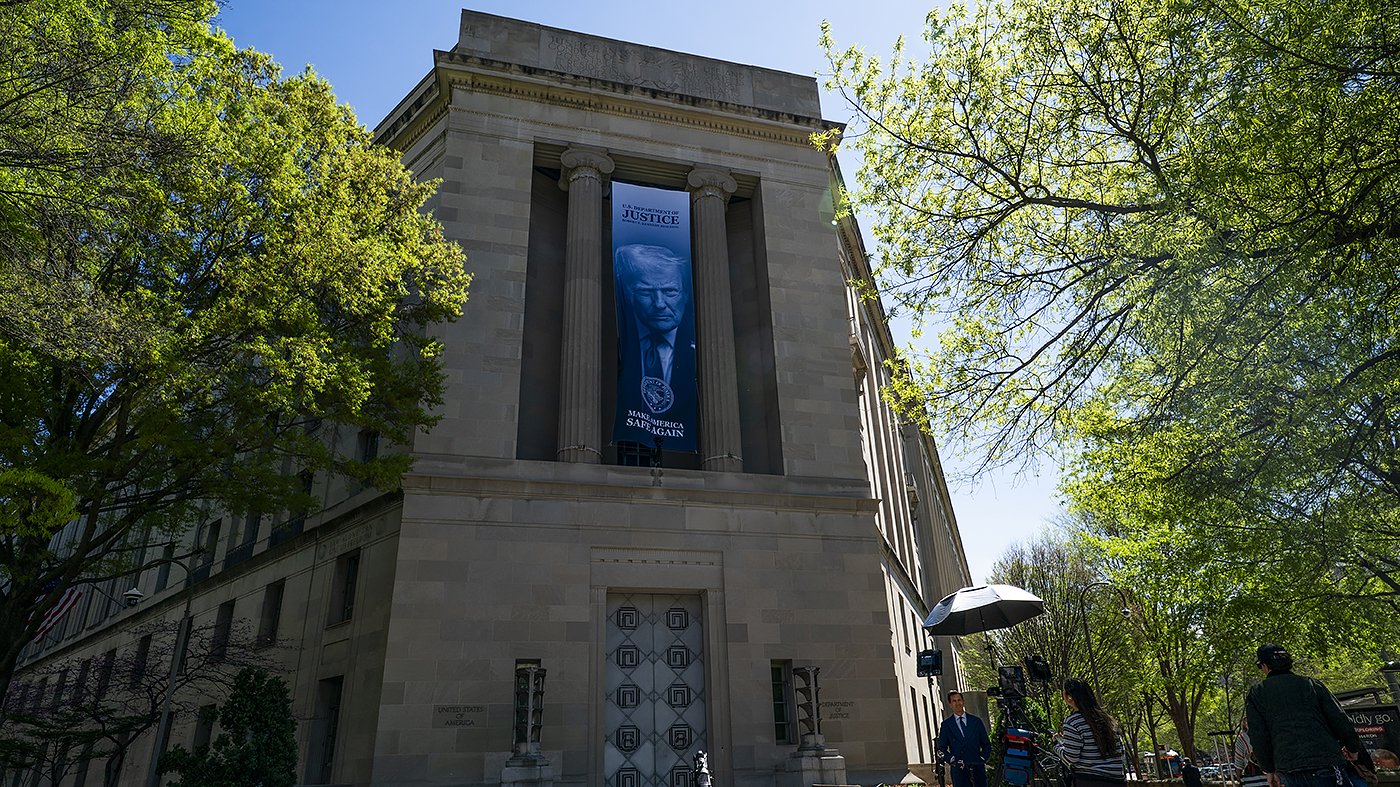
The Trump administration's nearly $1.8 billion Anti-Weaponization Fund, designed to compensate individuals who claim they were targeted by a politicized Justice Department, is facing its first legal challenge and growing backlash from within the Republican Party.
Two police officers who defended the U.S. Capitol on January 6, 2021—former U.S. Capitol Police officer Harry Dunn and Metropolitan Police officer Daniel Hodges—filed a lawsuit to block the fund, calling it a "slush fund" and "the most brazen act of presidential corruption this century." The suit argues the fund would effectively "finance the insurrectionists and paramilitary groups that commit violence" in Trump's name, as it could compensate individuals convicted for their roles in the Capitol attack. Trump pardoned over 1,600 people charged with Jan. 6-related crimes last year; more than 140 officers were injured during the riot.
The fund was created as part of a negotiated settlement between Trump and the Internal Revenue Service. Trump agreed to drop his $10 billion lawsuit over the leak of his tax returns, and in exchange, the IRS permanently barred itself from auditing his old returns. The settlement established the Anti-Weaponization Fund to distribute money to those alleging political persecution by the Justice Department.
Acting Attorney General Todd Blanche told lawmakers Tuesday there would be "no partisan requirement" to file a claim but declined to rule out eligibility for campaign donors or members of the Oath Keepers, the far-right group whose leaders were convicted of seditious conspiracy. "That's not for me to set, that's for the commissioners," Blanche said. "Whether an individual, an Oath Keeper, applies for compensation—anybody in this country can apply."
Democrats have seized on the fund as a symbol of corruption. Rep. Jamie Raskin (D-Md.) introduced legislation to block it, calling it an attempt to "commandeer nearly $1.8 billion in taxpayer funds to bankroll a slush fund for January 6 cop-beaters and aggrieved MAGA foot soldiers." Vice President Vance defended the fund, arguing it has been "misrepresented" and is meant to compensate "Americans for lawfare that we saw under the last administration." He said Trump and his family would not benefit, but like Blanche, he did not rule out payments to Jan. 6 defendants, saying cases would be reviewed on a "case by case basis." "We're not trying to give money to anybody who attacked a police officer," Vance said. "We're trying to compensate people where the book was thrown at them, they were mistreated by the legal system."
Trump himself has offered conflicting remarks, telling reporters he knows "very little about it" while simultaneously defending it as reimbursement for those "horribly treated." However, in a March 2025 Newsmax interview, he floated the idea of compensation for Jan. 6 participants, noting that "a lot of people in government really like that group of people."
The fund has drawn criticism not only from Democrats and watchdog groups like Citizens for Responsibility and Ethics, whose president Donald Sherman called it "one of the single most corrupt acts in American history," but also from some Republicans. Rep. Brian Fitzpatrick (R-Pa.) said, "We're going to try to kill it," and Senate Majority Leader John Thune (R-S.D.) told reporters he was "not a big fan" of the fund. Republican strategist Ford O'Connell argued the focus on Jan. 6 misses the point, noting that many potential claimants have nothing to do with the Capitol attack and were instead targeted by the Obama and Biden administrations.
The first person to file a claim under the fund is Michael Caputo, a longtime Trump ally who served as a Health and Human Services spokesman. He is seeking $2.7 million in restitution, alleging he was targeted by the Biden administration over the "illegal Crossfire Hurricane investigation"—the FBI probe into ties between Trump's 2016 campaign and Russia—and another investigation. Caputo's claim underscores the fund's potential to become a vehicle for Trump allies to seek compensation for perceived political persecution.