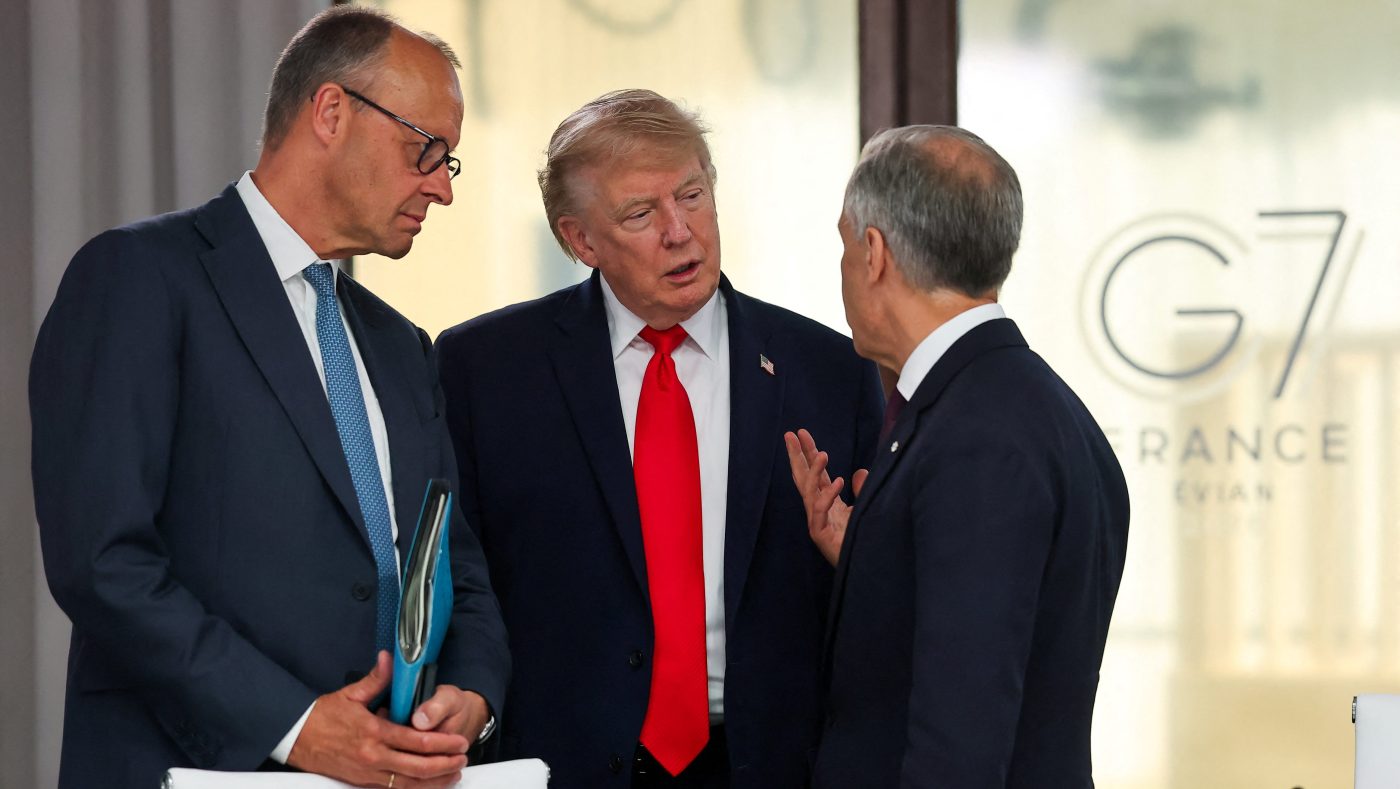
President Donald Trump told reporters Tuesday he would submit the agreement ending hostilities with Iran and opening nuclear talks to Congress for ratification, a move that would trigger a 30-day review under the 2015 Iran Nuclear Agreement Review Act. Speaking alongside United Arab Emirates President Sheikh Mohamed bin Zayed Al Nahyan, Trump said he “wouldn’t mind” sending the deal to Capitol Hill, though he immediately undercut the gesture by taunting Democrats.
“I wouldn’t mind,” Trump said. “I mean, you know, the Democrats – we call them Dumocrats because they’re dumb people. The Democrats are…Well what I’d like to do is send it to Congress, saying you shouldn’t approve it, and I’ll get it approved, whatever they, whatever I say, they want to do the opposite. It’s not working too well for them, by the way.”

The president added he had “never even thought about” submitting the agreement to Congress until the reporter’s question, but now “I like the idea.” The deal, signed by Trump and Vice President Vance on Sunday, remains classified, fueling speculation and criticism even as markets rallied Monday.
Senior administration officials said no funds would be released to Iran without verifiable commitments, but reports suggest the memorandum of understanding includes a $300 billion economic rehabilitation plan. Trump has insisted U.S. taxpayers won’t foot that bill. The ambiguity has left even loyal Republican senators demanding details. Trump has denied the existence of a $300 billion fund, adding to the confusion.
Sen. Lindsey Graham (R-S.C.), a staunch Trump ally who backed the president’s Operation Epic Fury, said he wants to see the full text. “The MOU, I want to see it myself. The way Iran describes it is awful. The way we describe it makes sense to me. Let’s look at it and see what it actually is,” Graham said, echoing calls from other GOP senators for congressional oversight.
The 2015 Iran Nuclear Agreement Review Act mandates that any nuclear deal with Tehran be submitted to Congress within five days, triggering a 30-day period for lawmakers to pass a resolution of disapproval. Trump pulled the U.S. out of the Obama-era accord in 2018, but his new approach could face similar legislative hurdles. The deal’s durability is also tested by ongoing Israeli strikes on Hezbollah in Lebanon, a key Iranian proxy.
The secretive nature of the agreement has drawn fire from both sides of the aisle. Critics warn that without transparency, the administration risks repeating the mistakes of the 2015 deal, which many Republicans argued gave Tehran too much relief without enough oversight. Proponents, however, see it as a chance to de-escalate tensions in the Middle East after months of heightened conflict.
As the White House weighs its next steps, the political calculus remains uncertain. Trump’s taunts about Democrats may complicate any bipartisan push for approval, while his own base demands a hard line on Iran. The coming weeks will test whether the president can navigate these crosscurrents and secure a legacy-defining accord.