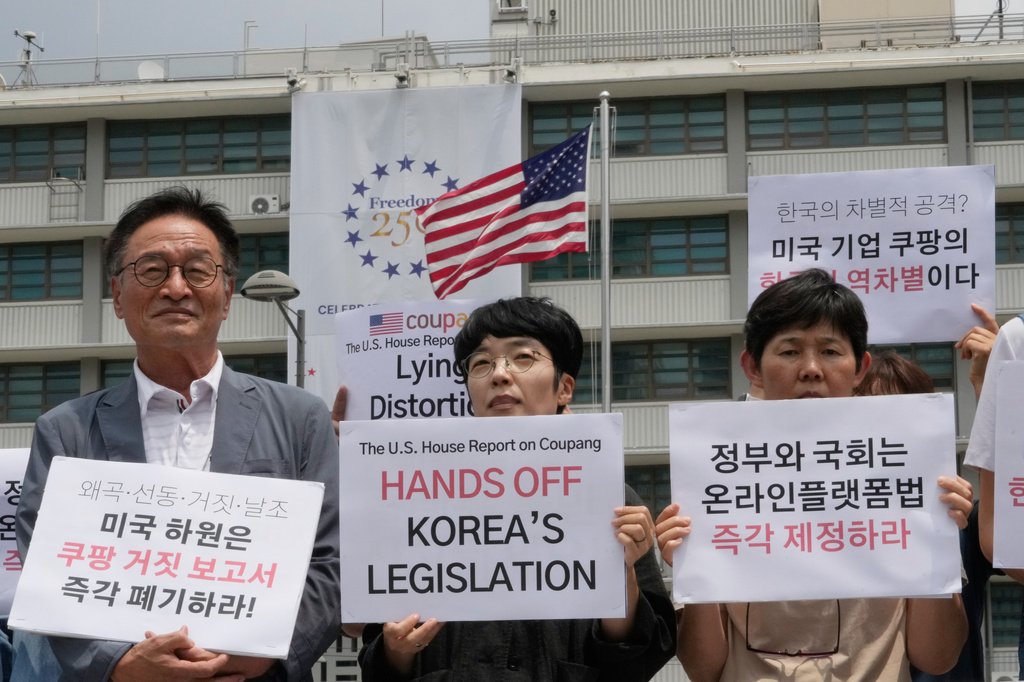
The U.S.-South Korea alliance celebrated two milestones this month: America's 250th birthday, marked by South Korean landmarks glowing in red, white, and blue, and the enduring partnership that has underpinned Indo-Pacific security for over seven decades. Yet days later, a House Judiciary Committee report cast a shadow over that bond, questioning whether Seoul is honoring the rule-of-law principles that have long defined the relationship.
Ceremonial gestures are easy; real alliances are measured by how governments treat each other's citizens and businesses. On that front, South Korea's recent handling of Coupang—a Fortune 150 American tech firm with major operations in Korea and across Asia—raises serious concerns. Having spent years on the House Intelligence Committee and the House China Task Force studying how authoritarian regimes weaponize state power against U.S. companies, I never expected to see an ally adopt such familiar tactics.
The facts are straightforward. Late last year, a former Coupang employee improperly accessed basic user data—names and addresses, akin to a phonebook—for customers in South Korea and Taiwan. He downloaded roughly 3,000 records, which were quickly recovered. No data was sold or misused, and no consumer suffered harm. Taiwan treated it as a routine regulatory matter. Seoul, however, unleashed an all-out government assault.
Police raided Coupang repeatedly; a dozen regulatory agencies launched investigations, most unrelated to data security. The company's American founder was branded a “devil.” Lawmakers summoned its acting CEO—also a U.S. citizen—for theatrical hearings, denying him American counsel, shouting epithets, ordering interpreters to distort his answers, accusing him of perjury for truthful testimony, and threatening travel bans, criminal charges, and jail time. Officials pressured Korea's national pension fund to dump Coupang stock, lawmakers urged the public to switch to domestic competitors, and the prime minister called for regulators to pursue the company “with the same determination used to wipe out mafias.” The result: a $409 million fine—the largest privacy penalty in Korean history, more than four times the next-highest fine on a Korean firm that exposed far more sensitive data.
This is precisely the conduct I warned American companies about when the country was China, Russia, or Iran. South Korea should not belong on that list. The House Judiciary Committee's investigation, now published as a formal report, details this pattern of discrimination. The economic stakes are significant given the scale of U.S.-ROK trade, but the strategic implications are broader.
State-directed pressure campaigns against American companies are what the U.S. intelligence community expects from adversarial systems. Such actions are flatly inconsistent with the alliance's foundational principles. If political actors can mobilize regulators, prosecutors, lawmakers, and even the national pension fund against an American company over a routine data incident, what message does that send to other allies and partners? And what does it tell Beijing?
The Chinese Communist Party has long promoted the idea that American companies are political instruments, not commercial actors. When allied governments embrace similar tactics, they validate Beijing's model. Every time an ally treats a U.S. firm as a political villain, Beijing notches a win. Every time a friendly government weaponizes regulatory power, Beijing's argument against the rules-based economic order gains credibility.
The lack of reciprocity should trouble every American. Korean firms in the U.S.—Samsung, Hyundai, LG, SK, and others—enjoy due process, transparent regulation, and predictable enforcement. Their executives aren't subjected to political spectacles. If South Korea expects fair treatment for its companies, it must extend the same standard to American businesses. Washington isn't a passive observer; the House Judiciary Committee's findings give Congress reason to act. The Trump administration has raised concerns, and some Democrats, like Sen. Maria Cantwell (D-Wash.), have also voiced alarm. The question is whether Seoul will heed the warning before it undermines a 70-year alliance.
For more on how political dynamics are shaping policy, see Democrats' approach to cost control and public opinion on Iran conflict.