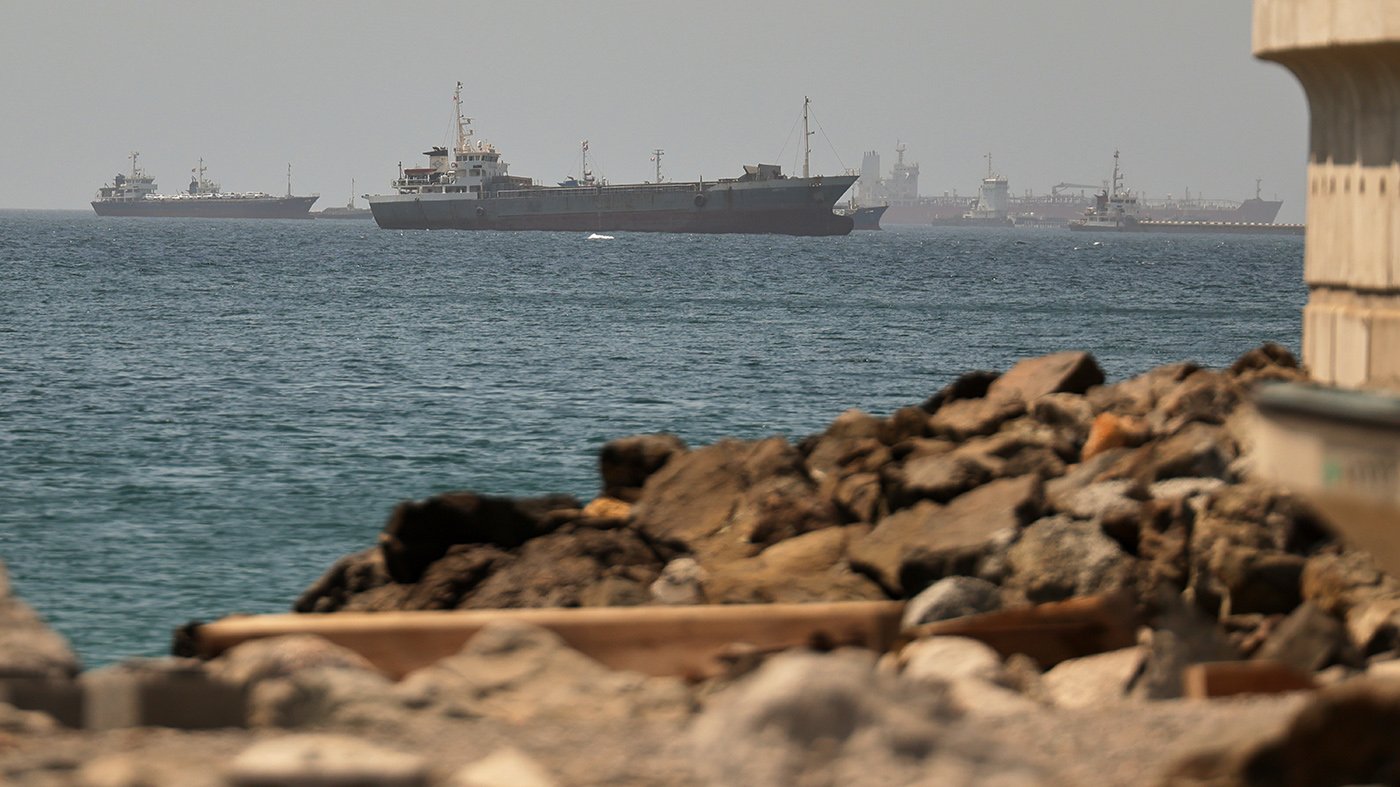
The Trump administration's plan to quickly restore shipping traffic through the Strait of Hormuz under a new agreement faces a significant obstacle: thousands of Iranian mines scattered across the waterway. President Trump acknowledged Monday that U.S. forces are already "doing a little hunting for a couple of mines," but experts warn the operation could take months and deter shipping companies until the area is proven safe.
Iran possessed an estimated 5,000 mines before the conflict began in late February, and U.S. officials believe Tehran deployed dozens in and around the strait during the early weeks of the war. The mines range from floating contact bombs to sophisticated seafloor weapons triggered by sensors, making detection and clearance a complex and dangerous task.

“They’re an unknown, they’re hard to find, and they create a sense of fear that other weapons don’t,” said Steven Wills, a naval analyst at the Center for Maritime Strategy. “They can just come out of nowhere if they’ve been laid in the right place at the right time.” Wills estimated that anywhere from dozens to 200 mines could be present, though he personally leans toward the lower end, given that Iranian Revolutionary Guard Corps boats can only carry one or two mines each.
Bryan Clark, a naval operations expert at the Hudson Institute, agreed that Iran likely laid “maybe a few dozen mines,” mostly at the conflict’s outset before U.S. forces began targeting mine-laying vessels. “Even a few mines can create the perception of a minefield,” Clark said, noting that the psychological deterrent is enough to keep shipping companies away. He predicted it would take one to two weeks just to locate the mines, followed by a couple of months of clearance work.
The mine-laying activity prompted a swift U.S. response. Defense Secretary Pete Hegseth declared on March 10 that Trump had ordered American forces to eliminate inactive mine-laying vessels in the waterway, “wiping them out with ruthless precision.” U.S. Central Command later reported attacking 16 Iranian mine-laying boats, but it remains unclear whether those strikes fully neutralized Tehran’s capability to deploy additional mines.
Now, with a deal to reopen the strait set to be signed by Washington and Tehran on Friday, the Navy may soon begin sweeping the waterway. Wills described the first step as mine hunting—using ships, helicopters, or unmanned vehicles to map a safe route, akin to “walking across your yard and pulling the weeds in front of you.” The more thorough process of mine sweeping, which involves detonating magnetic and acoustic mines with electromagnetic energy or physical cables, is typically done after a conflict and can take months.
The timeline echoes past operations. After the 1991 Gulf War, it took U.S. and allied forces nearly seven months to clear hundreds of mines laid by Saddam Hussein around Kuwait City. Even with modern technology, Iran’s diverse arsenal—from World War I-era contact mines to modern bottom mines that resemble rocks—complicates the effort. “You drop them on the bottom, they look like a rock or a piece of debris, so you have to hunt carefully,” Wills said.
The delay could have major economic consequences. The Strait of Hormuz normally carries tens of millions of barrels of oil daily, and shipping companies, insurers, and oil traders are unlikely to resume transit until they are convinced the waterway is safe. A related analysis on how the deal might ease gas prices notes that even after clearance, pre-war price levels remain distant. Meanwhile, the G7 has endorsed the ceasefire, but the mine threat could undercut the diplomatic momentum.
“It serves its purpose, even at that kind of scale,” Clark said of the minefield’s deterrent effect. Until the Navy can guarantee a clear path, the strait’s reopening—and the broader economic relief it promises—remains uncertain.