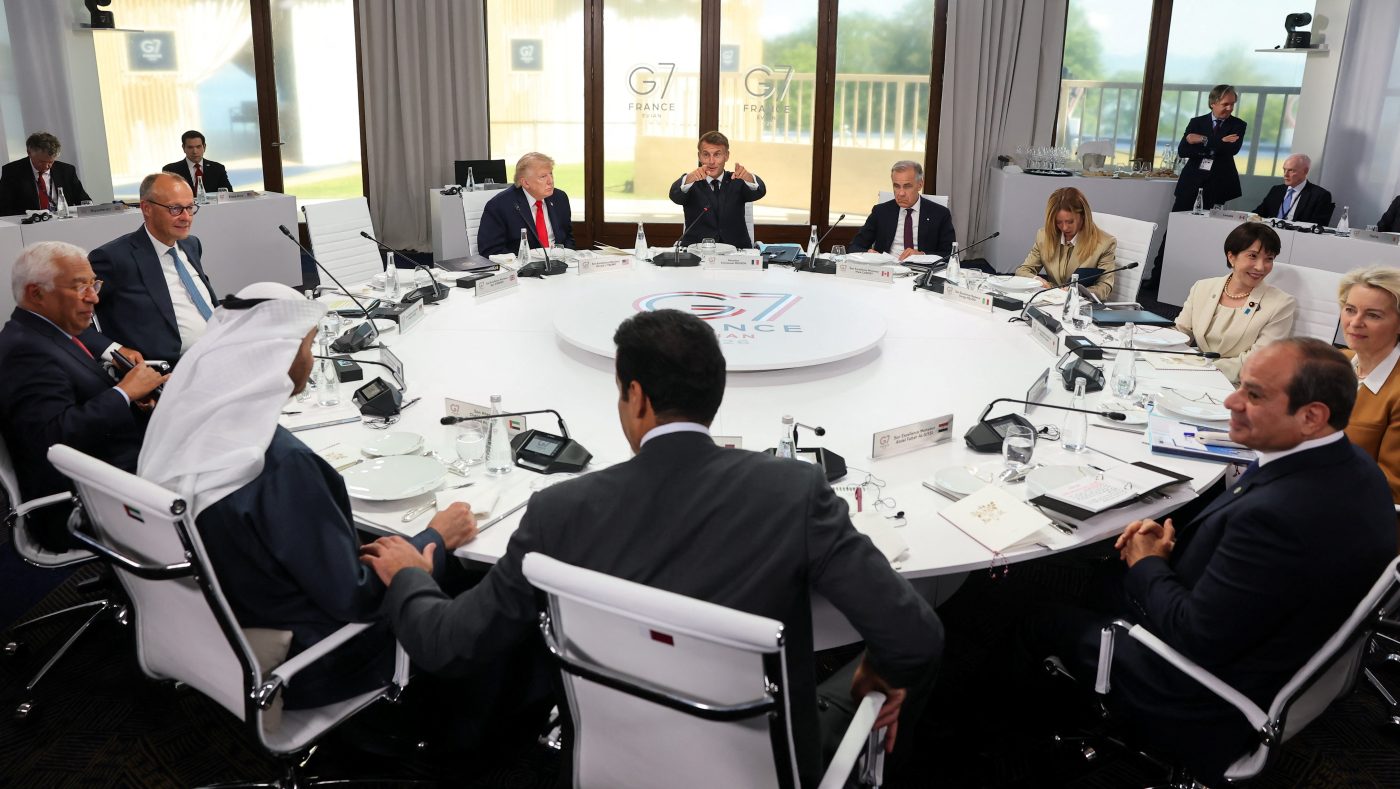
The Group of Seven (G7) concluded its summit in France this week with a unified declaration backing President Trump’s preliminary agreement to end hostilities with Iran. The joint statement, issued Wednesday, underscores the alliance’s support for a deal that includes a 60-day ceasefire and plans to reopen the strategic Strait of Hormuz—a critical oil transit route that has been effectively shut down amid the conflict and a U.S. naval blockade.
In their communiqué, the leaders of France, Germany, Canada, the United Kingdom, Japan, the United States, and Italy explicitly praised Washington’s role in securing the memorandum of understanding with Tehran. “We welcome the announcement of a deal between the United States and Iran, secured under the strong leadership of President Trump, with the support of mediating countries,” the statement read. The G7 described the accord as “an historic opportunity to prevent Iran from acquiring any nuclear weapon and tackling the threats related to its regional and ballistic activities.”
Canadian Prime Minister Mark Carney, speaking to CNN after a bilateral meeting with Trump on Tuesday, confirmed the ceasefire’s duration and the plan to reopen the Strait of Hormuz. Carney noted that the framework “sets the groundwork for a solution in Lebanon,” where Israel has been exchanging fire with the Iran-backed militant group Hezbollah. The G7 leaders also voiced support for a separate ceasefire in Lebanon, linking the broader regional stability to the Iran deal.
France and the United Kingdom are expected to take the lead on restoring safe passage through the waterway. According to the Wednesday letter, both nations will “play an important role” by protecting commercial vessels and clearing naval mines. The leaders emphasized the need for a “robust and comprehensive diplomatic follow-on agreement” to the memorandum, one that addresses Iran’s regional threats and ensures it never develops a nuclear weapon. They added that the negotiation process would “benefit” from input by the International Atomic Energy Agency and other international partners.
Diplomatic and Military Context
The deal, whose full details remain under wraps, marks a sharp pivot from earlier tensions. Trump has previously threatened to resume airstrikes if Tehran “misbehaves,” and he has warned that the agreement is only preliminary. The president also denied reports that the U.S. would fund a $300 billion Iran deal, suggesting private investment could play a role instead. These mixed signals have kept allies and adversaries alike on edge.
Carney, in his CNN interview, stressed that the framework “has to be followed through, it has to be implemented.” He added, “The president helped create that deal … the rest of the G7 and the broader community need to help implement it.” The statement from the G7 echoes that sentiment, pledging readiness to contribute to the implementation phase.
The leaders also reaffirmed their commitment to addressing geopolitical flashpoints beyond the Middle East, including the war in Ukraine and tensions in the Indo-Pacific region. The declaration did not, however, address the recent Senate GOP move to restrict Trump’s authority to withdraw troops from Europe, a separate but related debate over executive power and alliance commitments.
Broader Implications
Analysts see the G7’s unified backing as a significant diplomatic win for Trump, who has faced internal GOP pushback on other fronts, including farm policy and intelligence nominations. The president’s decision to halt the nomination of his DNI pick, demanding progress on FISA and voter ID bills, has further complicated his agenda. Yet on Iran, the G7 appears to have closed ranks, at least for now.
As the technical negotiations move forward, the focus will shift to whether the ceasefire holds and whether the Strait of Hormuz can be safely reopened. With France and the UK taking the lead on maritime security, the deal’s success may hinge on international cooperation—and on whether Trump’s threats of resumed strikes remain just threats.