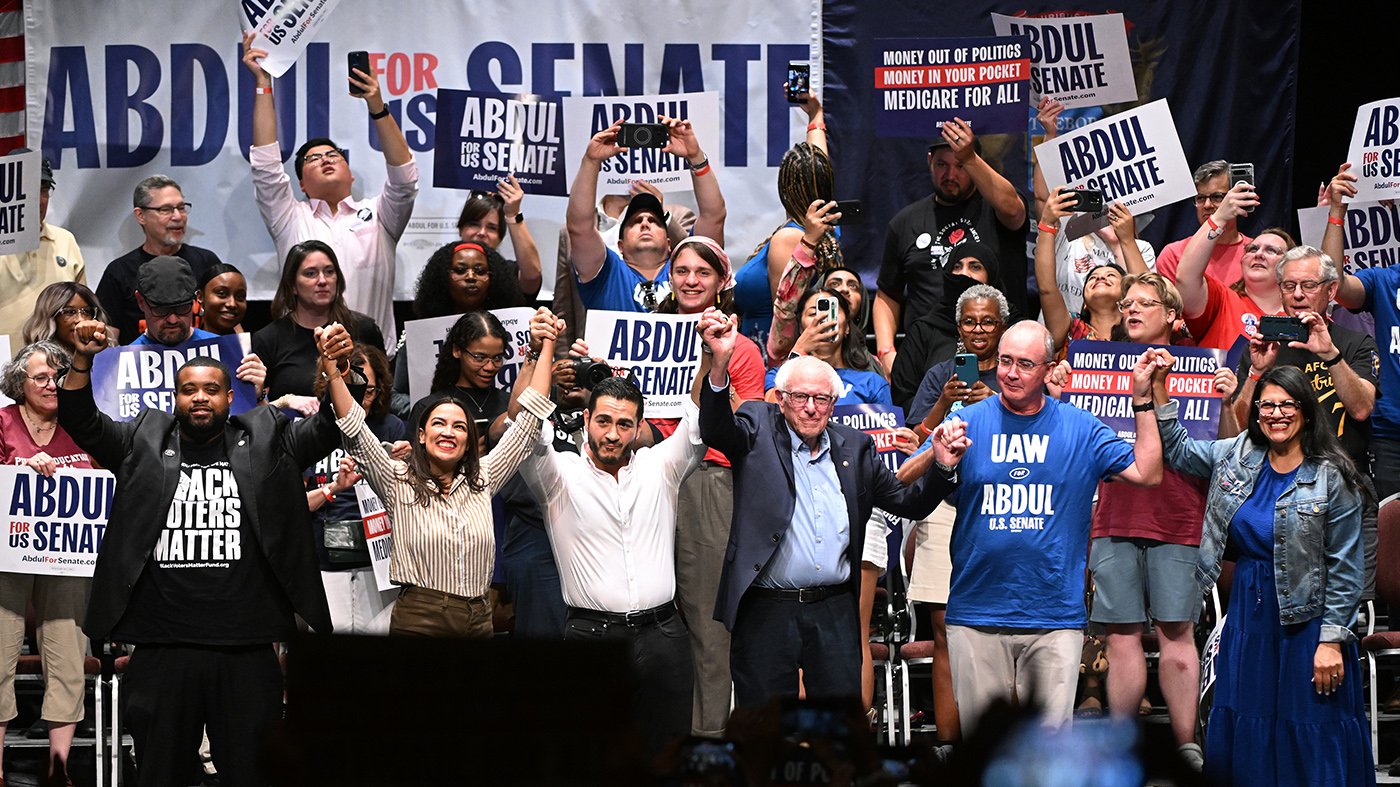
LANSING, Mich. — The Democratic Party's internal battle over ideology and electability reaches a critical juncture Tuesday, as Michigan voters head to the polls in primaries that could reshape the party's chances in two of the most competitive races this fall.
Mainstream Democrats are increasingly anxious that victories by progressive candidates Abdul El-Sayed and Will Lawrence — both endorsed by Senator Bernie Sanders — could alienate swing voters and cost the party seats it needs to hold or flip in November. El-Sayed is challenging centrist Representative Haley Stevens for the Democratic nomination to face Republican Mike Rogers for the Senate seat being vacated by Senator Gary Peters. Lawrence, co-founder of the Sunrise Movement, is seeking the nod in the 7th Congressional District, where he faces moderates Bridget Brink and Matt Maasdam, with the winner taking on Republican Representative Tom Barrett.
“We’re going to lose races we wouldn’t lose otherwise,” warned Joe DiSano, a longtime Democratic operative, pointing to the 4th and 10th Congressional Districts as well. “Both Democrats would put these races away, and now they’re in danger because of El-Sayed at the top of the ticket, possibly.”
But progressives counter that the establishment has misread the electorate. “I think the establishment’s been misjudging our politics for a very long time,” El-Sayed told The Hill last month. “We’re talking about people who don’t take the time to actually listen to voters but instead spend their time in D.C. talking to political elites.” The former Wayne County health official added, “I’ve spent my time talking to actual voters.”
The Michigan contests are the latest front in a nationwide struggle for the party’s direction, with progressive insurgents notching wins in several states this cycle. Mainstream Democrats fear that candidates like El-Sayed and Lawrence are riskier bets in competitive districts, where independent voters often decide outcomes.
El-Sayed’s race against Stevens has drawn national attention. Stevens has secured endorsements from Peters, Governor Gretchen Whitmer, and Senate Minority Leader Chuck Schumer. She has made electability her central argument, noting that she has flipped a Republican seat and has been named Michigan’s most effective Democratic lawmaker. “Abdul is running for celebrity,” she said during a debate this week. “Republicans are propping up his campaign.”
In the 7th District, Lawrence faces Brink, backed by former Governor Jennifer Granholm, and Maasdam, supported by Senator Elissa Slotkin. Some Democrats say elevating either El-Sayed or Lawrence could make winning more difficult. “I think it is going to potentially be more challenging,” said state Representative Joe Tate, a former House Speaker who dropped out of the Senate race and endorsed Stevens. “But there still is a path.”
Pollster Richard Czuba of the Glengariff Group said the margin of victory on Tuesday will be telling. If El-Sayed wins narrowly, he would enter a “very close race” against Rogers, given his “softness” with independents. But if El-Sayed wins by double digits, Czuba said, he would become “the clear favorite,” as “any softness he had with independents would be swamped by the new people he’s bringing into the process.”
The stakes are high: the Michigan Senate seat is one of Republicans’ best pickup opportunities, while Democrats view Barrett’s district—which President Trump won by just over one point in 2024—as a prime target. Recent polling from Glengariff showed El-Sayed trailing Rogers by 10 points, while Stevens and Rogers were statistically tied.
Greg Bowens, who worked on Democrat Hill Harper’s failed Senate campaign, predicted the establishment would rally behind El-Sayed if he wins, regardless of policy differences. “All that money that’s being poured into the Senate race is not going to turn off because El-Sayed wins,” he said. But Bowens acknowledged lingering resentment among some Democrats over El-Sayed’s support for the 2024 “uncommitted” movement, which could complicate his general election bid.
As the votes are counted, the results will signal whether the party’s progressive wing can expand its influence or whether the establishment’s caution prevails. The outcome will also shape the battle for control of Congress, with both parties watching closely. For more on the broader internal divisions facing Democrats, and recent polling showing Democrats with an edge nationally, the Michigan results could be a bellwether.