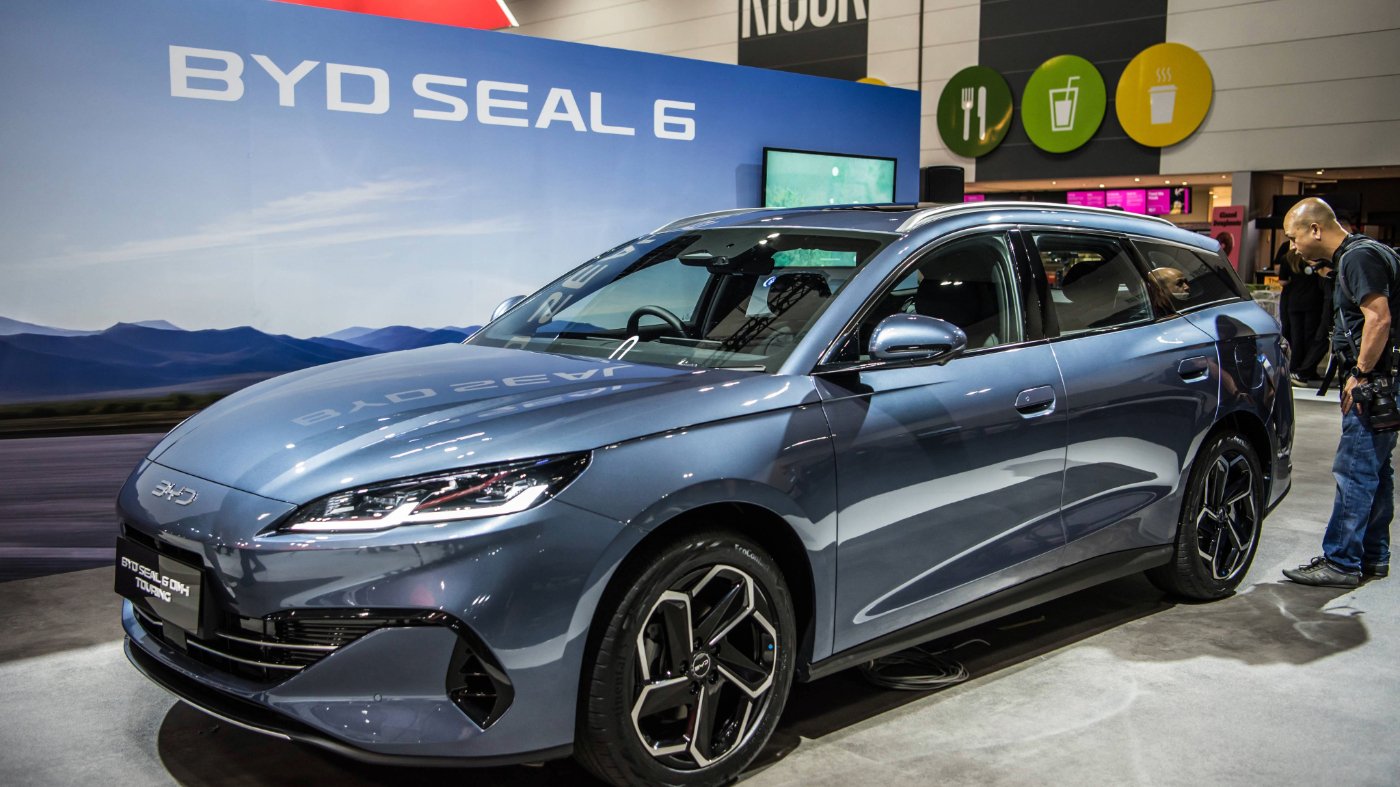
Assembly Plan Sparks Canadian Backlash
Stellantis NV is engaged in preliminary talks to manufacture Chinese electric vehicles at its dormant plant in Brampton, Ontario. The proposal involves assembling vehicles from knockdown kits provided by its Chinese partner, Zhejiang Leapmotor Technology, in which Stellantis acquired a 20% stake last year.
The plan has met immediate resistance from Unifor, the union representing workers at the idled facility, and the Canadian government. Both parties have rejected the approach, insisting on full manufacturing operations as originally promised when Stellantis accepted Canadian subsidies. Flavio Volpe, president of the Canadian Automotive Parts Manufacturers' Association, criticized the knockdown kit model, comparing it to assembling IKEA furniture rather than genuine manufacturing.

Trade Policy Opens Door for Chinese EVs
Despite the Stellantis controversy, Chinese electric vehicles are poised to enter the Canadian market through other channels. Prime Minister Mark Carney's administration agreed in January to reduce tariffs on 49,000 Chinese EVs from 100% to 6.1% as part of a trade arrangement with Beijing. The quota is scheduled to increase to 70,000 vehicles annually by 2030. The government has expressed interest in establishing joint ventures with Chinese automakers through "trusted partners."
Given Canada's limited domestic market, analysts suggest Carney's government anticipates exporting Canadian-assembled Chinese vehicles. The logical destination is the United States, but Washington has signaled strong opposition. U.S. Ambassador to Ottawa Pete Hoekstra stated bluntly that while Canadians could drive Chinese EVs into the U.S., selling them there "is not going to happen."
U.S. Barriers: Tariffs and Security Concerns
The American market remains effectively closed to Chinese electric vehicles through multiple barriers. Existing 100% tariffs prevent direct imports, while a January 2025 Biden administration rule prohibits Chinese and Russian hardware and software in "connected vehicles," citing national security risks that these vehicles could transmit data to China.
This regulatory environment is forcing Chinese automakers to consider alternative entry strategies. Former President Donald Trump told the Detroit Economic Club in January that he would permit Chinese companies to establish manufacturing facilities in the United States. Ford Motor Company has preliminarily indicated willingness to form a joint venture with a Chinese partner, with China auto analyst Michael Dunne noting that manufacturing within the U.S., potentially with an American partner, represents the most viable path forward.
Competitive Threat and Structural Challenges
Industry leaders acknowledge the formidable quality of Chinese electric vehicles. Ford CEO Jim Farley stated last year that Chinese EVs offer superior cost and quality compared to Western models, framing the competition as existential for American automakers. While U.S. manufacturers previously adapted to competition from Japanese and Korean automakers, analysts suggest Chinese competitors present a more disruptive challenge.
Bill Russo of Automobility Limited argues Chinese carmakers have created a "discontinuity in product architecture," pushing the industry into a "2.0 era" defined by software, computing architectures, AI capabilities, and data integration—effectively creating "smartphones on wheels." This technological advancement is supported by massive state subsidies, with China directing approximately $230.9 billion to its EV sector between 2009 and 2023, including at least $3.7 billion in direct payments to market leader BYD.
Underlying Vulnerabilities in China's EV Sector
Despite their technological edge, Chinese automakers face significant financial pressures. Few are profitable, and even BYD has experienced difficulties, with first-quarter sales dropping 30% year-over-year and March marking its seventh consecutive monthly decline. Volkswagen and Toyota both surpassed BYD in the Chinese market during the first two months of this year, partly due to reduced government incentives.
The broader Chinese auto industry is contracting, with overall sales falling 17.4% year-on-year in the first quarter and new energy vehicle sales dropping 27.5% in the first two months. These challenges come as former President Trump and Chinese leader Xi Jinping are scheduled to discuss automotive trade during their mid-May summit, placing the industry at the center of geopolitical negotiations. The timing raises questions about whether American policy might inadvertently provide relief to a struggling Chinese sector that has benefited from practices like state-coordinated labor programs for critical mineral extraction.
The situation unfolds against a backdrop of broader economic uncertainty, with North American job market confidence declining sharply amid slowing employment growth. The automotive sector's transformation carries implications for industrial policy and national security, intersecting with ongoing debates about surveillance, as seen in the congressional battle over FISA reauthorization and warrantless searches.