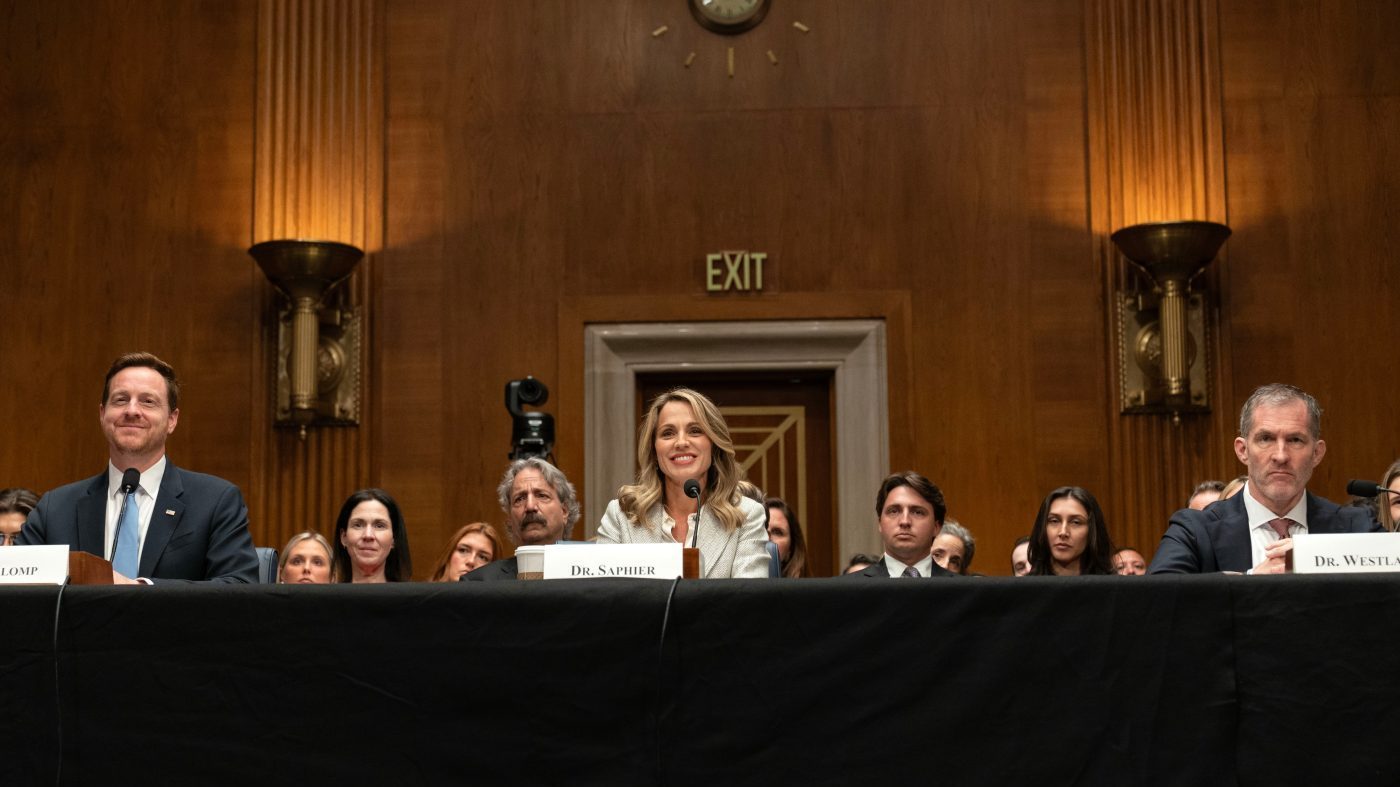
The Senate Health, Education, Labor and Pensions (HELP) Committee on Wednesday heard from three of President Trump's health nominees, including his third choice for U.S. surgeon general. Unlike previous contentious hearings, this session was notably subdued, with lawmakers from both parties showing a willingness to support the nominees.
Nicole Saphier, a radiologist and former Fox News contributor, is Trump's third pick for surgeon general after his previous two choices failed to secure enough Republican support. Alongside her, the committee considered Chris Klomp for deputy secretary of the Department of Health and Human Services (HHS) and Timothy Westlake for assistant secretary for mental health and substance use.
Klomp, a close ally of HHS Secretary Robert F. Kennedy Jr., currently serves as HHS chief counselor and has been credited with leading the administration's "most favored nation" policy. Westlake, an emergency physician, is the chief of staff at the Substance Abuse and Mental Health Services Administration (SAMHSA).
Nominees With Legislative Ties
Both Klomp and Westlake have prior interactions with committee members through their administrative roles. Klomp appeared before the Senate Finance Committee on Tuesday, while Westlake testified last year in support of the HALT Fentanyl Act, a bill he helped develop in Wisconsin in 2016. The legislation classifies all fentanyl-related substances as Schedule I drugs, a move praised by HELP Chair Bill Cassidy (R-La.).
Saphier also has a legislative background, having helped draft and pass state-level breast density notification laws while practicing in Arizona. She later supported similar measures in New York and New Jersey. Sen. Susan Collins (R-Maine) noted her work with Sen. Tammy Baldwin (D-Wis.) on reauthorizing the National Breast and Cervical Cancer Early Detection Program and expressed interest in collaborating with Saphier.
A Less Combative Hearing
The hearing's tone was markedly calmer than previous ones, likely due to the lower-profile positions and the nominees' more mainstream backgrounds. Cassidy opened warmly, saying he "really enjoyed all of your opening statements." He was particularly pleased when Saphier called the measles, mumps and rubella (MMR) vaccine "our greatest tool for combating measles" and stated it is not lethal, a departure from Trump's recent remarks.
Saphier also voiced support for a universal birth dose of the hepatitis B vaccine, a policy opposed by Trump and Kennedy but championed by Cassidy. She cited evidence-based medicine, saying the universal birth dose has been the most effective policy in the U.S. for reducing infection.
Sen. Tim Kaine (D-Va.) also offered a warm welcome, congratulating Klomp on his nomination.
More Direct Answers
Unlike previous nominees who gave vague or conditional responses, these three were noticeably more straightforward. Cassidy referenced past "wiggle room" from nominees, while Sen. John Hickenlooper (D-Colo.) noted that prior commitments to scientific integrity had not been upheld. Sen. Maggie Hassan (D-N.H.) asked both Saphier and Westlake whether they would follow the law or a presidential directive that breaks it, a question that has been posed to other health nominees.
The nominees' responses, while not fully detailed, were seen as more reassuring. The committee's bipartisan openness suggests a smoother confirmation path for this batch, though final votes remain pending.
As the administration continues to fill health positions, the contrast with earlier contentious hearings is notable, reflecting a possible shift in strategy or a more palatable slate of candidates. For more on the broader confirmation battles, see this analysis of Fed independence and the filibuster debate.