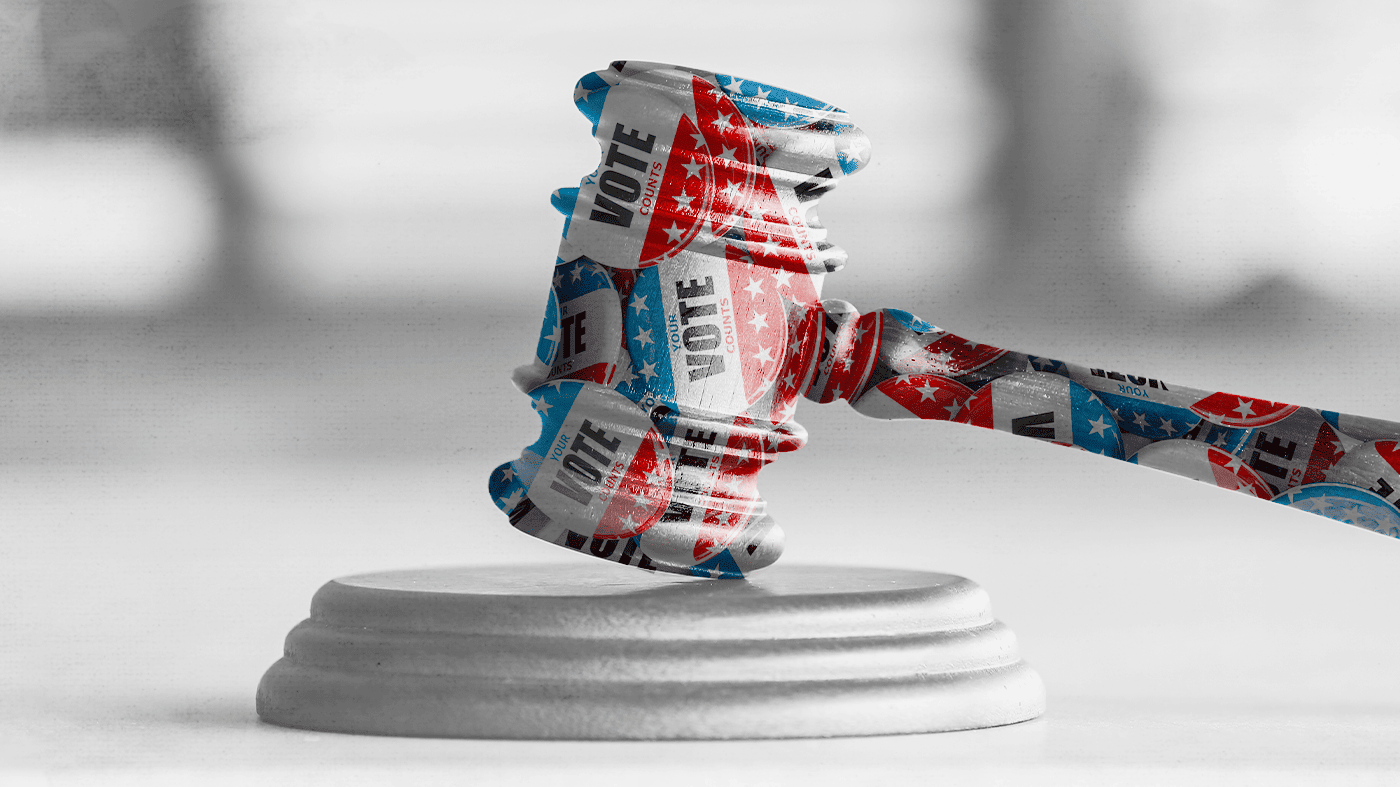
Voters in half the country will cast ballots Tuesday for seats on their states' highest courts, with two dozen states holding Supreme Court elections that could shape the interpretation of state law on issues from abortion to redistricting. The contests—partisan, nonpartisan, and retention—will determine who sits on benches that increasingly serve as the final arbiters of rights and liberties now that federal courts have narrowed protections.
"State Supreme Court is a super important level of the ballot for us because so much of people's rights and liberties is now determined at the state level," said Deirdre Schifeling, chief political and advocacy officer for the ACLU, which has spent roughly $5.5 million on voter outreach in Michigan, Montana, and North Carolina.

While the ideological balance of power isn't up for grabs in most states, experts say Tuesday's results could set the stage for shifts in 2028 and beyond. Here are five races to watch.
Michigan: Six candidates, two seats, one open election
Michigan voters will choose two justices from a field of six in a uniquely structured contest. Chief Justice Megan Cavanagh is seeking another eight-year term, while Justice Noah Hood is running for his first full term after Gov. Gretchen Whitmer (D) appointed him in 2025 following the retirement of former Chief Justice Elizabeth Clement.
All candidates appear on the same ballot: Cavanagh, Hood, Michael Warren, Casandra Morse-Bills, Thomas Howe, and Jody White. The top two vote-getters win. Although parties nominate candidates at conventions, the elections are technically nonpartisan, so no party labels appear. Cavanagh and Hood are Democratic nominees; Morse-Bills and Warren, both lower court judges, were nominated by Republicans. Howe and White were nominated by the U.S. Taxpayers Party, the state affiliate of the Constitution Party. Neither is licensed to practice law in Michigan, a requirement for judges in the state court system.
Liberals currently hold a 6-1 advantage on the Michigan Supreme Court, with only one Republican-backed justice. If both Democratic incumbents lose, the liberal majority would shrink but remain intact.
Missouri: Retention vote tests a Democratic appointee
In Missouri, Justice Paul Wilson, appointed to the high court in 2012, faces a retention vote with no opponent. The state's Supreme Court has a 5-2 Republican-appointed majority, so no power shift is at stake. But voters will weigh whether a mid-decade redistricting fight that reached the court should influence their decision.
Wilson authored the dissent in a narrow March ruling that allowed the GOP-controlled legislature to redraw congressional lines before the next census. In September, he joined a unanimous decision invalidating a 7-1 House map that would have dismantled Rep. Emanuel Cleaver's (D-Mo.) district and given Republicans a midterm pickup opportunity. The court ruled the new lines, already used in primaries, could not take effect until voters approved them in a referendum. The battle reached the U.S. Supreme Court three times, with Republicans losing each round.
The Missouri Judicial Performance Review Committee has recommended Wilson's retention. Judges rarely lose retention elections; Wilson received 63 percent yes votes in his last appearance on the ballot.
Montana: A rematch with partisan undercurrents
Montana voters will choose a successor to retiring Justice Beth Baker, who steps down after 16 years. The race is a rematch between Flathead County judges Amy Eddy and Dan Wilson. Eddy finished the June primary with just over 7,600 more votes than Wilson, and both advanced as the only candidates.
The contest is officially nonpartisan—no party labels appear—but it has become a proxy battle. The Montana GOP has backed Wilson, hosting him as keynote speaker at the state party's winter kickoff in February. "I call myself a constitutional Conservative because I decide cases based on the facts and not feelings, principles above all else, and the Constitution," Wilson said, according to Montana Public Radio.
Eddy has picked up endorsements from labor unions and environmental groups, including Montana Conservation Voters, amid debates over the state constitution's environmental protections.
Across these states and others, the outcomes could influence how courts handle abortion access, redistricting, and other issues now largely decided at the state level—a dynamic that has drawn increased attention and spending from national groups. The results may also offer early clues about the political landscape heading into 2028.