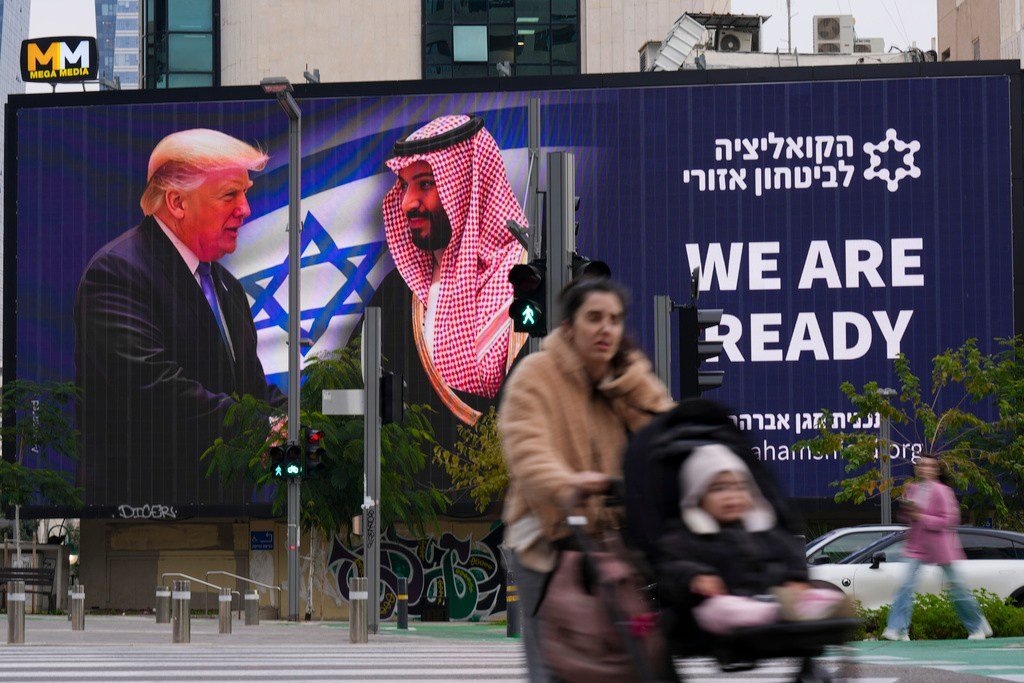
President Trump is making normalization with Israel a precondition for advancing a civilian nuclear agreement with Saudi Arabia, even as Washington expands defense ties with Riyadh. The Saudis have not publicly accepted this quid pro quo and continue to insist on meaningful progress toward Palestinian statehood.
Trump may achieve what seemed unattainable after the Oct. 7 attacks: Saudi recognition of Israel. But a diplomatic breakthrough should not be mistaken for a warm peace. Crown Prince Mohammed bin Salman may be ready for a strategic partnership, but Saudi society is far from ready to embrace the Jewish state.

The critical question is what kind of relationship would follow. Would it resemble Israel's relatively warm ties with the United Arab Emirates, which have weathered the strain of the Gaza war? Or would it mirror the cold peace with Egypt and Jordan, where security cooperation is robust but public hostility remains high?
Washington often uses the word "peace" as if Middle East normalization could replicate U.S.-Canadian relations. That is unrealistic. Regional governments must navigate conservative domestic politics, Islamist currents, and populations whose views on Israel are often far more hostile than their rulers' positions.
Saudi Arabia exemplifies this tension. Bin Salman has modernized parts of the kingdom, but Saudi society is not the business elite of Riyadh. Polling underscores the challenge: in 2025, 81 percent of Saudis viewed establishing normal peaceful relations with Israel negatively, and only 13 percent viewed the Abraham Accords positively. After Oct. 7, 96 percent favored cutting ties with Israel, revealing a vast gap between the crown prince's strategic calculus and public opinion.
Israel and Saudi Arabia have cooperated quietly for years, sharing intelligence and coordinating against Iran. For the foreseeable future, Riyadh may prefer that behind-the-scenes arrangement over an Emirati-style embrace. The Oct. 7 attack disrupted normalization efforts and served the interests of Hamas and Iran. The optimism of the pre-war period has faded.
Even if Trump persuades Bin Salman to resume normalization, the relationship will begin under far less favorable circumstances. Washington should also think carefully before granting Saudi Arabia the right to enrich uranium on its soil as part of the bargain. Saudi Arabia is stable today, but nuclear agreements must last for decades. The crown prince will eventually succeed his father, and royal family members still remember being detained at the Ritz-Carlton during his consolidation of power. A future succession could bring instability, making indigenous enrichment a long-term proliferation risk.
Israel also has work to do. A future government could offer Riyadh enough movement on the Palestinian issue to facilitate normalization, but Israel can take immediate action on a more manageable problem: extremist violence in the West Bank. While Israel faces genuine Palestinian terrorism daily, that threat should not be equated with settler violence. Israelis who attack innocent Palestinians or violate Israeli law undermine their country's strategic interests.
The Netanyahu government, or its successor, should enforce Israeli law, including administrative detention where justified, against the small number of extremists responsible. Allowing these actions to continue creates an unnecessary diplomatic vulnerability when Israel needs to rebuild international and American support. European governments are increasing pressure over West Bank policies, and congressional Democrats have proposed sanctions related to settlement activity.
Substantial public progress between Israel and Saudi Arabia is unlikely before Israel has a stable government after its elections. Yet Iran will continue to push the two countries together. Shared threats from Tehran and the Houthis make Saudi-Israeli intelligence and security cooperation necessary, even if much remains in the shadows. Riyadh must also weigh America's long-term commitment to the region. Trump leaves office in January 2029, and neither Saudi Arabia nor Israel knows whether his successor will sustain the same level of engagement. American credibility in the Middle East also reverberates in Beijing and Taipei.
Trump should not be underestimated. The Abraham Accords overturned decades of conventional wisdom that Arab-Israeli normalization could not advance without first resolving the Palestinian conflict. He could surprise the region again. But Saudi recognition of Israel, however historic, would not necessarily mean reconciliation. The more realistic outcome may resemble Egypt or Jordan: formal diplomatic ties and extensive security cooperation while societal normalization remains years, perhaps decades, away. For more on regional dynamics, see Trump's diesel policy shift and White House responses to Iran remarks.