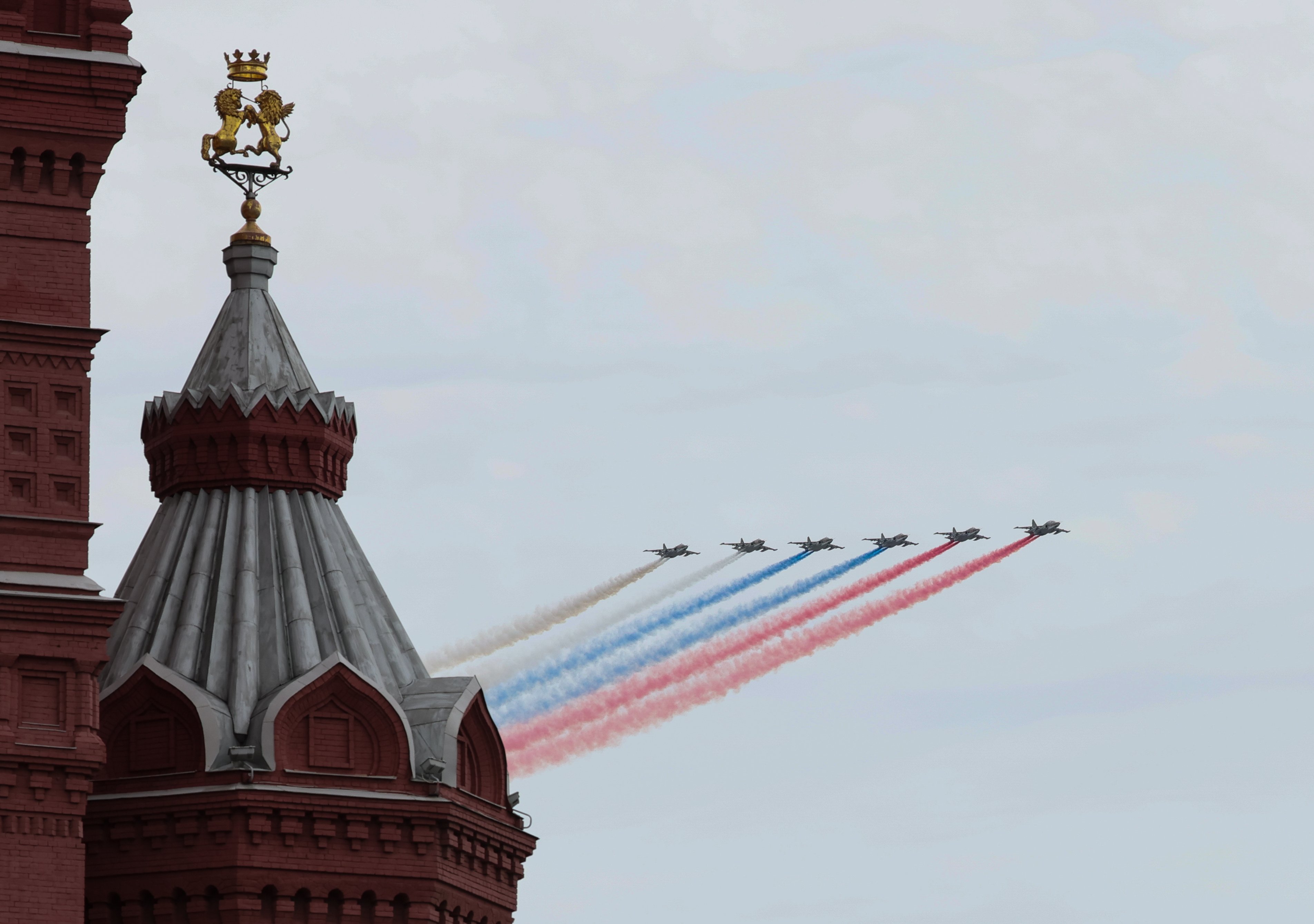
For the first time in nearly twenty years, Russia's annual Victory Day parade on May 9, 2026, will roll through Moscow without a single tank or piece of heavy military equipment. The Defense Ministry blamed the “current operational situation”—a thinly veiled admission that much of the country's armor has been destroyed in Ukraine, is still committed to the front lines, or is being held back to protect the regime itself.
This stark image should force a fundamental reassessment in Western capitals. The Russia that still dominates security debates—a powerful, expansionist juggernaut poised to overrun NATO's eastern flank—is increasingly a phantom. What actually exists is a demographically collapsing, militarily exhausted, and economically strained state armed with nuclear weapons. And that Russia is far more dangerous.
Demographic Freefall Accelerated by War
Russia's demographic crisis predates the 2022 invasion. In 1992, deaths first exceeded births in peacetime, following the Soviet collapse's hyperinflation and healthcare collapse, which slashed male life expectancy. By 2025, Rosstat reported a total fertility rate of just 1.37 children per woman—well below the replacement level of 2.1. Three waves of emigration have stripped the country of its most educated and productive citizens, with the latest wave—triggered by the Ukraine invasion and mobilization—costing over a million people. Even Belarus, Russia's closest ally, has closed its border to Russian men of military age fleeing conscription.
The war has dramatically accelerated this decline. Independent counts by Mediazona and BBC Russian have verified more than 213,000 named deaths by late April 2026, while Western estimates place total casualties—killed and severely wounded—well above one million, overwhelmingly young men in their prime reproductive and working years.
Economic Strain Reaches Cold-War Levels
Economically, the picture is equally grim. Russians now spend 39 percent of their income on food—a 16-year high. New car prices have surged 216 percent since 2014. The federal budget deficit hit 5.63 trillion rubles in 2025, while the broader consolidated deficit reached 8.29 trillion. Nearly 40 percent of federal spending goes to defense and security—a Cold War-level burden on a much weaker economy. These numbers come exclusively from official Russian government sources: Rosstat, the Federal Treasury, the Russian Central Bank, and state media.
Russia entered the war at maximum sustainable capacity without general mobilization. After years of attrition, it has burned through most of its Soviet-era equipment stocks. Given Russia's weakened state, a conventional confrontation with NATO is not only unlikely now—it has become almost impossible, prohibitively expensive and demographically unsustainable. As analysts have urged, Western policymakers should start planning endgames for Ukraine, Iran, and Taiwan now to manage the risks of a cornered adversary.
The Real Danger: A Cornered Nuclear State
The real strategic risk is not a confident Russia launching a conventional assault on the Baltics. It is the behavior of a cornered, nuclear-armed state that perceives itself in terminal decline. A leadership facing military failure and domestic crisis may calculate that tactical nuclear signaling or hybrid escalation offers its best chance to reset the board. This risk does not negate nuclear deterrence, but it complicates it significantly, making traditional calculations far more dangerous.
For too long, Western policy has responded to the Russia of 1980 rather than its weakening state of 2026. This misdiagnosis risks either strategic complacency or dangerous overreaction. The right approach lies between abandonment and annihilation: maintain rigorous sanctions, sustained military support for Ukraine, and strong conventional deterrence. At the same time, the West must quietly develop credible off-ramps and channels to the real centers of power inside Russia—its oligarchs, businessmen, and regional elites—who may one day conclude that the current path is unsustainable. Meanwhile, some in Congress are proposing tariffs on Russian oil purchases to tighten economic pressure.
A wounded bear is dangerous. A wounded bear that believes it has no exit is far more dangerous. The West must stop fearing the Russia that no longer exists and start preparing for the risks posed by the one that does.
Emzari Gelashvili is a former member of parliament of Georgia and a former senior official in the Georgian Ministries of Defense, State Security and Internal Affairs.