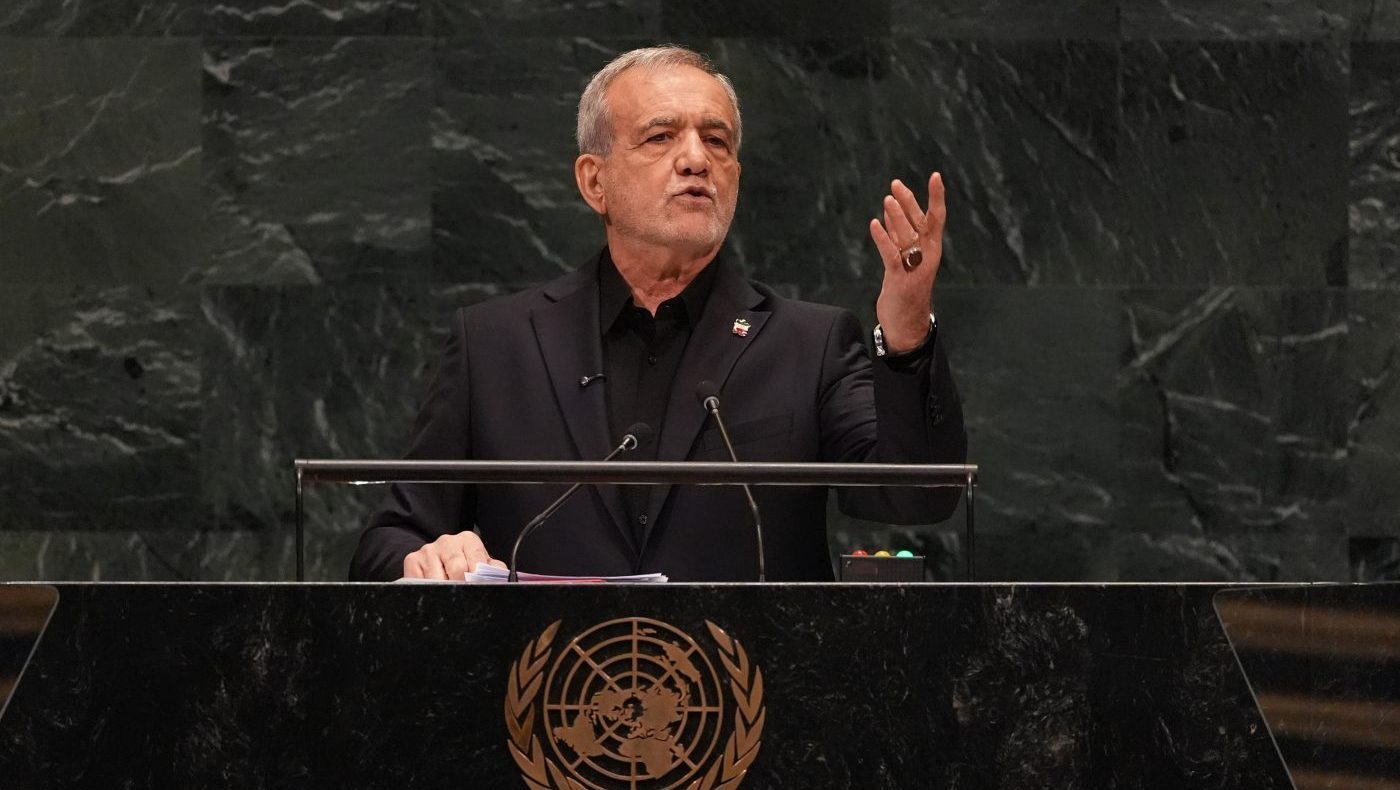
Iranian President Masoud Pezeshkian used his address to the United Nations General Assembly on Wednesday to strike a defiant tone, insisting that the Islamic Republic will not capitulate to American military and economic pressure. His remarks came just a day after indirect talks between Iranian officials and US envoys Steve Witkoff and Jared Kushner on the sidelines of the global summit.
“We will never bow our head or bend at the knee,” Pezeshkian declared, directly responding to President Trump’s ultimatum that Tehran either negotiate a deal or face “annihilation.” The US delegation had walked out before Pezeshkian took the podium, a diplomatic snub that underscored the deep rift between the two nations.
Pezeshkian framed the confrontation as a test of wills, asserting that “the resistance of the Iranian people will only increase in the face of sanctions, increased pressure, increased bullying.” He insisted that Iran is open to dialogue but rejects any negotiations conducted under the threat of force. “Iran must be understood by Mr. Trump and those who seek to bully us that we are ready for dialogue and diplomacy and negotiations without accepting the language of force,” he said.
The Iranian president also took aim at Trump’s recent threats to wipe out Iran, calling them a violation of the UN’s founding principles. “Everything uttered about our country goes against the very essence and charter and the spirit of the United Nations,” he told the assembly.
On the nuclear file, Pezeshkian reiterated Tehran’s long-standing position: it seeks no atomic bomb but rejects any limits on its peaceful nuclear program. “We say it clearly: no nuclear weapons and no limitations to peaceful nuclear technology,” he said. That stance has brought Iran into renewed conflict with the international community. Earlier this month, the UN’s nuclear watchdog reported Iran to the Security Council for noncompliance with its safeguard agreements—the first such censure in two decades. In September 2025, the Security Council triggered a snapback of sanctions on Iran after talks with the US stalled and monitoring restrictions remained unresolved.
Trump has framed his military campaign against Iran as a mission to prevent it from acquiring a nuclear weapon, but a combination of airstrikes and economic sanctions has so far failed to force Tehran’s surrender. Instead, Iran has managed to disrupt global energy markets, driving up gasoline and diesel prices in the US and inflicting economic pain at home, a factor that could weigh on the upcoming midterm elections.
Trump predicted that Iran would come to the negotiating table after the midterms, suggesting Tehran is waiting to see if his political position weakens should Republicans lose control of Congress. “I gave absolutely no credence and will not give credence to the election when it comes to Iran,” he said in his UN speech, seeking to preempt any suggestion that domestic politics could affect his Iran policy.
The indirect talks between Witkoff, Kushner, and Iranian officials on Tuesday were described as “lengthy,” with Witkoff expressing hope in a post on X that they would “prove constructive and promising.” The outcome of those discussions remains unclear, but they signal that despite the heated rhetoric, both sides are still willing to explore a diplomatic off-ramp.
As the standoff continues, the stakes are high not only for the region but for global energy security. The recent attack on an Iranian cargo ship in the Strait of Hormuz underscores the volatility of the situation, while Trump’s broader UN agenda has focused on Iran, cartels, and Greenland. With midterm elections looming, the political calculus in Washington is increasingly intertwined with the crisis in the Persian Gulf, as Republicans and Democrats alike navigate the fallout of a conflict that shows no signs of resolution.