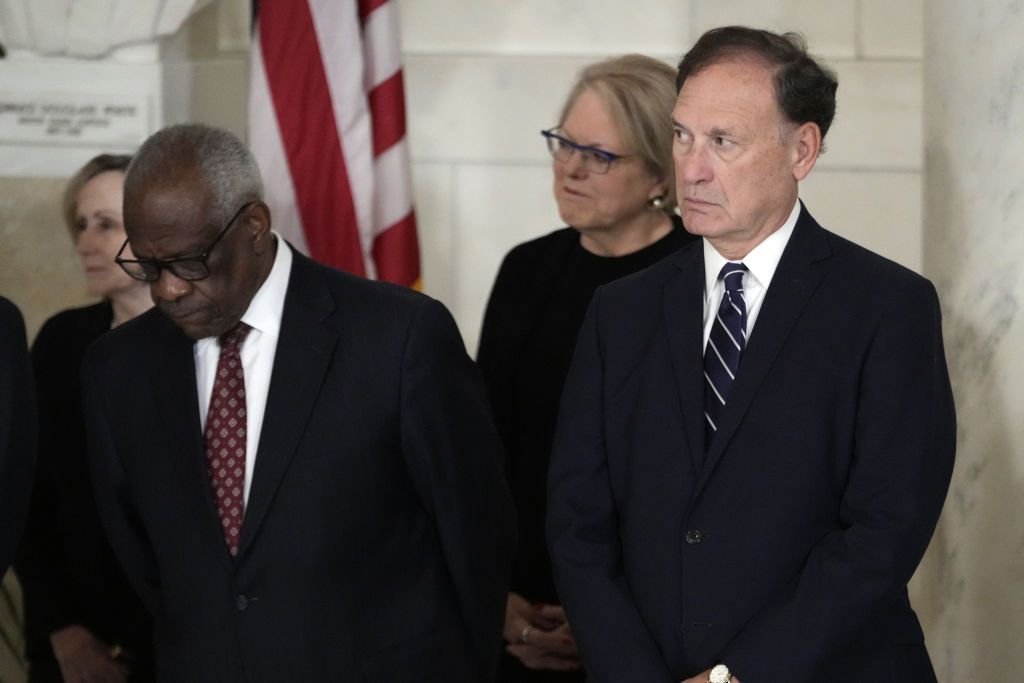
Shakespeare's warning in Henry VI that "defer no time, delays have dangerous ends" could serve as a fitting motto for the Supreme Court's conservative justices. History shows that justices who linger too long often watch their legacies slip away—a lesson that now looms over Clarence Thomas and Samuel Alito as the political landscape shifts dramatically.
For conservatives, the Democrats' decisive capture of both congressional chambers has transformed a manageable concern into a potential nightmare scenario. Without the need for court-packing, Thomas and Alito could inadvertently hand liberals control of the high court simply by waiting too long to step down. The 6-3 conservative majority could become a 5-4 liberal one through attrition alone.

The timing question has always haunted justices who wish to see their seats filled by ideological allies. But leaving the bench is notoriously difficult, especially for those who have spent decades shaping American law. Some, like William Douglas and Thurgood Marshall, held on past their prime, appearing confused and isolated in their final years. Others, like Ruth Bader Ginsburg, made the opposite mistake—she refused to retire while Barack Obama was president, and her death during Donald Trump's term allowed Amy Coney Barrett to take her seat, a decision many liberals now rue.
Now, conservatives fear a "double tap" scenario. For two years, speculation swirled that Thomas (78) and Alito (76) might retire to secure Republican replacements under a GOP Senate. Both declined. With the GOP's Senate majority evaporating in January, that window has slammed shut. Even if they resigned in the next two years, Democrats—holding at least 54 seats and likely more—could block any Trump nominee, citing the Merrick Garland precedent from 2016 as justification.
Democrats have already signaled their readiness. Senate Minority Leader Chuck Schumer has vowed to reject "any crappy nominees," a thinly veiled threat against any Trump pick. Liberal dark-money groups like Demand Justice, which once hounded Stephen Breyer into retirement, have preemptively raised funds to oppose future conservative nominees. The strategy is clear: stall until a Democrat occupies the White House, then fill vacancies with left-wing jurists.
Thomas and Alito, however, show no signs of cognitive decline. Both remain sharp and active, having authored landmark opinions in recent terms—Thomas on gun rights in Bruen, Alito on abortion in Dobbs. Yet the political clock is ticking. If they wait for a Republican president, they could be 84 and 82 respectively by 2028, with no guarantee the Senate will be friendly.
The stakes are immense. A "reverse Ginsburg" scenario would not only flip the court's ideological balance but also jeopardize the very precedents Thomas and Alito worked to establish. Their signature rulings could be overturned in short order. Some argue that justices should never time their retirements for political advantage, instead serving as long as they are able and leaving the rest to fate. But with the Senate poised to confirm only liberal nominees, the conservative legal movement faces a stark choice: accept the risk of attrition or pressure these two aging jurists to step aside now—a move that may already be too late.
As the final weeks of Republican Senate control tick away, the opportunity for strategic retirement has effectively vanished. The conservative movement, which owes much of its judicial success to Thomas and Alito's patience and persistence, now watches helplessly as their legacy rests on the very longevity that once seemed their greatest asset.