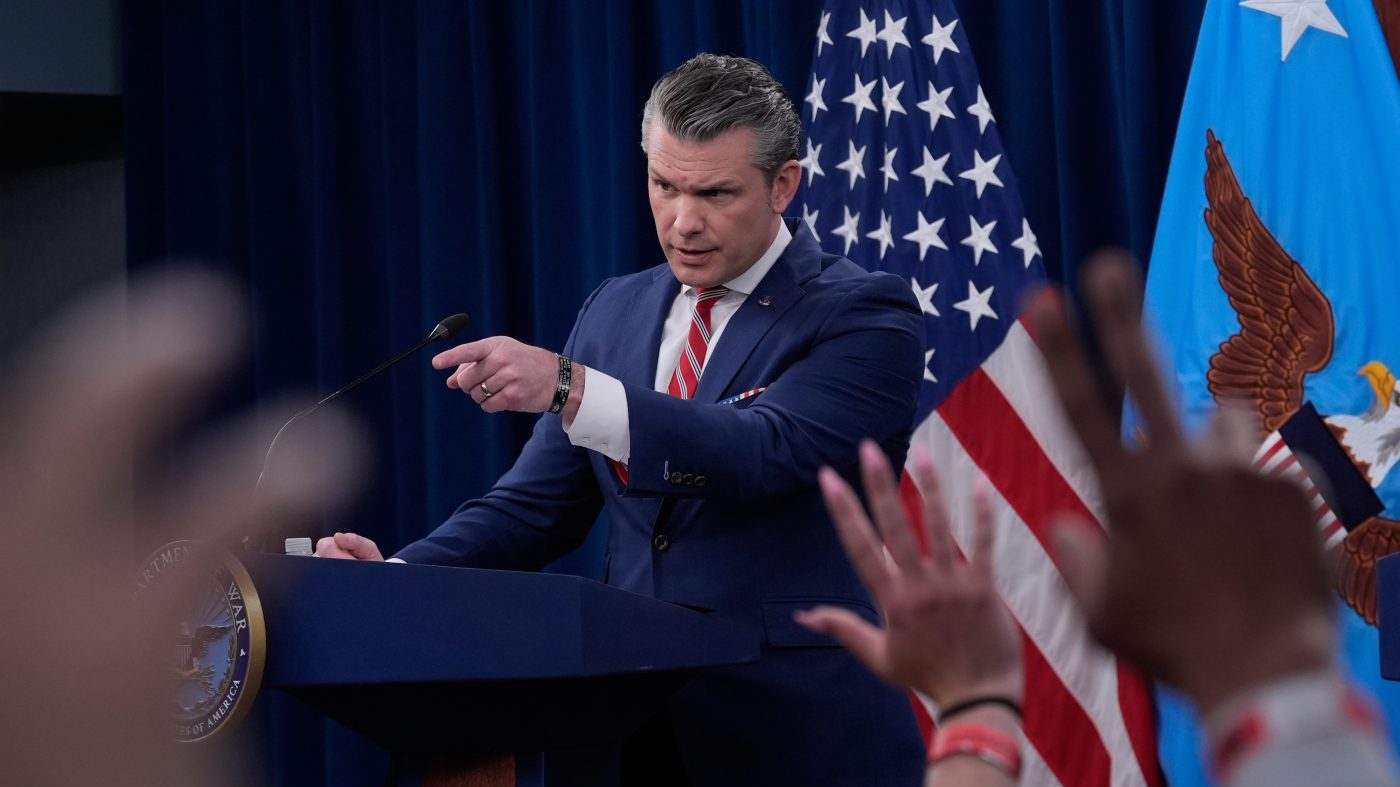
Defense Secretary Pete Hegseth visibly bristled at a Pentagon press briefing on Tuesday when a Newsmax reporter pressed him on President Trump's evolving stance toward Iran, questioning when the commander-in-chief abandoned his initial call for Tehran's unconditional surrender.
James Rosen, a veteran Newsmax correspondent, opened his question with praise for the military's performance in Operation Epic Fury, the U.S. campaign against Iran that began on Feb. 28. But he quickly pivoted to what he called a "central default" in the administration's war aims.
"On the first day of this conflict, President Trump addressed the Iranian people directly and said, 'When we're finished, take over your government. It'll be yours to take.' And then on the seventh day, in a Truth Social post, the president said, 'There will be no deal with Iran except' all caps, exclamation mark 'UNCONDITIONAL SURRENDER!'," Rosen recounted.
"What happens to that pledge to the Iranians? And when did the president decide to capitulate on his demand for unconditional surrender?" he asked.
Hegseth shot back, accusing Rosen of setting a trap. "James, I wouldn't—You started out nicely, but you ended exactly where we knew you would end," the defense chief said. "The president hasn't capitulated on anything. He holds the cards, we maintain the upper hand, and Project Freedom only strengthens that hand."
He insisted the administration's core objective remains preventing Iran from acquiring a nuclear weapon. "He will ensure that whatever deal is made, or whatever end state is reached, creates ensuring that Iran never has a nuclear weapon, which is A No. 1," Hegseth added, deflecting the question about Trump's rhetorical shift.
The exchange underscores a growing tension within the administration's Iran policy. Trump initially framed the conflict as a campaign for regime change, urging Iranians to overthrow their government. But as the war dragged on, he softened his language, declaring that regime change had already been achieved after Iran's original leadership was "decimated" and replaced.
The U.S. is now operating under a fragile ceasefire with Tehran, which Trump extended indefinitely on April 21 to pressure the regime into a permanent peace agreement. The president has repeatedly claimed the fighting is near an end, even as he continues to issue new threats against the Islamic Republic.
Critics, including some lawmakers, have accused the administration of mission creep and a lack of clear strategic goals. The constitutional clash over war powers has intensified, with several members of Congress questioning whether the president has the authority to continue hostilities without a formal declaration.
Hegseth, for his part, has maintained that the ceasefire effectively halts the clock on the War Powers Resolution, a claim that has drawn skepticism from legal experts and sparked heated exchanges with Senate Democrats over the cost of the conflict and recent Pentagon personnel changes.
As the Hormuz Strait remains a flashpoint, with clashes continuing despite the truce, the administration's shifting narrative has left many allies and adversaries questioning Washington's ultimate intentions in the region.