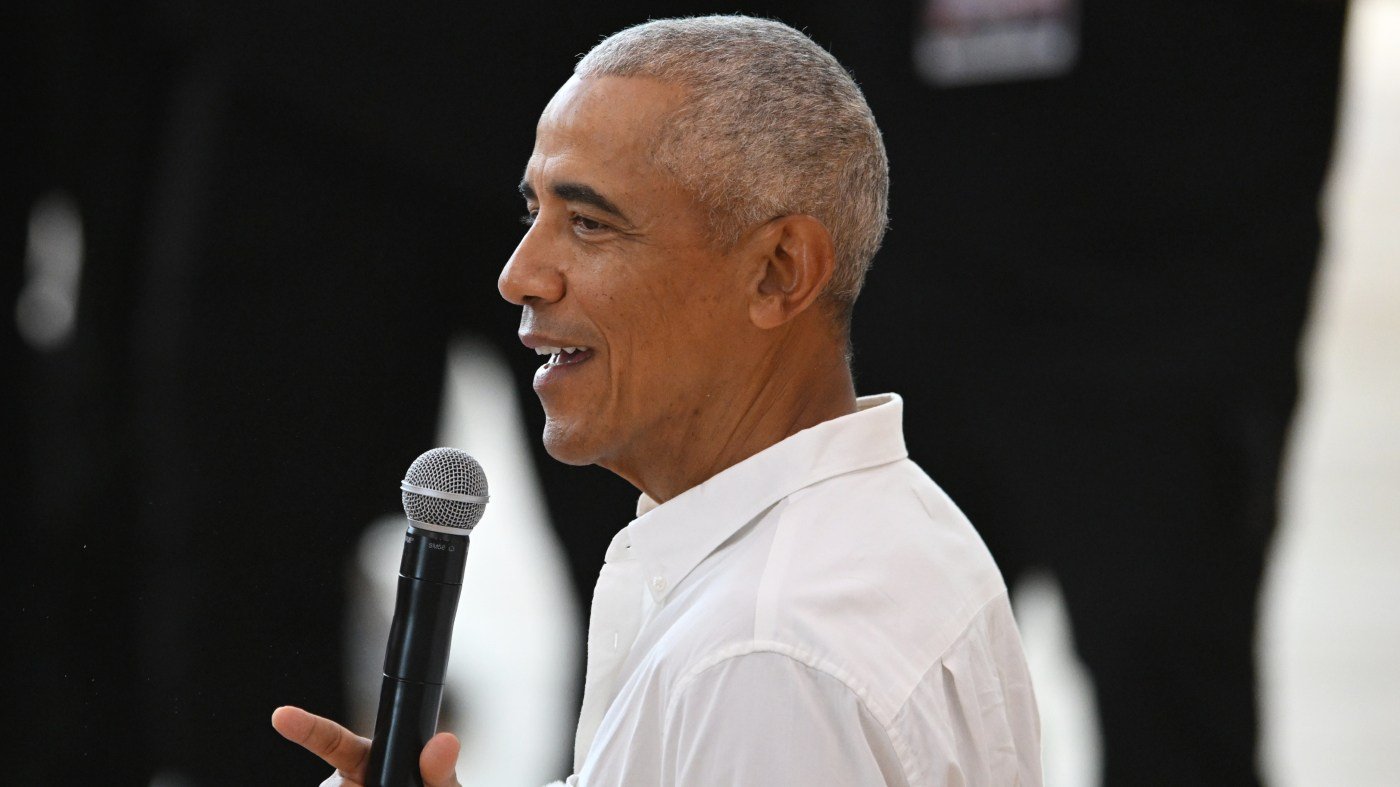
Former President Barack Obama is pushing back against the notion that Washington is more corrupt than ever, arguing instead that the federal government has never been cleaner when it comes to outright bribery and political favors.
In a preview clip from his newly launched literary podcast, A Great Book with Barack Obama, the 44th president tells Pulitzer Prize-winning historian Jill Lepore that the modern federal government is “so much less corrupt than probably it’s ever been” in terms of “pure bribes, or patronage or favors.”
The six-episode series, which debuted Thursday on Audible, features Obama in conversation with authors, actors, and thinkers about books that have shaped his worldview. The third episode focuses on Robert Penn Warren’s 1946 novel All the King’s Men, a fictional account of a populist Southern governor’s rise and fall amid corruption—a fitting backdrop for a discussion about political ethics and reform.
Obama, reflecting on his own career in the Illinois state legislature, Congress, and the White House, noted that the old political machines relied on more than intimidation. “It was like, ‘What do you need?’” he said, describing how lawmakers used favors and vote-trading to build coalitions. He credited post-Watergate reforms with largely dismantling those systems, but he also suggested that the change came with trade-offs.
“It’s part of the reason why things got a little harder to get done,” Obama said, explaining that the old practices served as “lubrication” in Congress, helping bridge ideological divides and secure votes for uncomfortable measures.
Lepore, a staff writer at The New Yorker, agreed, arguing that while political machines were hardly virtuous, they played a role in sustaining civil society. She pointed to the Progressive Era’s good-government reforms—campaign finance limits and voter protections—as the forces that ultimately killed the machines, only to be replaced by a new industry: political consultants.
Obama’s comments come amid ongoing debates over government integrity, with some lawmakers and critics alleging corruption in the current administration. The former president has previously weighed in on governance issues, including accusing the Trump administration of failing on AI deregulation and privately urging Democratic leaders to prioritize AI oversight.
The podcast also includes episodes with Tom Hanks on Marilynne Robinson’s Gilead, Ta-Nehisi Coates on James Baldwin’s The Fire Next Time, and conversations with former national security adviser Ben Rhodes and authors Percival Everett and Lauren Groff.
Obama’s broader point—that systemic corruption has declined even as political dysfunction persists—offers a counterintuitive take at a time when public trust in government remains near historic lows. But his acknowledgment that cleaner processes have made governing harder highlights a persistent tension in American politics: integrity and efficiency do not always go hand in hand.
The former president’s remarks are likely to fuel further discussion, especially among those who argue that the current political system suffers from its own forms of influence-peddling, even if they differ from the old-style machines. As Obama himself noted, the post-Watergate reforms eliminated some problems but created new ones—a message that resonates in today’s hyper-partisan climate.