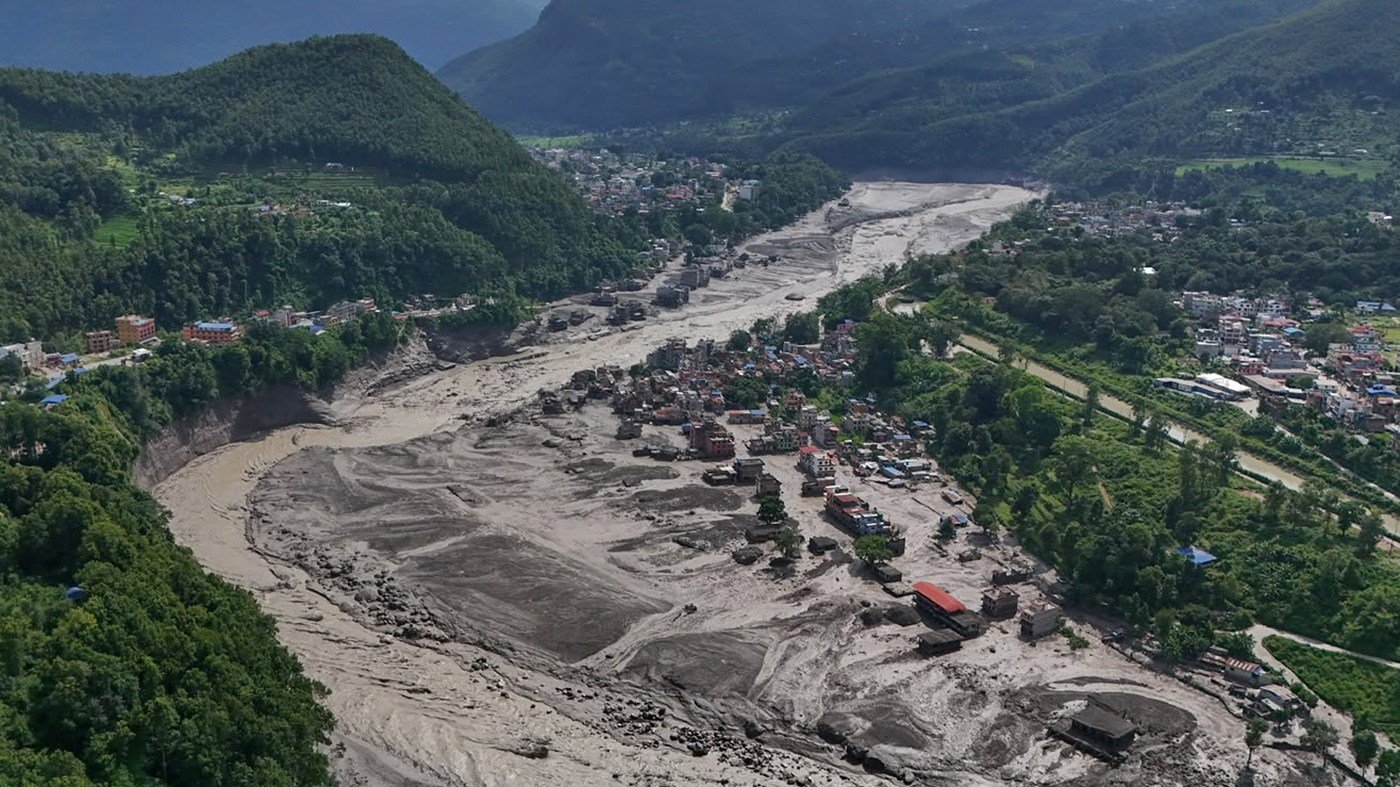
A catastrophic flash flood that swept through Nepal and Tibet on Wednesday morning has left hundreds dead and thousands unaccounted for, including dozens of U.S. citizens, according to officials. The Bhotekoshi River overflowed around 9 a.m. local time, devastating villages, infrastructure, and hydropower projects in the region.
The exact death toll remains uncertain, but Nepali police reported Thursday afternoon that at least 389 people have died and 466 more were injured. More than 1,400 individuals are still missing. In response, the government has deployed over 4,000 law enforcement officers to assist in rescue and recovery efforts.
The United Nations has also mobilized emergency teams on the ground. Tom Fletcher, UN Under-Secretary-General for Humanitarian Affairs, announced Thursday that $2 million from the UN Global Emergency Fund has been allocated to aid Nepal and Tibet. “The immediate priority is saving as many lives as we can and getting those emergency response teams in,” Fletcher told CNN. “And then, it’s the medicine, it’s the health, it’s the water, the sanitation, the shelter for those who’ve been displaced. It’s a massive job.”
What Caused the Flooding?
The precise cause of the flash flood is still under investigation, but the U.S. Geological Survey (USGS) has pointed to a glacial collapse near the China-Nepal border that occurred at 8:37 a.m. local time on Wednesday. This event registered as seismically equivalent to a 5.2-magnitude earthquake. Chinese authorities have warned of a “high risk” that a natural dam formed by the landslide could break, potentially triggering additional flooding downstream.
U.S. Response and Missing Americans
President Trump told reporters in the Oval Office on Wednesday that an estimated 50 to 60 Americans are missing. “We haven’t gotten a full list yet, but hopefully they’re OK, but that looked like something that people will not be, somebody will be lost, unfortunately,” he said. He added that his administration has offered Nepali leaders “any help that they need.”
The State Department issued a statement Wednesday confirming that the U.S. Embassy in Kathmandu is working with local authorities to assist affected American citizens. The department also announced $500,000 in assistance and the deployment of a disaster response advisor to the region. “The United States extends its deepest condolences to the families and loved ones of those who lost their lives in the devastating flash floods in the Rasuwa district of Nepal. Our thoughts are with all those affected by this disaster,” the statement read.
In a Thursday morning update, the U.S. Embassy in Kathmandu said that Tribhuvan International Airport “remains open” for both domestic and international flights, providing a critical lifeline for relief operations and evacuation efforts.
This disaster comes amid growing concerns over the impact of extreme weather events, which have affected communities across the U.S. as well. The flooding in Nepal underscores the urgent need for international cooperation on climate resilience and disaster preparedness.
As rescue teams continue to search for survivors, the international community is rallying to support the affected region. The full scale of the tragedy is still unfolding, and officials expect the death toll to rise as communication and access to remote areas improve.