Less than four weeks before Election Day, Republicans are watching their hold on the House slip further out of reach. President Trump's approval numbers remain deeply underwater, the GOP's emergency redistricting effort has failed to deliver the expected gains, and voters rattled by a volatile economy are signaling they want a change.
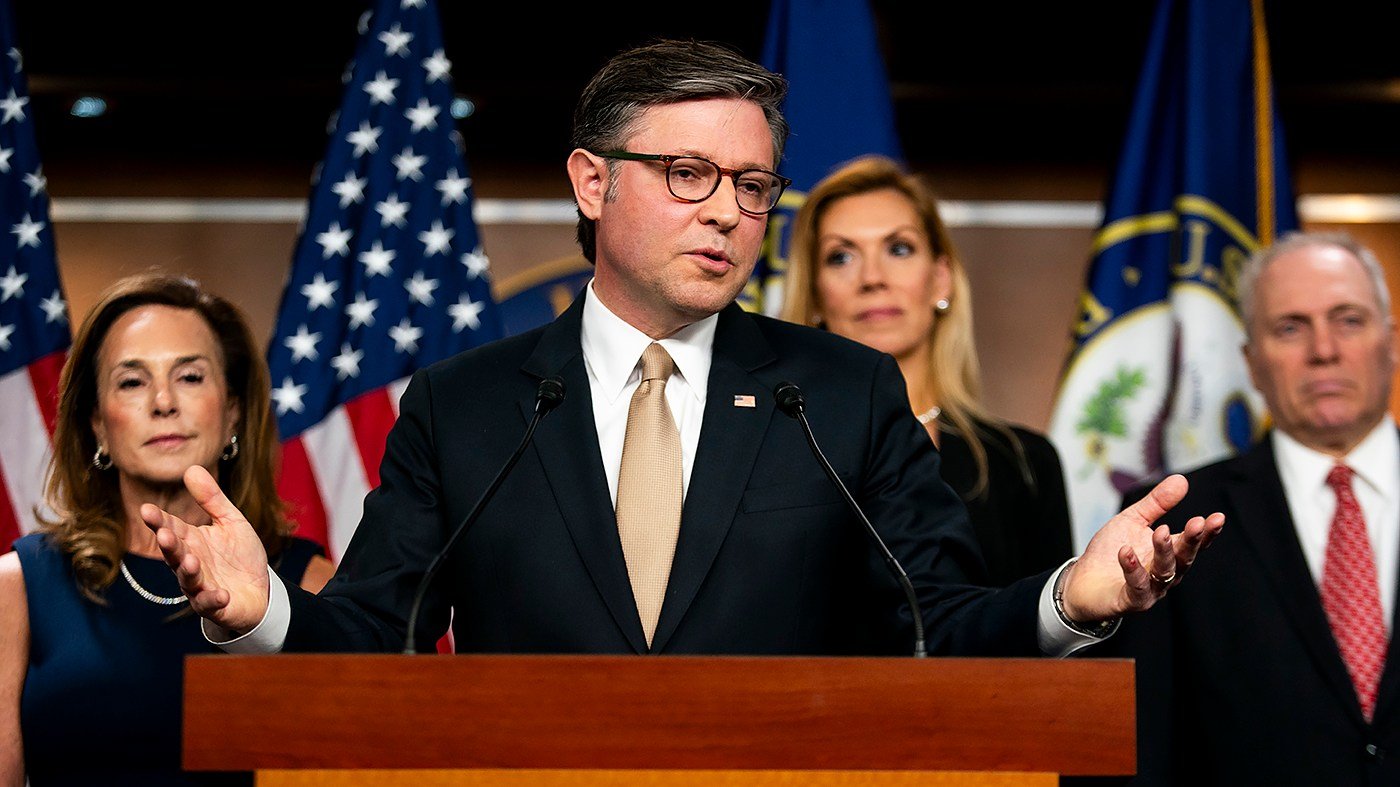
The cumulative effect has left Speaker Mike Johnson (R-La.) and his leadership team navigating a political minefield, fighting against increasingly long odds to preserve their narrow majority in the next Congress. The scale of the challenge has come into sharp relief as the nation's leading nonpartisan election analysts have revised their ratings on dozens of House seats in recent weeks—nearly all of them in Democrats' favor.

Those shifts indicate Republicans are not just struggling in the traditional purple battlegrounds where majorities are decided, but also in deeply red territory that Trump carried comfortably just two years ago. Midterm elections are historically unkind to the party holding the White House, but analysts say this cycle's headwinds have been intensified by the high cost of everyday goods—a burden tied directly to Trump's tariff policies and the economic fallout from the Iran conflict—and the president's eroding support.
"Republicans holding on to the House would be a shock given where the overall numbers are," Kyle Kondik, managing editor of Sabato's Crystal Ball at the University of Virginia, said in an email Friday.
The latest blow came Friday when the Cook Political Report moved 18 House races toward Democrats. Among the highlights: two Republican incumbents previously favored to win—Reps. Bill Huizenga (Mich.) and Rob Whitman (Va.)—are now in toss-up territory. Five toss-up races shifted to "leans Democrat," including four GOP incumbents now projected to lose: Iowa Reps. Mariannette Miller-Meeks and Zach Nunn, and Pennsylvania Reps. Scott Perry and Ryan Mackenzie. The fifth, centrist Washington Democrat Marie Gluesenkamp Perez, is now favored to win in a district Trump carried by 3 points in 2024. Three vulnerable Democratic incumbents—Reps. Tom Suozzi (N.Y.), Laura Gillen (N.Y.) and Susie Lee (Nev.)—are now likely to hold their seats. And in a sign of the GOP redistricting campaign's limited reach, Rep. Don Davis (D-N.C.), whom North Carolina Republicans had hoped to draw out of contention, has been moved into the toss-up column.
Erin Covey, the Cook analyst who authored the report, said the environment points to Democrats—who need a net gain of just three seats—picking up between nine and 19. "At this point, Democrats only need to win 20% of the Toss Ups to get to a majority, assuming the seats that favor Democrats in our ratings all break their way," Covey wrote. Sabato's analysts have reported a similar trend, shifting more than 20 seats toward Democrats since mid-September. Kondik attributed much of the GOP's trouble to the cost of living. "High prices can destroy a political coalition—it happened to the Democrats and now it's happening to the Republicans," he said.
Republicans are pushing back, pointing to three factors they believe can stave off a blue wave. First, they say a late spending surge from MAGA Inc., Trump's super PAC, has given them a clear cash advantage in the campaign's final stretch. Second, most of the seats Democrats are targeting are not in evenly divided districts but in conservative regions Trump won by wide margins. Third, they note that Democrats' own approval ratings remain deeply negative.
"Voters might not like Republicans, they might not like Trump, but they don't like Democrats," a national GOP operative said by phone Friday. "If we turn out our base, they might hold their nose and vote for our guy, but they sure as hell are not going to vote for a Democrat. And they're going into these districts that Trump won by 15, 20 points—that's a huge uphill climb."
Still, the electorate is restless. A Pew Research Center survey released Friday found that 68 percent of respondents disapprove of Trump's job performance, including 31 percent of those who voted for him in 2024. Even Johnson, who has consistently predicted Republicans will keep the House, recently conceded he might lose the speaker's gavel. "Heaven forbid, if we lose this majority or whatever, I don't know what my next chapter of life is," Johnson told Fox News.
With the political environment tilting sharply against them, Republicans are running out of time to reverse the trajectory. The latest Cook report underscores the breadth of the Democratic advantage, while the speakership itself hangs in the balance. As one GOP operative put it, the party's base may ultimately fall in line—but the terrain they must defend is growing steeper by the day.