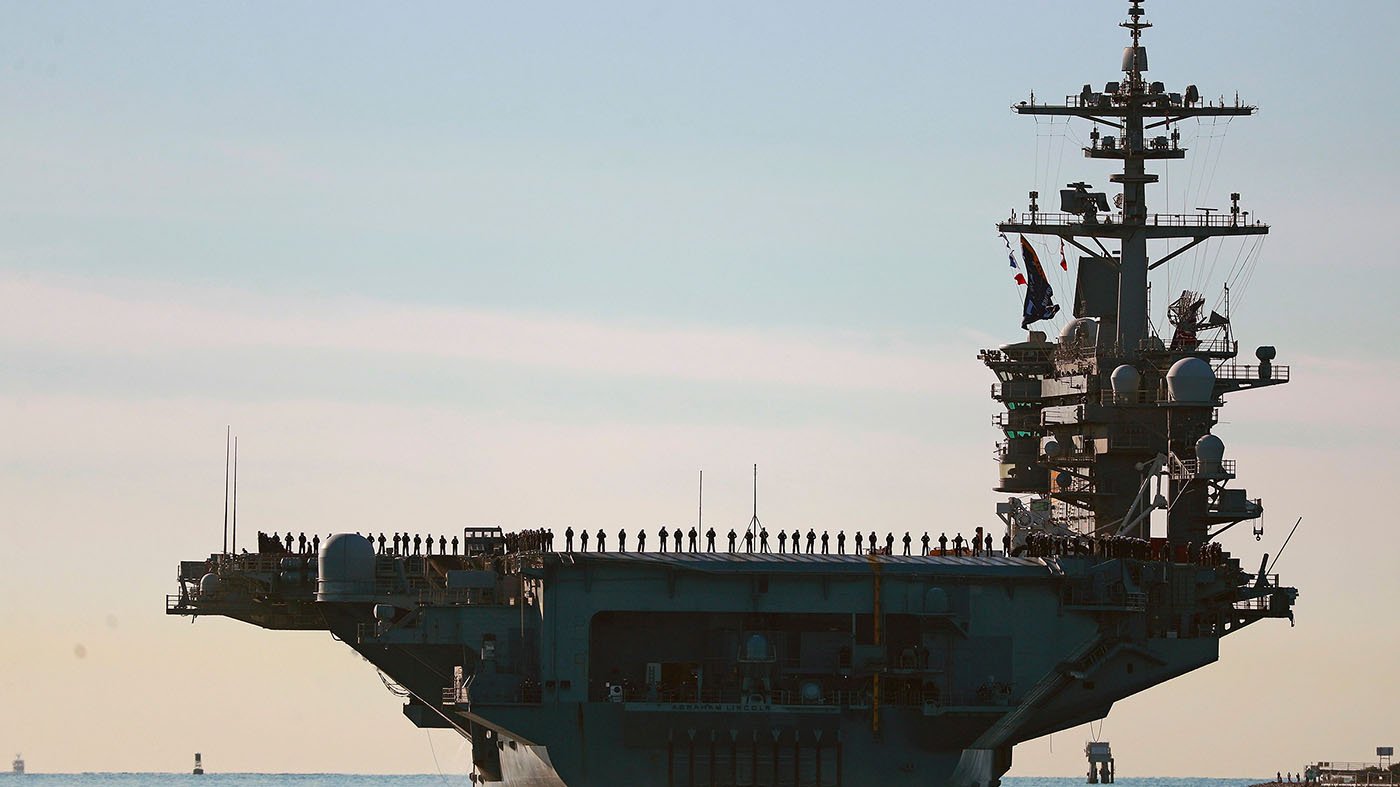
The Pentagon is rotating a fresh aircraft carrier into the Middle East as the USS Abraham Lincoln—stretched by one of the longest continuous deployments in modern Navy history—faces mounting criticism over the wellbeing of its crew.
The USS George Washington, a Nimitz-class carrier, left port in Vietnam last week and was tracked crossing the Strait of Malacca on Thursday, according to ship-monitoring accounts on social media. The waterway connects the Indian and Pacific Oceans, a key transit point for vessels heading toward the U.S. Central Command (CENTCOM) area of responsibility.

The Pentagon declined to comment on the move. But The Wall Street Journal reported Thursday that the George Washington will replace the Lincoln, which has been on station for more than 240 consecutive days—a record for uninterrupted time at sea.
The Lincoln departed San Diego in late November, was redirected to CENTCOM in January, and was originally slated to return in May. No new return date has been announced, and the prolonged deployment has taken a toll on the crew.
Recent reports have detailed supply shortages, declining mental health, and even suicide attempts among sailors. Several lawmakers have demanded greater transparency and have urged the Navy to allow a bipartisan congressional delegation to inspect the ship. The situation has drawn sharp attention on Capitol Hill, with some calling it a carrier crisis that requires immediate answers.
Defense Secretary Pete Hegseth pushed back on the characterizations, telling Newsmax on Thursday that conditions aboard the Lincoln have been “completely misrepresented.” He insisted that every ship, crew, and captain has everything the department can provide. “Some deployments are longer than others,” he said, “and I have more respect and gratitude for those sailors than anybody. What they do in those high seas and those austere conditions with less port calls, it’s incredible.”
The carrier swap comes as the Navy continues to enforce a naval blockade in the Arabian Sea, barring Iranian ships from reaching Iranian ports. The Lincoln is one of two carriers in the region, a posture that has drawn criticism from some lawmakers who question the sustainability of such operations. Meanwhile, broader tensions with Iran persist, with Tehran rejecting claims of ongoing negotiations and demanding concessions before any reopening of the Strait of Hormuz.
The George Washington’s arrival could ease the strain on the Lincoln’s crew, but the episode has already fueled a broader debate about the pace of deployments and the support provided to sailors. Navy leaders have faced families over the mental health crisis, and the service has yet to announce a timeline for the Lincoln’s return home.
As the new carrier steams toward the region, the Pentagon faces continued pressure to address the underlying issues that have made this deployment so punishing—and to ensure that the next crew does not face the same conditions.