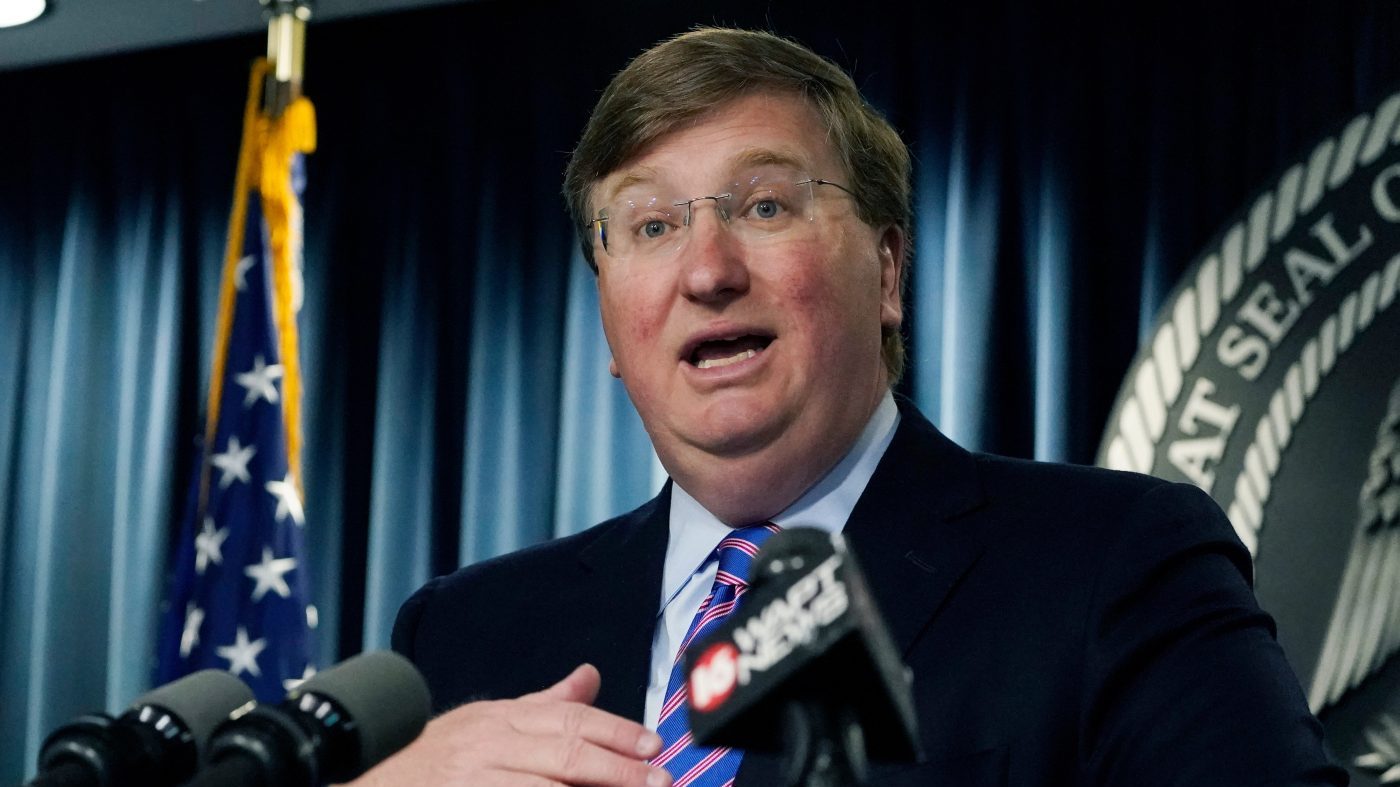
Mississippi Governor Tate Reeves announced Friday that he will call state lawmakers back to Jackson for a special session to consider new voting maps, timed to follow the U.S. Supreme Court's upcoming decision in a landmark redistricting case.
The Republican governor said the session will convene 21 days after the high court rules on Louisiana v. Callais, which tests whether race-based redistricting under Section 2 of the Voting Rights Act (VRA) comports with constitutional guarantees of equal protection.

“It is my belief and federal law requires that the Mississippi Legislature be given the first opportunity to draw these maps,” Reeves wrote on X. “And the fact is, they haven’t had a fair opportunity to do that because of the pending Callais decision.”
The case centers on a second majority-Black congressional map reluctantly adopted by Louisiana’s GOP-controlled legislature after the original maps were challenged under the VRA. Louisiana now argues that the new map amounts to racial gerrymandering, a claim the Supreme Court will weigh.
The outcome in Louisiana v. Callais could have direct implications for Mississippi’s proposed maps for its three state Supreme Court districts. Those maps are currently stalled in the Fifth Circuit Court of Appeals, pending the Supreme Court’s ruling. Mississippi is defending its map after a federal district court found that the proposed lines diluted Black voting strength in violation of the VRA.
Reeves expressed hope that the Supreme Court sides with Louisiana, echoing arguments that race-based classifications are inherently divisive. “It is my sincere hope that, in deciding Callais, the U.S. Supreme Court will reaffirm the animating principle that all Americans are created equal,” he said, adding that classifying citizens by race “engages in the offensive and demeaning assumption that Americans of a particular race, because of their race, think alike.”
The political stakes are high. The VRA has long been a flashpoint in Southern states, and the Callais ruling could reshape how states draw electoral boundaries. A decision favoring Louisiana might embolden other GOP-led states to challenge VRA-based redistricting, while a ruling against Louisiana could reinforce protections for minority voting blocs.
Mississippi’s special session will likely be closely watched, especially given the state’s history of voting rights litigation. The governor’s move preempts further court intervention but leaves the legislature with a tight timeline to produce maps that satisfy both the VRA and the Supreme Court’s forthcoming guidance.
For now, all eyes are on the Supreme Court. As recent polling shows, a majority of Americans believe the Court sidesteps rulings that President Trump would defy, adding another layer of scrutiny to this case.