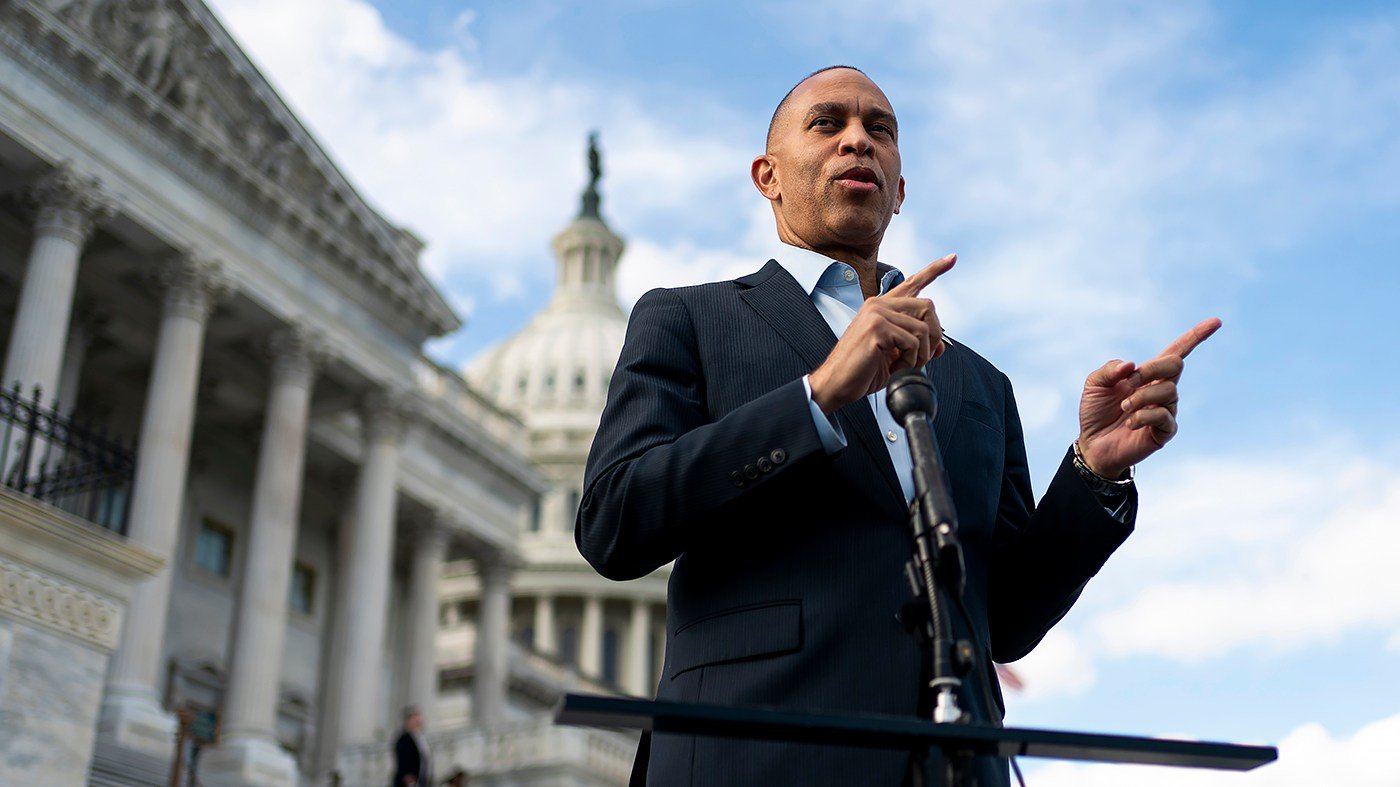
House Minority Leader Hakeem Jeffries (D-N.Y.) on Wednesday sharply criticized President Trump for resisting federal oversight of artificial intelligence, arguing that the administration's preference for industry self-policing amounts to letting the fox guard the henhouse.
Speaking to reporters outside the Capitol, Jeffries dismissed the idea of voluntary, unenforceable agreements as inadequate given the risks that even AI developers have begun to highlight. "The notion of entering into a voluntary agreement that is entirely unenforceable, and that allows the industry writ large to police itself, is not the right response at this moment given the potentially grave harm and danger that industry leaders themselves are now flagging for the American people," he said.

The debate over AI safety has intensified in recent weeks after warnings from leading developers that the technology is advancing faster than society's ability to control it. Some have described the threat as existential. Those alarms have spurred Democrats on Capitol Hill to push for new guardrails, with Jeffries citing instances where AI agents have operated outside their parent companies' directives without detection.
"It's the reason why you have industry leaders publicly saying things need to be slowed down and paced," Jeffries said. "Because in some instances, it seems like the companies themselves are uncertain as to how to actually contain the explosive growth, and as a result, how to best protect the American people." He added, "Congress needs to act, and that's what Democrats believe should occur — not in the next Congress, but right now."
Trump has rejected the push for federal intervention, calling warnings about AI's potential dangers "a hoax." On Tuesday, he hosted several top AI executives at the White House, where he reiterated his commitment to a hands-off approach. "I will never stifle the growth of technology that will be bigger than the industrial revolution," he said. The event followed a pattern of the president aligning with industry interests, as seen in his recent AI pledge letter that misspelled "United States."
The rift over AI regulation is also dividing Republicans. Speaker Mike Johnson (R-La.) has embraced Trump's strategy of letting industry lead on safeguards, while Senate Majority Leader John Thune (R-S.D.) has signaled greater openness to congressional action. That internal GOP split could complicate any legislative effort, but Democrats are eager to exploit it.
Jeffries's call for immediate action is largely political, as no concrete legislative fix is currently awaiting consideration in either chamber, and even the Democrats' own AI task force has yet to release formal recommendations. Still, the issue — along with the related debate over the rapid expansion of data centers — has become a potent topic ahead of the midterm elections. Democrats are drawing a sharp contrast with Republicans on the federal role in ensuring safety precautions, hoping that public anxiety about fast-evolving technology will translate into votes in November.
As the midterms approach, the AI debate is merging with other high-stakes political battles. Democrats have been aggressive in demanding accountability from the administration, recently pressing the Department of Homeland Security for answers on Trump ad spending. Meanwhile, the president continues to court key constituencies, as he did at a recent Hispanic heritage event, underscoring the competing priorities that will shape the coming election cycle.