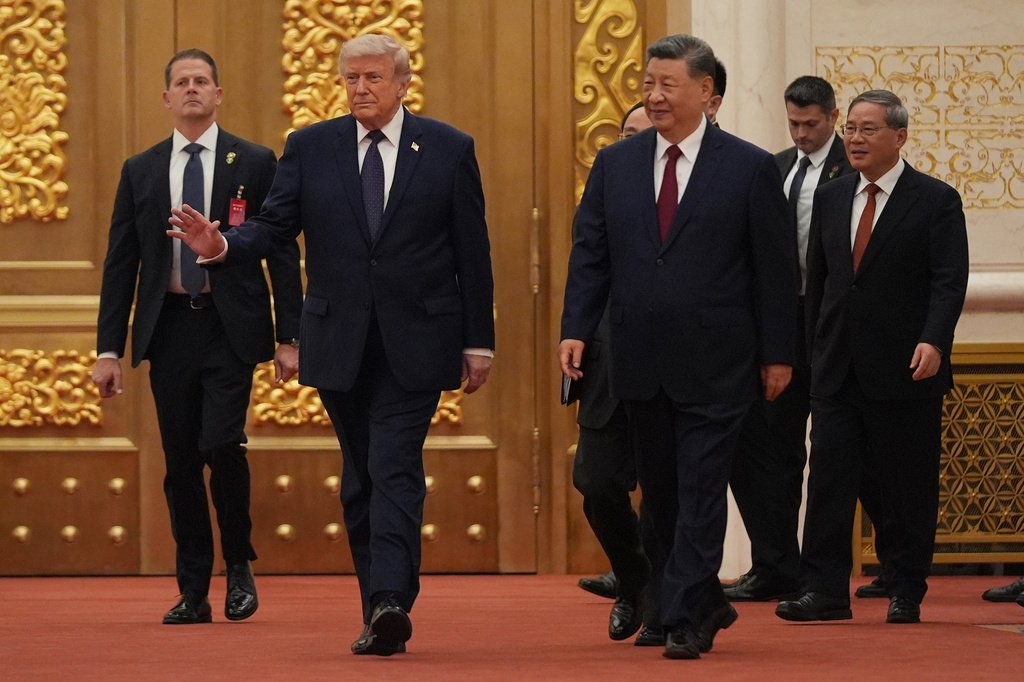
Global markets cheered President Trump's recent summit with Chinese President Xi Jinping in Beijing as a sign of de-escalation. Semiconductor stocks surged, and analysts in Washington declared a stable floor beneath the US-China rivalry. But they may have misread the room entirely.
The real significance of those talks isn't eased tensions—it's that Washington has signaled a profound shift in its strategic architecture. Under a hyper-transactional foreign policy framework, Taiwan is dangerously transforming from a non-negotiable geopolitical red line into a flexible variable within a broader trade and security ledger. This shift threatens to quietly unravel decades of American deterrence in Asia.
US strategy toward the Taiwan Strait has never relied solely on military hardware; it has always rested on a psychological premise. Beijing had to believe that any attempt to alter the status quo by force would trigger an automatic, overwhelming American intervention. Today, that credibility is becoming explicitly conditional. While transactional bargaining works well in commercial real estate or tariff disputes, deterrence systems require predictability. When red lines become subject to political negotiation, the structural integrity of an alliance collapses.
This diplomatic shift coincides with a critical policy paradox inside Washington's own legislative and industrial apparatus. For years, Taiwan's monopoly on advanced semiconductor manufacturing functioned as its ultimate geopolitical insurance policy—the “Silicon Shield.” Because the global economy, AI development, and US defense infrastructure relied entirely on advanced fabrication plants, a cross-strait conflict guaranteed immediate global economic collapse.
However, Washington's own success in diversifying these supply chains is altering this dynamic. Driven by the landmark CHIPS and Science Act, advanced chip manufacturing is successfully decentralizing. Taiwan Semiconductor Manufacturing Company has dramatically scaled up its presence in Phoenix, speeding up production timelines on its completed second facility to launch high-volume, 3-nanometer US manufacturing by the second half of 2027. Major tech firms are moving aggressively on this capacity, with Apple announcing it will purchase more than 100 million Arizona-made chips this year alone.
While this diversification is economically rational and vital for long-term US supply chain resilience, it introduces a dangerous geopolitical side effect: It thins Taiwan's shield. As the island becomes marginally less indispensable to global tech infrastructure, the perceived cost of a conflict changes in the minds of Chinese planners. Deterrence is not determined by Washington's actual intent, but by how that intent is interpreted by its adversaries.
Beijing is likely drawing three conclusions from this trajectory. First, Washington's global attention is profoundly fragmented across multiple competing theaters. Second, the economic foundations of Taiwan's strategic centrality are being actively diluted. Third, and most importantly, strategic time is drifting back into China's favor. This does not imply the US is planning to abandon Taipei. Rather, China no longer faces an ideologically rigid American posture, but a transactional one.
Predictably, this uncertainty is forcing regional allies into aggressive hedging. Under Prime Minister Sanae Takaichi, Japan has forcefully pushed to advance its 2 percent of GDP defense spending target, drafting a record-high 9 trillion yen ($58 billion) defense budget plan to fortify strike-back capabilities. Meanwhile, South Korea continues to debate long-term strategic autonomy, and Southeast Asian nations are deepening economic integration with Beijing even as they sign security pacts with Washington. They are preparing for an era where American commitments are no longer permanent, but subject to political revision.
While Congress and the Pentagon remain laser-focused on high-intensity tactical scenarios—such as a sudden military blockade or an amphibious invasion—Beijing is playing a much longer, structural game. Chinese planners think in decades, not election cycles. They understand that with gross US national debt climbing rapidly toward $39 trillion, domestic political pressure to prioritize fiscal stabilization will increasingly clash with expansive global defense commitments.
Beijing's objective may not be a costly, destructive war today, but the gradual, patient erosion of certainty surrounding American resolve. If China can convince regional actors that American security guarantees are conditional, they win the positioning challenge without firing a shot. The most volatile phase of a great power competition is rarely an open, sudden confrontation. It is the quiet, ambiguous interlude when one superpower begins to suspect that its rival's commitments have become negotiable. By treating strategic deterrence like a corporate restructuring plan, Washington risks showing Beijing that the price of the Indo-Pacific status quo is entirely up for debate.
For further context, recent signals from the Pentagon have done little to reassure allies, while calls for accountability on China sanctions highlight the growing tension in Washington's approach.