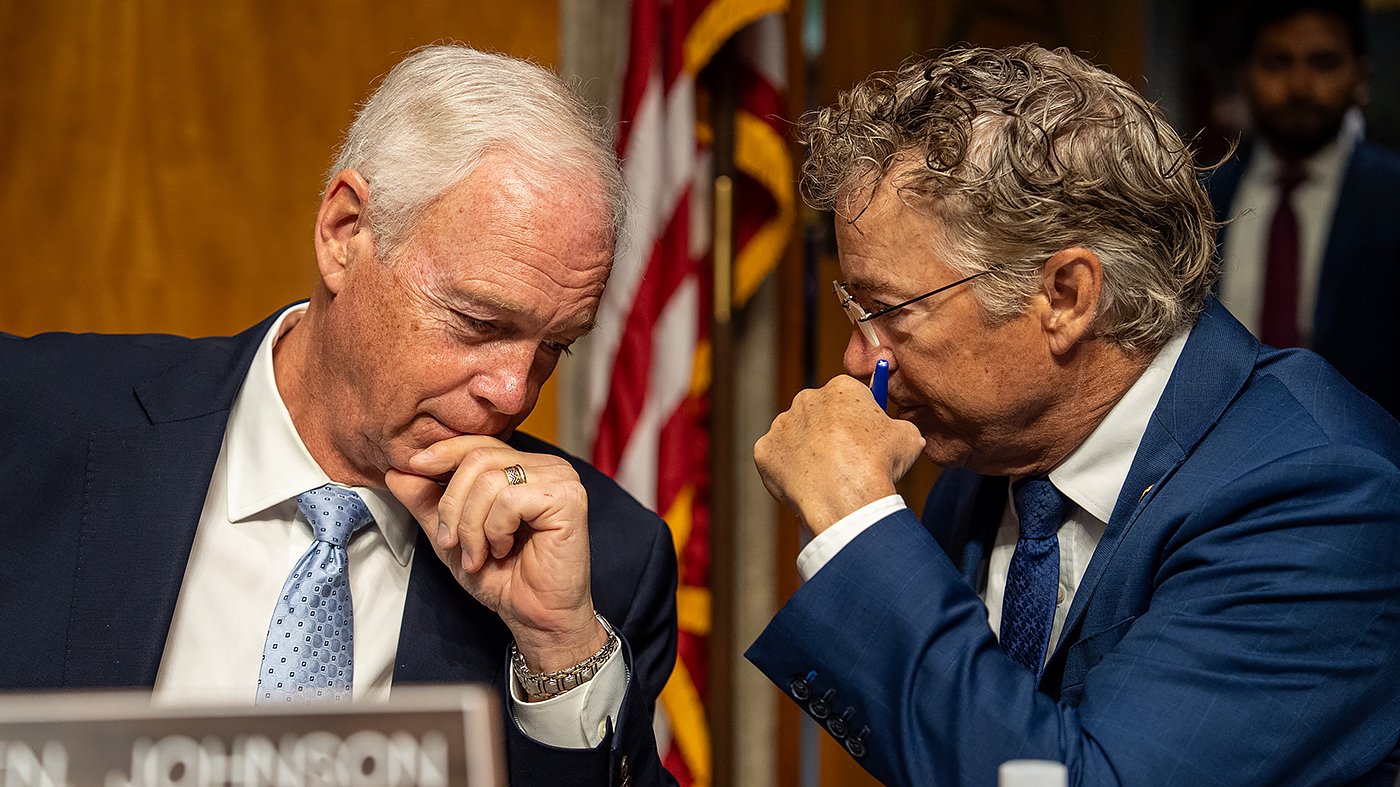
Republican Sens. Rand Paul (Ky.) and Ron Johnson (Wis.) on Monday released a trove of text messages from Dr. Anthony Fauci's government-issued cellphone, offering a rare glimpse into his private deliberations on COVID-19 vaccine policy for pregnant women. The messages, part of a larger cache of over 34,000 texts and 522 voicemails, were obtained by Johnson's office as part of an ongoing investigation into the former top infectious disease official.
The newly public exchanges, dated January 2021, show Fauci, then-director of the National Institute of Allergy and Infectious Diseases, discussing with Dr. Vivek Murthy, the U.S. Surgeon General, and Dr. Rochelle Walensky, then-head of the Centers for Disease Control and Prevention, whether pregnant women should receive the COVID-19 vaccine and at what stage of pregnancy.
In a text from Jan. 25, Murthy asked: "For pregnant women considering getting the vaccine, are you aware of any data or theoretical reason why vaccinating early vs late in pregnancy would be preferred? And any sense of when there will be more robust data on vaccine risk in pregnant women?" Walensky noted that over 15,000 pregnant women had enrolled in the CDC's V-safe vaccine safety monitoring system. Fauci responded that there were "no data or theoretical reason to believe that vaccinating early versus later in pregnancy would be preferred," but added that some, including female health care professionals, harbored concerns about injecting a "genetic" vaccine early in pregnancy. He also flagged a "misperception" that mRNA vaccines alter recipients' genes.
Nearly two hours later, Fauci sent a follow-up message raising a more specific concern: "Since many people have significant cytokines storm and fever after the 2nd dose, this theoretically could be associated with miscarriage in the 1st trimester." Cytokines are proteins that act as immune system messengers, and a cytokine storm is a severe immune response. Walensky and Murthy both agreed, with Walensky calling it a "good point."
The next day, Jan. 26, the trio discussed the World Health Organization's advisory against pregnant women taking the Moderna vaccine. Fauci wrote that pregnant women "must weigh the potential risks against the benefits" of immunization, noting that COVID-19 "can be a serious disease especially in pregnancy." He pointed out that the FDA, the CDC's vaccine advisory panel, and the American College of Obstetricians and Gynecologists all allowed pregnant women to choose whether to get the shot.
Johnson, who has long been a critic of Fauci's pandemic response, said the investigation "has only just begun." In a separate interview Friday on NewsNation's "Katie Pavlich Tonight," he revealed that the texts span from roughly 2014 until just before Fauci left NIAID in December 2022. However, Johnson cautioned that "my staff can't guarantee that everything was preserved" and noted a peculiar detail: "most of those text messages are associated with a phone number. He only had three contacts, which is pretty odd."
The release comes less than a week after the Senate Homeland Security and Governmental Affairs Committee, on a party-line vote, approved a resolution holding Fauci in contempt of Congress. Last month, Fauci invoked the Fifth Amendment 111 times during testimony before the committee. While criminal referrals typically go to the full Senate for a vote, Paul has indicated he intends to send the referral directly to the Justice Department to avoid delays.
This latest disclosure adds fuel to the ongoing political battle over Fauci's handling of the pandemic. Critics argue the texts reveal that federal health officials privately acknowledged potential risks that were downplayed publicly. Supporters counter that the messages show careful, data-driven deliberation during an unprecedented health crisis. The contempt referral now lands at the Justice Department, where prosecutors will weigh whether to pursue charges—a decision fraught with legal and political implications. Meanwhile, some commentators have called Fauci's Fifth Amendment stance a "gigantic mistake", arguing it undermined his credibility. As Johnson said, the investigation will "take some time," with privacy concerns for individuals mentioned in the texts still to be addressed.