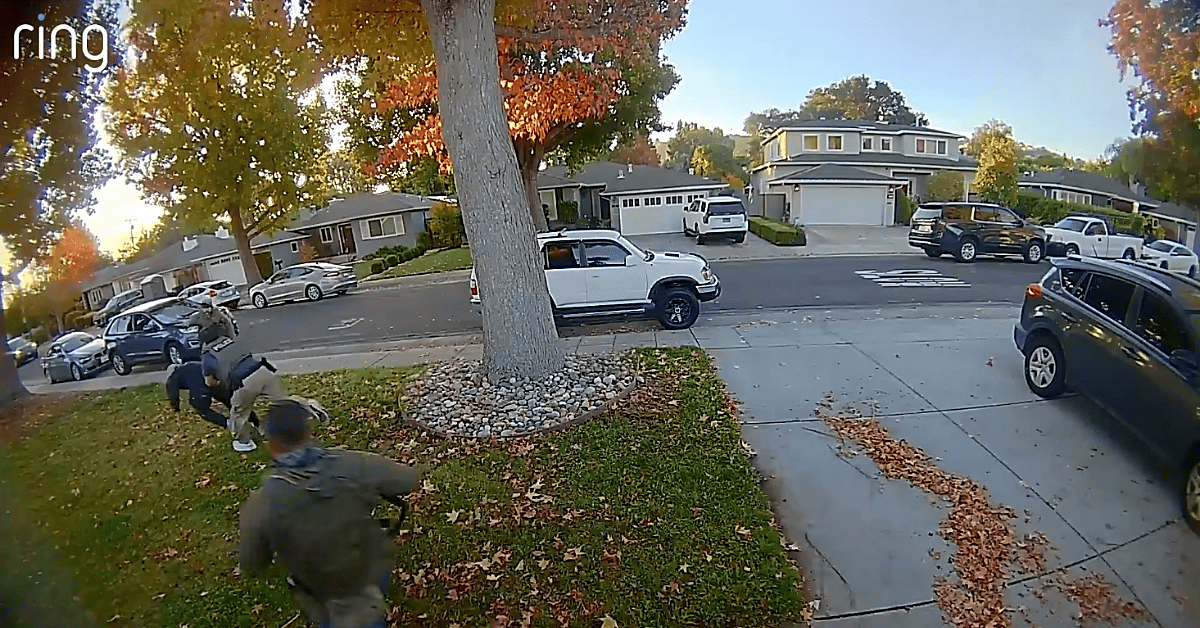
Newly released doorbell camera footage captures the moment U.S. Immigration and Customs Enforcement (ICE) officers tackled and arrested a man in the front yard of a San Mateo, California, residence. The incident unfolded just after 7 a.m. on November 6, according to local reports.
The San Mateo County Rapid Response Network, which tracks ICE activity and provides emergency assistance, said it has documented 21 arrests over the past ten days—including five on that Tuesday alone. Officers were also seen in public areas such as the parking lots of Home Depot and Dollar Tree in San Carlos, and near Chavez Supermarket in Palo Alto.

The network, which connects detained individuals with legal counsel and helps families navigate the aftermath, is now launching a fundraising appeal to sustain those services. Spokesperson Nani Friedman said the recent enforcement push has created widespread anxiety.
“Creating so much fear and concern in the community and having a big impact on the families,” Friedman said. “We know that those families are at risk of homelessness. We know that their children struggle to stay in school, to focus on their education, so it’s an important opportunity for our community to come together and provide them some support.”
The surge in arrests comes amid a broader national debate over immigration enforcement. California has often positioned itself as a sanctuary state, and local officials have repeatedly clashed with federal authorities over deportation policies. The recent rejection of a voter ID measure highlights the state’s ongoing resistance to stricter immigration-related rules.
Advocates argue that such high-visibility arrests in residential neighborhoods and commercial lots are designed to intimidate immigrant communities. They also point to the psychological and economic toll on families, many of whom are already vulnerable.
Local leaders have called for more transparency from ICE, while federal authorities maintain they are targeting individuals with final removal orders or criminal records. The recent Supreme Court rebuff in a separate California voting case underscores the ongoing legal friction between state and federal policies.
Meanwhile, the governor’s recent clemency actions have drawn attention to California’s criminal justice approach, but immigration advocates say enforcement remains a pressing concern. The Rapid Response Network is urging residents to report any ICE sightings and to donate to its legal defense fund.
As the community grapples with the latest wave of arrests, Friedman emphasized the need for solidarity. “We have to stand together,” she said. “These families need our help now more than ever.”