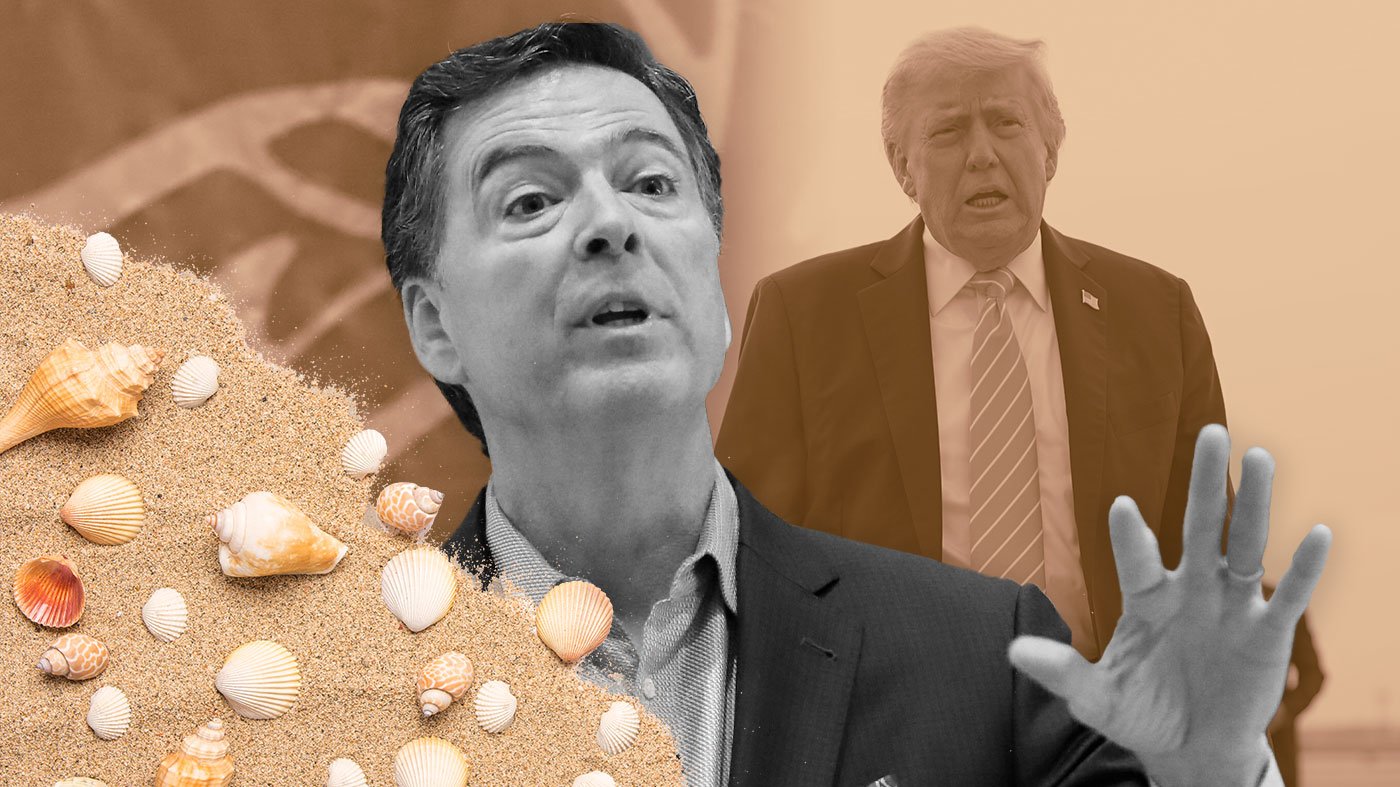
Can arranging seashells on a beach and posting the photo to Instagram really be a federal crime? It sounds absurd, but the Trump administration's Justice Department is pressing forward with just such a case against former FBI Director James Comey.
After President Donald Trump fired Attorney General Pam Bondi—reportedly for failing to deliver a prosecution against his longtime nemesis—acting Attorney General Todd Blanche took up the mantle. Blanche, widely seen as angling for Bondi's old job, secured a two-count indictment charging Comey with threatening the life of the president. The charges stem from a May 2025 Instagram post in which Comey shared a photo of seashells that appeared to form the numbers "86 47."

The bare-bones three-page indictment, filed in the Eastern District of North Carolina, alleges that a reasonable person familiar with the circumstances would interpret the image as a serious expression of intent to harm Trump. Comey captioned the post, "Cool shell formation on my beach walk," and later added that he saw it as a political message but was not advocating violence. After the Secret Service contacted him about the implications, Comey deleted the post.
Federal law prohibits threatening the life of the president, and the Department of Justice defines a threat as "an avowed present determination or intent to injure." Courts have ruled that prosecutors need not prove the defendant intended to carry out the threat—but the Fourth Circuit, which covers North Carolina, has not fully adopted that standard. In that circuit, a conviction requires proof that the threat was made with a present intention to do injury, not just to communicate a menacing idea.
Legal analysts question whether Comey's post meets that bar. The number 86 has long been slang for removing someone from a premises, not for violence. And Trump himself has often claimed he is the 48th president, not the 47th, because he continues to deny Joe Biden's 2020 victory. That ambiguity could undercut the prosecution's argument that the seashells were a clear threat.
Comey, a former federal prosecutor and FBI director, has a long record of public service. His legal team is expected to argue that the prosecution is politically motivated and that the government cannot prove criminal intent beyond a reasonable doubt. "The government must prove Comey's criminal intent beyond a reasonable doubt," noted James D. Zirin, a former federal prosecutor. "His history as a respected lawyer and public servant bears strongly on how difficult it will be for prosecutors to prove the essential element of criminal intent."
The First Amendment also looms large. The Supreme Court has held that protected speech can be robust, contentious, and even obnoxious. The government cannot criminalize an idea simply because it finds it offensive. Trump himself has posted images of Biden hog-tied in a truck and a photo of himself wielding a baseball bat next to the head of New York District Attorney Alvin Bragg. On January 6, 2021, he exhorted a mob to "fight like hell," after which they stormed the Capitol.
The indictment has drawn sharp criticism from legal experts and lawmakers, who see it as part of a broader pattern of weaponizing the Justice Department against political opponents. Representative Adam Schiff called the case "weak" and suggested Blanche was driven by ambition rather than justice. Meanwhile, Blanche has defended the indictment, insisting it is not just about a seashell Instagram post but about a credible threat.
King Charles III was in Washington last week to celebrate the rule of law enshrined in the Magna Carta. The irony was not lost on critics: With this second Comey indictment, Trump has taken the justice system back to what some call a Stone Age approach to law—one where personal vendettas override legal principles.