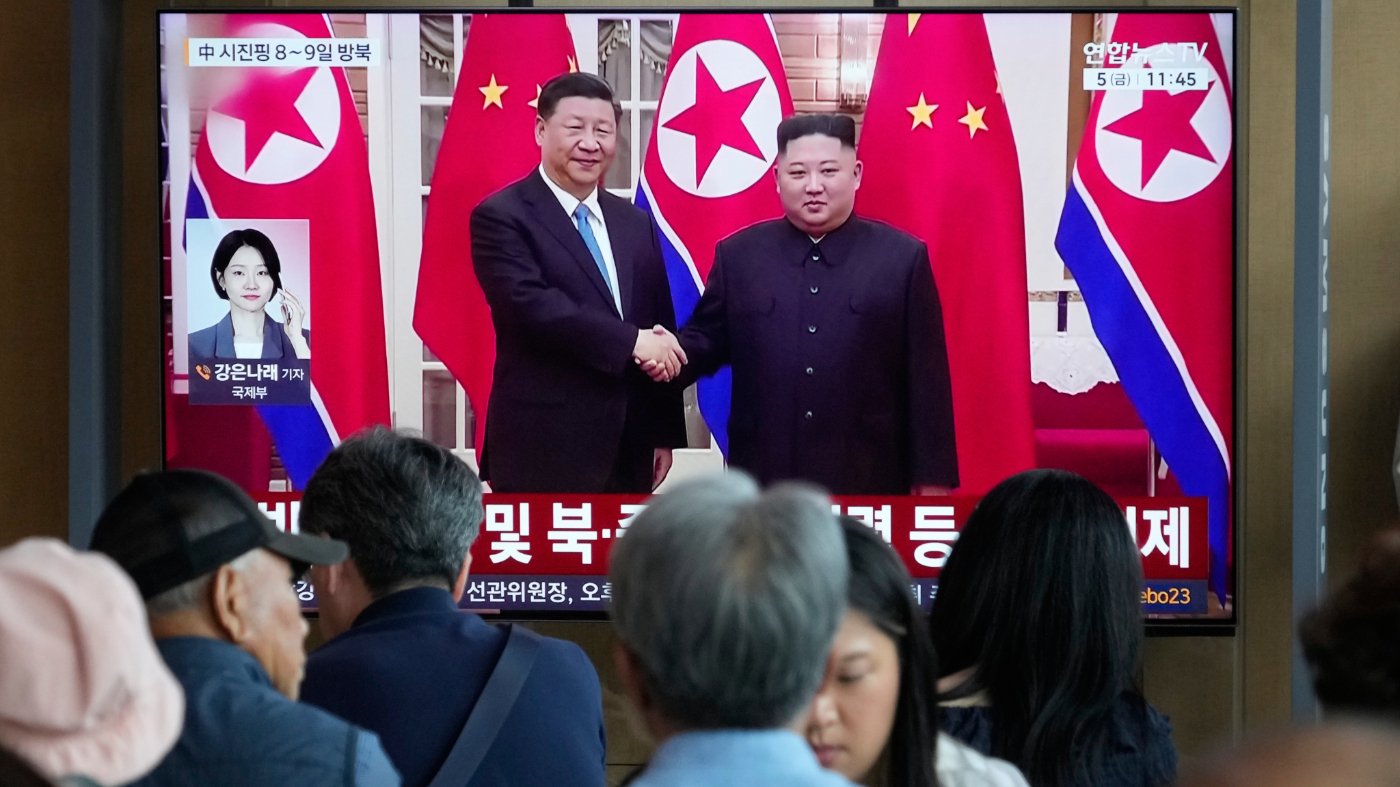
In a move that has stunned diplomatic circles, China appears to have abandoned its long-standing demand for North Korea to denuclearize. The shift became evident during President Xi Jinping's recent summit with Kim Jong Un in Pyongyang, where the official Chinese statement conspicuously omitted any reference to denuclearization—a stark contrast to their 2019 meeting when Xi publicly committed to playing “a positive and constructive role” in achieving a nuclear-free Korean peninsula.
This policy change has not gone unnoticed. Tong Zhao of the Carnegie Endowment for International Peace described it to NPR as “a very significant policy change to tacitly accept the reality of a nuclear North Korea.” While some Chinese experts dismiss the omission as “mere media hype,” the lack of pushback from Beijing during the two-day event suggests a deliberate recalibration.

North Korea first joined the Nuclear Nonproliferation Treaty in 1985, receiving civilian nuclear technology in exchange for forgoing weapons. But Pyongyang secretly pursued a bomb, withdrew from the treaty in 2003, and is believed to have tested its first nuclear device in 2006. Since then, Kim Jong Un has aggressively sought international recognition as a nuclear power, amending the constitution as recently as 2023 to enshrine the country's nuclear status. On the eve of Xi's visit, Kim's powerful sister, Kim Yo Jong, dismissed denuclearization as an “anachronistic dream,” declaring the program “irreversible.”
Beijing's commitment to denuclearization has long been suspect. For decades, China has been accused of transferring nuclear materials and technology to the North, while shielding Pyongyang from international pressure during the Six Party Talks. Now, with Russia also abandoning the denuclearization goal—Foreign Minister Sergey Lavrov last year praised North Korea's nuclear development as the work of “its own scientists”—Beijing appears to be doubling down on its support.
Some analysts argue that the shift is driven by competition with Moscow for influence in Pyongyang. But China's economic dominance—accounting for 95 percent of North Korea's foreign trade before recent Russian arms deals—gives Beijing significant leverage. As former Russian diplomat Georgy Toloraya put it, Russia is “an ambulance” treating emergencies, while China is “the doctor who treats her day by day.”
Charles Burton, a former Canadian diplomat and analyst at the Sinopsis think tank, noted that “North Korea fully depends on China's economic aid to survive,” ensuring that any independent Russia-North Korea alliance will not go far. “Beijing has leverage to ensure that any independent Russia-North Korea alliance will not go very far,” he said, adding that neither Vladimir Putin nor Kim is strong enough to betray China.
Ultimately, Beijing's support for North Korea's nuclear program is a strategic tool to pressure Washington. Greg Scarlatoiu, president of the Committee for Human Rights in North Korea, explained that “For Xi, any thorn in the side of the United States, especially North Korea's nuclear program, is appealing.” This aligns with China's long-standing pattern of denial and deception, as described by China watcher Bill Triplett, who called Pyongyang and Beijing's operations “one of the most successful denial and deception operations ever mounted.”
The apparent abandonment of denuclearization is not a reversal but an affirmation of China's enduring support for a nuclear North Korea. As tensions on the Korean peninsula simmer, Beijing's tacit acceptance of Pyongyang's arsenal could reshape regional security dynamics. For more on related developments, see North Korea's constitutional rewrite and Trump's paradoxical nuclear approach.