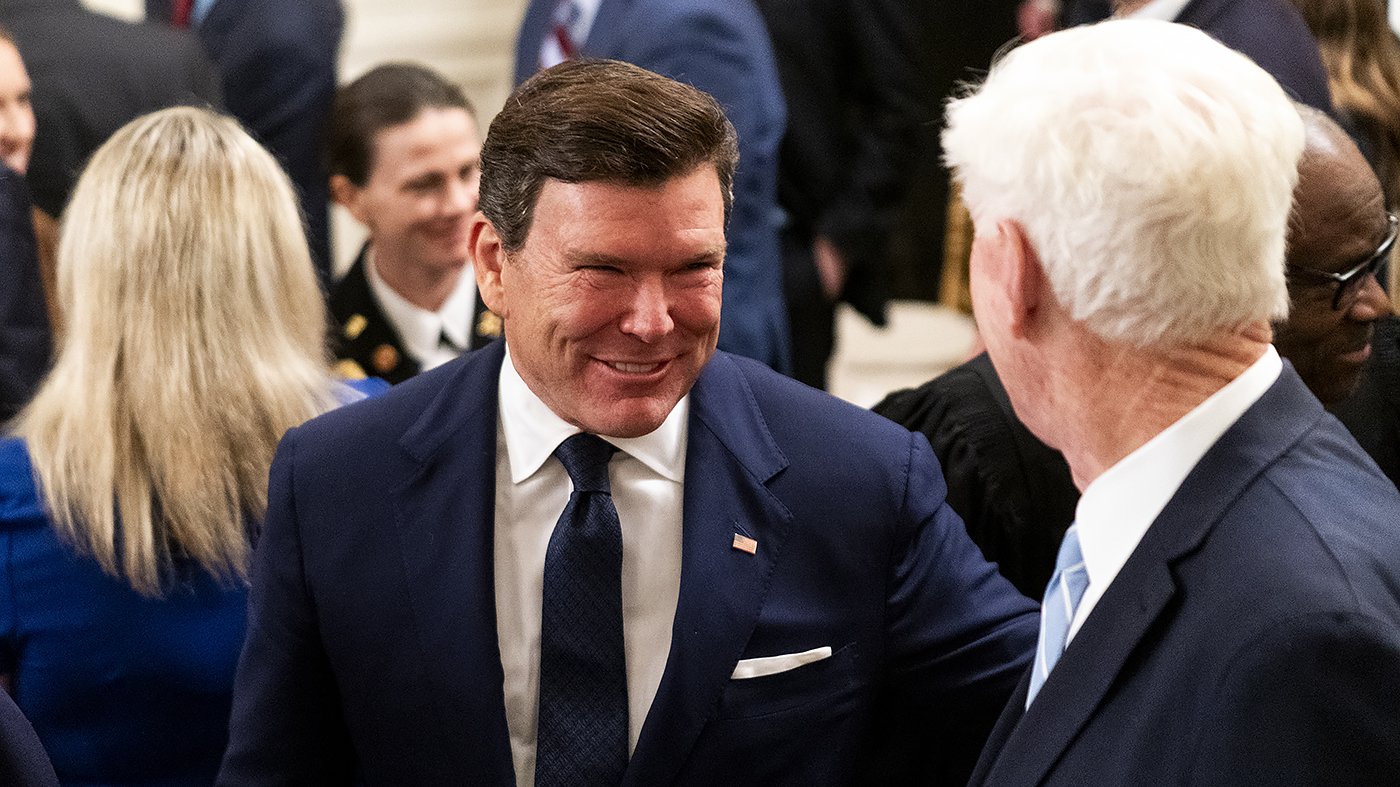
Fox News anchor Bret Baier on Wednesday directly challenged President Trump's assertion that the United States has "total" control over the Strait of Hormuz, pointing to a sharp decline in vessel traffic through the critical waterway. Speaking on his evening program, Baier noted that while the administration has touted dominance, the reality on the ground shows a different picture.
"Usually, about one-fifth of the world's liquefied natural gas trade moves through there as well," Baier said. "Despite President Trump claiming total control over the strait, traffic has slowed, really, to a trickle if you look at this." He cited data showing that only 14 vessels passed through the strait on Tuesday and eight on Monday, compared to more than 100 per day before the recent conflict escalated.
The president told reporters on Tuesday, "We totally control the Strait of Hormuz. We have control over it. Nobody else. Only us. Our navy is unbelievable, and things are going great for our country." This is not the first time Trump has made such a claim; he has repeatedly asserted U.S. naval supremacy in the region, including two deployments of a blockade during the six-month conflict.
However, Iranian officials have dismissed the president's rhetoric. The Persian Gulf Strait Authority wrote on X that claiming ownership "does not change the reality: the Strait of Hormuz remains blocked and will not be reopened until Iran's conditions are accepted." The strait was shuttered by Iran following a nearly two-week tit-for-tat with the U.S., though it was reopened as part of an interim peace deal in June—only to be closed again amid renewed tensions.
Baier also highlighted broader energy market stress. The International Energy Agency reported that global crude oil inventories fell by 2.2 million barrels per day in July, and it now expects a supply deficit of 1.8 million barrels per day in the third quarter—more than double its earlier estimate. The strait's closure has already driven up oil prices, with Brent crude trading at just under $87 a barrel and West Texas Intermediate above $81. U.S. gasoline prices have also climbed, with the national average reaching $4.07 per gallon on Thursday, up 20 cents from a month ago.
The economic impact extends beyond fuel costs. The Pentagon estimated that the initial blockade cost Iran around $4.8 billion in oil revenue. The White House has shifted toward economic pressure, believing that Iran's economy is already strained by inflation and poverty. This strategy is part of a broader pivot to an economic siege as military options appear limited.
Trade intelligence firm Kpler reported that from Friday to Sunday, only 32 ships passed through the strait, with 17 using Iran's designated transit route and 10 taking an undetermined path. The slowdown has raised questions about the effectiveness of U.S. control and the stability of global energy supplies.
Baier's commentary underscores a growing disconnect between presidential statements and observable facts. As the standoff continues, the international community watches closely, with energy markets and diplomatic efforts hanging in the balance. The situation remains fluid, and the administration's claims of control are increasingly under scrutiny.